Showing posts with label Orientalism. Show all posts

22 August 2026

Eastbourne UK bandstand and pleasure pier

entertainment facilities on Eastbourne Pier

Like other coastal towns, Eastbourne began to grow rapidly as the medicinal and leisure benefits of sea air and sea bathing became well known. Locals scrambled to provide a wide variety of facilities and amusements for the thousands who flocked to Eastbourne each summer. My favourite would have been Devonshire Park which was first designed in 1874 with terraces, walks and a cricket ground. As the money flowed in, the owners added tennis courts and a roller skating rink. Very sensibly they located Devonshire Park next to the baths, the Winter Gardens and the Theatre. 

In this post, I am interested in publicly funded facilities. There were many pleasure piers built around the coastal resort towns of Britain, and then in other countries. The earliest was probably Ryde’s on the Isle of Wight (1813) although the majority did not start until the late C19th. Early pleasure piers were made of wood; iron structures only became more popular with the construction in 1855 of Margate Jetty. The National Piers Society suggests that only 55 seaside piers survive today in England and Wales, the oldest extant iron pier being in Southport (1860).

Eastbourne's pier was designed by Eugenius Birch in 1865 and built by the Eastbourne Pier Company for £15,000. Originally a landing stage for steamers, it soon became a "pleasure pier" because it enabled the gentry to walk over the water and to participate in the social life there.

Spouse and I loved the pier when we first lived in Britain. But decades later it was starting to look just a little bit old fashioned. The only innovation that I remember was The Victorian Tea Rooms which  specialised in Sussex Cream Tea and attractive table settings.

Agatha Christie's story, The Jewel Robbery at the Grand Metropolitan, was set in Brighton but partially filmed in Eastbourne. Just as well the film was finished in 1993. Firstly the owners put Eastbourne Pier up for sale in 2009; included were Victorian tea rooms, an amusement arcade, bars and a nightclub. Secondly Eastbourne Pier experienced a fire in July 2014 that burned through a large amount of the central domed building. The two-thirds of the 305-metre pier that were not destroyed ...were quickly reopened.

Even more popular than pleasure piers, re leisure time activities, were the bandstands built in the UK, Australia and other countries in the world. Presumably they too resulted from changing social life in late Victorian & Edwardian years.

Normally bandstands were built in the centre of a public park, surrounded by lawns & gardens where families strolled or sat on portable chairs. The old practice of military bands marching through built up areas in town, surrounded by scruffy children and hangers-on, was no longer acceptable.

Each coastal town sought to unify the pleasure activities in the centre of the town’s beach area. Many towns liked to choose from amusement arcades, theatres, restaurants, tea rooms, striped deck chairs, slot machines, lunar park rides, fishing sites, fairground stalls and walking areas. What was less common was a bandstand being located right next to a beach, very close to that coastal town’s pleasure pier.

Eastbourne bandstand, pleasure pier and beach

This East Sussex town had its bandstand by 1893, standing on cast iron stilts right on the seafront. Decades later, as a part of the town’s plan to improve its resort facilities, a newer Eastbourne Band stand went up. The 2nd bandstand, built in 1935, had a rather special semi-circular design, Orientalist blue domed roof and silver finial. Still today, see its main arena with middle and upper balconies seating 3,500 people.

Ten thousand people attended the three concerts given in that special summer of 1935.

For many years Eastbourne bandstand ran a daily programme of military bands, at least until the end of each summer season. But new audiences don’t necessarily love what their grandparents loved. So in 2010, the 75th anniversary of the new bandstand, big band nights, rock 'n' roll and Last Night of the Proms were added to the programme. The concert music ended triumphantly with Tchaikovsky’s 1812 overture, accompanied by a spectacular firework display.

Clearly the organisers are making the programme more relevant for modern audiences and the bandstand is having a new lease on life. Some 150 concerts are now held per year in Eastbourne (pop 90,000).

Eastbourne bandstand and concert

One last thought that I have raised before - a connection between bandstands and the Titanic. See a commemorative plaque at the rear of the original Eastbourne bandstand, in memory of a local  bands-man who was playing on the Titanic when it sank in April 1912. That plaque was transferred to the newer, 1935 bandstand.

Grand Hotel, Eastbourne

I hope you enjoy Eastbourne History Tour by Kevin Gordon, Amberley Publishing, 2019.


11 January 2025

Visit architecture in gorgeous Fez.

Fez Carpet market
Bob Cromwell

Let me examine some of the connections between Morocco and Europe I was familiar with. Visitors to the Paros Gallery in Greece should see the Sèvres Imperial Hunting tea service 1812, commissioned by Napoleon as a gift his second wife Empress Marie-Louise. The porcelain and silver gilt cups, saucers and pots each have an individual hunting scene, painted by French artist Jean Francois Robert. Each object slotted into a Morocco leather box, so servants could carry the porcelain wherever the courtiers wanted. The exhibition Napoleon: Revolution to Empire even came to Australia.
                                                  
In 1882 Englishman William Quilliam went to Southern France to recover from stress. Then he decided to cross the Mediterranean to North Africa, to visit Morocco and Algeria. He had ?nurtured a quiet interest in Islam before, but it was in North Africa that his lure to Islam became public. He converted formerly, calling himself Abdullah. Quilliam then accused Prime Minister William Gladstone of wilfully ignoring Christian crimes against Muslims. Fortunately Quilliam received support from his Islamic leaders abroad. He was made the Sheikh of Britain/leader of British Muslims by the last Ottoman emperor and was honoured by the Sultan Shah of Persia. But aggravation of Liverpool’s Muslim community eventually forced Liverpool’s mosque to close.

Claude Monet already admired those French artists who'd trav­elled to create Orientalist subject matter. Especially Eugène Dela­croix, the artist whose colours were influenced by visiting Morocco in 1832. Monet hoped a posting to Algeria would enable him to study the special light, subject matter and colour  that could never be found in France.
                                                          
Riad Fes, once a beautiful palatial home, was restored as a stunning hotel
Holiday Architects

What caught Viennese artist Rudolf Ernest’s interest was Orientalist art de­pict­ing the imagined repr­es­entation of the East by European artists, not by locals. Ernst’s Orientalist era began in 1885 when he travelled to Spain, Morocco and Tunisia. There he was able to sketch and ph­oto­graph the lo­cals’ daily life so these im­ages would later become colourful canv­as­es and int­er­iors. This was a major turning point for Ernest who loved colourful, exotic Orient­alism, espec­ially Islamic mosques and harem scenes.

In 1912, Australian artist Hilde Rix left to study in London & Paris, and enjoyed spending long periods in Tangier Morocco. There the colour and light, different from Northern France, reminded her of Australia. She championed the diverse culture of Morocco, carefully recording the public life of the market place, especially the role of women in it. Staying at Tangier's famous Hotel Villa de France at the same time as Henri Matisse, she depicted some of his sites and models.

Rix's drawings and paintings of Morocco added to her fame! A large painting was shown at Salon des Artistes Francais 1911 and many works were included in exhibitions conducted by Paris’ Societe des Peintres Orientalistes. In 1912 the French government bought her work Grand Marche Tangier, for the Luxembourg Gallery. Art articles about Rix appeared in The Studio, London and Notre Gazette Paris.

I’ve often referred to Orientalist art in this blog i.e by late C19th French, British, German and Russian artists who spent time in Algeria, Morocco, Tunisia, Egypt and Israel. See their paintings of  crafts, male guards and life in the harem. But in my blog there were few references to Orientalist architecture. So I asked my late son, a travel agent in Israel, where in Morocco his clients loved most.

Bab Bou Jeloud, ornate city gate in Fes el Bali, the old city of Fez
visitsights

The historic city of Fez, Morocco’s cultural gem, is a city that weaves the nation’s past and present, providing a fascinating look into the country’s traditions. Wander through the winding streets of Fes el-Bali and admire the architectural splendours of its madrasas; let eyes absorb the vibrant atmosphere, indulge in the sights, sounds and flavours of this special city, and let Fez fill their memories.

In North Morocco, Fez witnessed the nation’s rich heritage and vibrant culture. With winding streets, great architecture and old traditions, Fez invites travellers to immerse themselves in the 1000-year history. This city served as the capital of Morocco for several dynasties and remains a centre of learning, craftsmanship and religious devotion. 

Fez Medina
Tripadvisor

The historic Fez el-Bali Medina is a UNESCO World Heritage site which hasn’t changed much. Explore the derbs/narrow winding streets and examine the architecture of the ancient buildings. Discover traditional Moroccan riads/guest houses, bustling markets and hidden wonderful Chouara Tanneries, where leather has long been dyed using traditional methods.
 
Chouara Tanneries
Tripadvisor


Visit the prestigious Al-Qarawiyyin University, founded in the C9th by Fatima al-Fihri. Recognised as the oldest continuously operating university in the world, this educational institution played a vital role in the community’s intellectual development. Non-Muslims stay out of the prayer area, but can admire the architectural grandeur of the university’s courtyards and library.

Bou Inania Madrasa is great Moroccan architecture. This C14th religious school displays intricate stucco carvings, mosaic tiles and a tranquil courtyard adorned with marble columns. See the detailed craftsmanship and appreciate the peace of this spiritual haven.

Experience the opulent C14th Attarine Medersa/theological college. Admire the intricately carved cedarwood doors, elegant zellij tilework and delicate plasterwork on the walls. The medersa shows the special craftsmanship of Moroccan artisans, taking visitors to an early era of artistic excellence.

See Nejjarine Museum of Wood Arts & Crafts. Housed in a well restored caravanserai/inn, it used to be for travelling merchants who stored and sold their goods below, and lodged on the floors above. Now the museum shows great examples of woodwork: intricately carved doors, ceilings and furniture with a beautiful, tiled fountain outside the entrance. The techniques and history here have shaped the city’s architectural landscape. Centred on a courtyard, the rooms display traditional artefacts eg craftsmen’s tools, prayer beads, chests and musical instruments. The rooftop cafe has great views over the medina.

Dar al-Makhzen is the royal palace of the King of Morocco
visitsights


10 February 2024

Hilda Rix Nicholas: France, WW1, Aus art

Hilda Rix  (1884-1961) was born in rural Victoria. Her mother was artistic so Hilda was allowed to study at the National Gallery School Melbourne from 1902-5 under Frederick McCubbin, Australia’s greatest artist then. In 1907 she left Australia for Europe with her mother and sister, studying at the New Art School in London, followed by studies at three of the best known art académies in Paris.

Hilda Rix Nicholas
La Robe chinoise c1913,  oil, 141 x 83 cm, 
Art Gallery of WA

Every summer between 1910-1914 Rix established herself at the artist’s colony in Etaples in northern France, enjoying painting the local people in their traditional dress. The work entitled Dear Old Fairy Godmother was drawn there.

In 1912 and 1914, Rix visited Spain and Morocco, with long periods in Tangier. There the colour and light, very different from that in Northern France, reminded her of the Australian light. She championed the culture of cosmopolitan Morocco, carefully recording in a discreet way the public life of the market place, especially the role of women in it. Staying at Tangier's famous Hotel Villa de France at the same time as Henri Matisse, she depicted some of his sites and models.

Rix's drawings and paintings of both Picardy and Morocco added to her fame. A large painting was shown at the Salon des Artistes Francais 1911 and many works were included in exhibitions conducted by Societe des Peintres Orientalistes, Paris. In 1912 the French government bought her work Grand Marche Tangier, for the Luxembourg Gallery. Serious articles about Rix appeared in The Studio published in London, and Notre Gazette published in Paris.

La Robe chinoise c1913 depicted Hilda Rix’s sister, Elsie, in fancy dress. The blue and red costume of oriental design looked very lush, and by placing it in an ornamental frame, Rix was making her sister look exotic. Elsie and Hilda sent heaps of correspondence to friends and family - letters that have recently been published.

Hilda Rix Nicholas
Camouflage, 1914
crayons and charcoal on paper, 37 x 27 cm

Rix wrote to her sister talking of women doing brutal physical labour in Public Space i.e in Moroccan streets and markets. She said "I proceeded to work while a merry interested crowd grew behind me, I put into my foreground one of the many women who, like any of the other beasts of burden, had tramped fifteen miles bearing a heavy load on her back. She wore scant attire made of a series of towels, her face bound and veiled. Her legs were encased in primitive leather gaiters".

When WW1 started in 1914, Rix happily lived and worked in Paris. Then Rix, her mother and sister were all forced to evacuate to the safety of London. Several months later her sister died of typhoid. Her mother died in early 1916.

Later in 1916 in London Hilda Rix met and married an Australian, Major George Nicholas. Stratford Historical Society and Museum in Gippsland has a fantastic photo of the young couple in their wedding week, leaving Buckingham Palace. After a short honeymoon, Major Nicholas returned to the French Front where he was killed in action at Flers. It was a time of irrepairable tragedy.

Rix Nicholas maintained her husband's name throughout the remainder of her career, although she later remarried. She was devastated by the death of her sister and husband in 1916; she painted that devastation into the work Desolation. Catherine Speck wrote movingly about women artists and their visual responses to terrible wartime events .

A mother of France c1914 was purchased later by the Australian War Memorial Canberra. It was a portrait of her elderly neighbour in Étaples, whose son had been killed in an early WW1 battle. Nicholas painted the poor woman as silenced by her private grief. The Australian War Memorial noted that by identifying the woman only “as a mother of France”, Rix Nicholas presented her as a symbol of the suffering of all grieving mothers. This image countered the nonsense that mothers should take pride in their sons' sacrifice for their country.

At war's end Rix left England for Australia. Going first to Sydney, her art was widely shown there. Young artist  Grace Cossington Smith told people that Rix’s work was stunning. During the next 6 years Rix Nicholas continued to establish herself as one of Australia's finest painters, but not without raising some strife within the conservative and male dominated art establishment.

More used to Europe’s liberalism, Rix began to explore Australia's great outback landscapes eg The Shearers 1922. This was gutsy since landscape was the domain of male artists in this country. Women artists were expected to specialise in portraiture and still life. But she had fallen in love with her own country again and it was the start of her grand romance with the Australian bush and landscape.

Hilda Rix Nicholas
The Shearers 1922,  oil, 79 x 98 cm
sold at auction in 2005

In 1928 she married an Australian soldier, Edgar Wright. But unlike Major Nicholas, Wright had survived the war and offered a peaceful life as a grazier’s wife. Amazingly when she was over 40, they had a beloved son (Rix).

While artist Margaret Preston was supported by the art establishment; fortunate to have her work reproduced in Art in Australia, Nicholas thought her own work was being undermined. This was because: 1] her best-known work, A Man 1921, had been refused by the Australian War Memorial and 2] her entry for a War Memorial Mural in Melbourne's Public Library failed. But knowing how popular she had been, her fear of a gender-based rejection was telling.

Une Australienne, Portrait of Dorothy Richmond, 1926
oil, 103 x 81 cm.
National Gallery Australia

In 1924, Hilda was invited to exhibit her Australian art in both France and England, so she rather happily returned to Paris. The French government purchased one of her most important paintings, In Australia, and she exhibited at London's prestigious, Royal Academy. And in 1926, even more recognition arrived - she was elected an associate of the Societe Nationale des Beaux-Arts and died in 1961.

Hilda Rix Nicholas
The Summer house, 1931, 81 x 100cm, oil, 
Newcastle Region Art Gallery

See John Pigot's book Hilda Rix Nicholas: Her Life and Her Art, (Miegunyah 2000); Jeanette Hoorn's book Moroccan Idyll: Art and Orientalism (Miegunyah 2012) and Catherine Speck's article "Women Artists and the Representation of WW1" in The Journal of Australian Studies, March 1999.


08 November 2022

wonderful Austrian-French-Orientalist artist: Rudolf Ernst

Vienna was in turmoil in the mid C19th, starting with the Octob­er Re­v­olution in 1848 when Austrian Empire troops battled in the street with work­ers fighting for democracy. By late Oct, the imperial armies had bombarded Vienna and executed many. Thus Austria suffered an ugly period that lasted until WWI

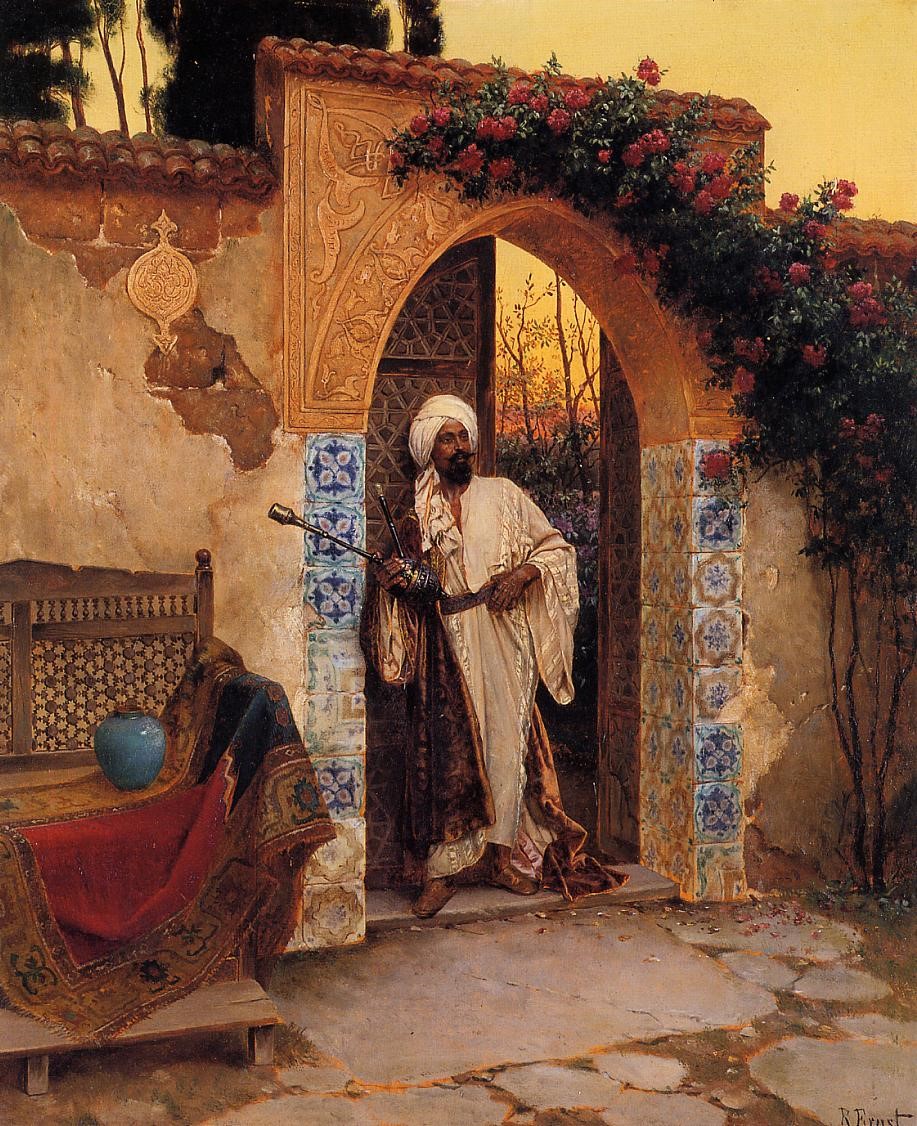
At the entrance to the palace garden

Rudolph Ernst (1854-1932) was born to arch­itect Leo­pold Ernst, a man who enc­ou­r­aged his son’s interest in the arts. In 1869 dad sent Rudolf to study at the Academy of Fine Arts, where he himself had studied architecture in the 1820s. Rudolf’s dr­awing teacher was August Eisenmenger (1830-1907), a portraitist & mural painter famous for the Wiener Musik­verein ceiling panels.

In 1869, Ernst joined the Academy of Fine Arts Vienna at 16! In 1873, Ernst also began studying under Anselm Feuerbach (1829-80) at the Academy, an artist who had trav­el­led extensively and stud­ied at the Düsseldorf Academy. Plus he studied Gustav Wappers’ romantic style at the Royal Academy of Fine Arts in Antwerp. Wap­pers was influential on many of the next gener­at­ion of painters, espec­ial­ly Lawrence Alma-Taddema and Ford Maddox Brown. 

Ernst went to Rome to study classical and romantic land­sc­apes. Ernst left the Academy in 1874 to study Old Masters in Rome, and two years later, he moved to Paris. Both of Ernst’s parents had died during his years at the Ac­ademy, which must have made his decision to leave Austria easier.
 
1876 was a great year for a young art­ist to arrive in a city that was now the centre of avant-garde art. In Paris Ernst Frenchified his name, Rodolphe, and settled in Montparn­asse as both his home and studio. From 1877, he exhibited at the Salon of Fr­ench Art­ists every year, then opted for French nat­ionality, per­haps because of the increasing polit­ical tensions be­tween France and the Austrian Empire. [This was lucky; as a Fr­ench cit­izen, Ernst could remain in France during WWI while oth­ers had to leave]. In those early years in France, Ernst was exp­osed to Impress­ionism to academic art, from Barbizon painters to Realists.

Ludwig Deutsch (1855-1935) was another Viennese artist who arrived in Paris in 1878 to study with Carl Muller, genre painter special­is­ing in peasant scenes from Hungary, Italy and North Africa. Deu­t­­sch and Ernst met in Paris and remained close friends forever.

What caught Ernest’s attention was Orientalist art, peaking in the C19th and de­pict­ing the imagined repr­es­entation of the East by European artists. This movement blur­red the line bet­ween fantasy and reality, largely because the scenes were­n’t painted by locals. Ernst’s Orientalist era began in 1885 when he travelled to Spain, Morocco, Tunis and Turkey. There he was able to sketch and ph­oto­graph the lo­cals’ daily life so that these im­ages could later tr­ansformed into colourful canv­as­es and int­er­iors. The trip mark­ed a sig­nificant turning point for the artist; he was del­ight­ed to focus on colourful, exotic Orient­alism, espec­ially Islamic scenes eg the interiors of mosques and harem scenes.

After the Prayer
 
Back at home Ernst used gen­uine Orientalist artefacts that he had gath­ered, to create out­standing fantasy eg tiles, lamps, pottery, silks, satins and kaftans. His C17th Persian blue-white pot app­eared in Per­fume Makers. The C19th Sy­r­ian bronze lamp near the Chieftain app­eared in After the Pr­ayer and The Wedding Day. The red-gold emb­roid­ered silk Dam­ask curt­ain was used in Smoking the Hookah, and the Moorish octagonal blue-green tiles were used in Reading the Koran. The C19th Syrian in­laid table near the Chief­tain was seen in The Refreshment. And the Alhambra-style back­gr­ound was a favourite set­ting that Ernst reprised: Wedding Day, Moorish Harem Guard and Alhambra.

In the Alhambra
 
Ernst successfully submitted Orientalist paintings to the Salon beginning in 1887, and in 1889, he received a bronze medal at the Exposition Un­iverselle. Winning a medal meant that his pro­­s­pects for a successful career increased, so he con­t­inued to exhibit at the Salon for another three decades. And like many artists, Ernst also op­ened his atelier to students, probably in the 1890s.

In 1890, Ernst and Deutsch travelled to Constant­inople and Cairo, recording what they saw with photos and through buying photographs from local stud­ios. Ernst also collected quite a num­ber of objects that he sent back to Paris; these later became the props and back­grounds of his art and were often rep­eated in different canvases. See Deutsch's handsome Nubian Guard, painted in 1895 .

By 1900, Ernst added yet another medium to his oeuvre: ceramics. Incl­uded in his faience pieces were the expect­ed Orient­al­ist imag­es and eventually he branched out into the pro­duction and sale of Orientalist tiles, inspired by the Isl­amic tiles he had seen. Ern­st moved just outside Paris to a vill­age c1900 and decor­ated his new home in the exotic Ottoman style.

The war years were grim and the art sales collapsed. It imp­r­oved after the Treaty of Versailles was finalised in 1919, and Ernst again showed his work at the Salon in 1920. His friend Deutsch had returned to France by then, and had also become a French citizen.

Ernst worked at his various forms of art in the 1920s, occas­ion­ally visiting his old Montparnasse haunts. As one of the first ar­t­ists to see the advantages of living in the left bank neighbour­hood, he enjoyed the young artists, musicians and writers moving into the area. Rodolphe Ernst died in Paris in 1932 at 78.

The Flower Seller

Thank you to Wikioog.org for the images


09 May 2020

Gender, Orientalism and the Jewish Nation: EM Lilien ..... guest post

In January 2020, Bloomsbury Academic Press published Dr Lynne Swarts’ first book, encompassing her passion for intellectual int­ersections: modern European history, Jewish history, gender studies and visual culture. Gender, Orientalism and the Jewish Nation: Women in the Work of Ephraim Moses Lilien at the German Fin de Siècle is about one of the important (but overlooked) Jewish artists of modern times, Ephraim Moses Lilien (1874–1925).

EM Lilien,
Das stille Lied, c1900,
Judo.


EM Lilien has been romanticised or demonised, depending on one’s view, as the first major Zionist artist. Surprisingly there has been little in-depth scholarly research and analysis of Lil­ien's work available in English, and so this research makes an important contribution to historical scholarship. Most of the hist­or­iography on Lilien so far has concentrated on his ground-breaking iconography of the muscular (male) Jewish body, much discussed amongst scholars of Israeli and Zionist art histography. There has been little debate on his images of the modern Jewish women.

Lilien was a superb illustrator, printer, photographer and film maker. Born in Drohobycz, at the base of the Carpathian Mountains in the Hapsburg Empire in 1874, Lilien went to art school in Krakow before ending up in Munich. Arriving in 1896, he worked for the fledgling Jugend art magazine as an illustrator and photographer. This was when the journal was first published, and Jugendstil (named after the rebellious style) became a household name. With the same ability to sense new moments in art history, he moved to Berlin in 1899, just as Berlin was taking over as the centre of the German art world.

In Berlin Lilien collaborated with Börries von Münchhausen (1874–1945) on a book titled Juda (c1900). The book became an overnight sensation. Von Münchhausen, fascinated by German Romantic poetry, composed a series of Hebrew Ballads that Lilien illustrated. In perhaps the most well-known illustration from these ballads, Das stille Lied, Lilien fashioned a new, modern and Jewish artistic style, a fresh interpretation of Jugendstil for a very different audience. As Juda, the male hero of the story, kisses his female lover, their bodies dissolve into an erotic, sensual embrace.

Juda’s cloak, with its decorative, flat Jugendstil patterns, swirls around them, helping to convey their passionate, exotic or Oriental love. For Lilien’s Jewish German audiences, the kiss was not a gen­eric Germanic kiss but a specifically Jewish kiss, with the hand­some Juda looking a little like Herzl. The emphasis on handsome good looks and normative sexuality were all part of the Zionist body aesthetics that encouraged strong, heterosexual, manly behaviour.

His images of muscular new Jews, tilling the soil like their socialist brethren, helped launch Lilien’s career. Martin Buber (1878–1965) and the cultural Zionists, who believed that Jewish re­newal would be based on culture not politics, were happy to praise Juda for its depiction of ancient male heroes. Lilien became the darling and hope of their movement. However his depiction of a Jew­ish woman as licentious or submissive was passed over in silence.

EM Lilien at his drafting table in c1902,
National Library of Israel, Jerusalem. 

Wikicommons

This book concentrates on Lilien’s female imagery and divides them into 3 separate genres:
1. his non-Jewish femmes fatales (similar to other non-Jewish successful avant-garde artists);
2. his images of courageous Jewish biblical heroines; and
3. his more sensuous images of Jewish orientalised women with a certain amount of sexual agency.

Lilien merges misogynist Jugendstil aka Art Nouveau images of the femme fatale with a western Orientalism, that often worshipped the exoticism and unbridled sexuality of the eastern other. The book argues that his use of orientalism as an artistic style to repres­ent images of strong heroic Jewish women was not a part of these white, Western, male fantasies. Rather his images represented a fundamental and critical attempt to explore the complexities of German and Jewish identity.

To Lilien, the Orient was not simply a fanciful place, but an internal space to explore multiple and transnational identities. Lilien was part of an increasingly large, ingenious and active group of fin-de-siècle Jewish writers, poets and artists whose response to the problems of otherness was to view German Jewish orientalism as an inspiration that would help explain their multiple identities.

Lilien searched in his oriental and biblical imagery for an authentic Jewish identity that would help overcome how non-Jewish Germans perceived or classified him and his fellow Jews: as being ‘not quite white’ and certainly ‘not quite German’ i.e as barbaric Asiatics or Orientals. Lilien’s sense of otherness not only prod­uced tensions between his apparent Germanness and Jewishness but demanded a psychological gestalt or answer to the perennial quest­ion that Buber’s spiritual ideas had posed to the cultural Zionists on the Jewish essence. His images of orientalised Jewish women form part of that search for identity, roots and meaning. Grounded in their European origins, Lilien’s images were, also part of the quest for a Jewish and authentic oriental voice.

Concentrating mainly on his illustrations for journals and books, the book acknowledges the importance of Lilien's ground-breaking male iconography in Zionist art. Like other vanguard male artists at the end of the C19th, painting continued to be a male preserve. Lilien’s work mirrored the misogyny inherent amongst non-Jewish avant-garde artists. As a secular Zionist, Lilien pushed the limits of Jewish visual representation in the interests of Jewish cultural literacy. The modern Jewess who emerges from the shadows or blind spots of the gendered male historiography is a distinctly contemporary figure. Lilien's female images offer a compelling glimpse of an alternate, independent and often sexually liberated modern Jewish woman, a portrayal that often eluded the Zionist imagination.

Using an interdisciplinary approach to integrate intellectual and cultural history with issues of gender, Jewish history and visual culture, the book explores the important fin de siècle tensions between European and Oriental expressions of Jewish femininity. Gender, Orientalism and the Jewish Nation demonstrates that Lilien was not a minor figure in Europe's art scene, but a major fig­ure whose work needs re-reading in light of his cosmopolitan and national artistic genius.


Dr Swarts is a Sydney historian and academic. Her book Gender, Orientalism and the Jewish Nation can be purchased here.


30 November 2019

How the Islamic world influenced Western art: British Museum

At university, I loved medieval art and architecture, but it was 100% Christian in patronage and in iconography. There had to be more! It wasn't until my first trips to Israel, Jordan, Egypt and Turkey that I discovered (and collected) Islamic, Jewish and other Oriental art forms. Even better, my sons married women whose parents came from Damascus and Alexandria.

The British Museum’s special exhibition is called In­­s­pired by the East: how the Islamic World Influenced Western Art. Until the end Jan 2020, it is examining how West­ern visual arts have been inspired by the Islamic world for centuries. Known as Or­ientalism, this rep­res­entation of the East in Western art oft­en blurred the line between fantasy and reality. In paint­ing, decorative arts, interior design and arch­it­ecture, the works depicted or referred to subjects and styles from the Orient.

The Orientalist art movement peaked in the C19th and was best known for its production of impressive oil paintings and works on paper. But this movement had started back in the C15th and continued to be referenced in art. It influenced the production of a wide range of works of art inc­lud­ing ceramics, metalwork and photography, and extended more widely to include theatre, architecture and music.

Palestinian-American scholar Edward Said’s influential text “Orientalism” brought critical attention to the subject in 1978, questioning the ways in which the West saw and misrep­resented the East in culture. In it he criticised the over-romanticised and inaccurate views the West presented of the Orient, particularly through literature. He defined the Orient as being the place of Europe’s greatest, richest and oldest colonies, the source of its civilisations and lang­uages, its cultural contestant, and one of its deepest and most recurring images of the Other. This exhibition, however, focuses only on the art movement of Orientalism.

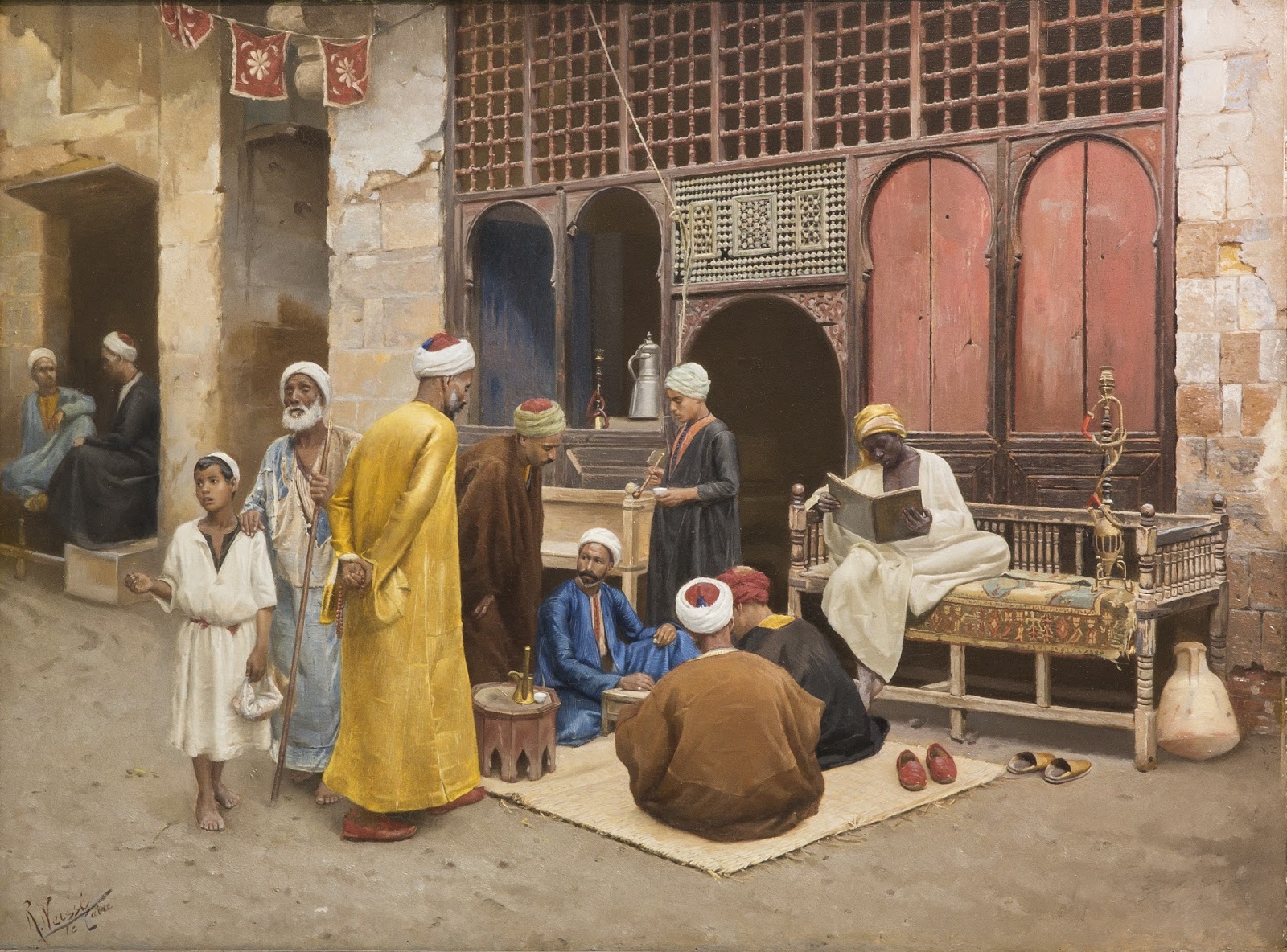
The Dice Players. oil, 1859, 
Painted by the Czech artist Rudolf Weisse. 
Islamic Arts Museum Malaysia.

Stanislaus von Chlebowski,
a Polish painter with Russian and Turkish connections.
At Prayer in Hagia Sophia, 1879


Engage with such critiques by recognising misrepres­entations ... while identifying a long, rich his­t­ory of influence and exchange in both directions. Indeed from c1500, as Europeans became both increasingly curious and aggressive in their dealings with outsiders, there was a sust­ained awareness of the empires of the Middle East. These Eastern neighbours were the Safavid Empire (1501–1722), cent­red around modern Iran, and the Ottoman Empire (c1300–1924), which comp­ris­ed modern-day Turkey, most of SE Europe and the Arabic-speaking lands. Likewise, European traders and dipl­om­ats were considered an "exotic other" by people in the Middle East. At a time when relations between Europe and the Middle East were more evenly balanced than in later periods, this was a period marked by exchange and fluidity.

This can be seen in the imitation of certain styles in Iznik plates from the C17th, a centre for high-quality pottery prod­uction for centuries. The distinctive floral designs were also popular on tiles that decorated the inside of buildings during the Ottoman period (14th–C20th) eg see tiles made by English designer William De Morgan in the C19th. He was influenced by Middle Eastern ceramics and designs, creating floral motifs that appeared in fashionable ceramics, stained glass and furnishings. 

Enamelled glass mosque lamp,
inspired by late medieval Mamluk originals
Made in France in 1877 by French glass master Brocard
Islamic Arts Museum Malaysia


Alhambra vase, Spain late 1800s.
Glazed ceramic with lustre decoration
British Museum/Islamic Arts Museum Malaysia

Bottle in the Persian late Safavid style, glazed and lustre-painted ceramic,
Made in France, late 1800s.


As Europeans increasingly looked out to the Americas, Af­rica and Asia from the 1500s, they developed new ways of id­entifying and disseminating information about the people they met. Costume books became a popular way of classifying diff­er­ent groups according to their dress, from sultans and mystics to dancers. But these portrayals were often based on stereotypes that only helped perpetuate the mistakes in Europe. 

The best-known artistic output of the Orientalist art movement was a huge body of paintings by Western artists. Many of the artists travelled to the places they depicted: Const­ant­inople aka Istanbul, Jerusalem, Cairo or Marrakesh. Others trav­elled no further than Paris or Vienna, but used a mixture of photo­s and imagin­at­ion for inspiration. Recurring im­ag­es incl­uded everything from images of daily life to imagined scenes of the har­em. Int­er­est in Orientalism developed toget­h­er with European col­onial interests in the Middle East, which gave soldiers, trad­ers and artists ready access to the region. 

This exhibition reveals that Orientalism convered many typ­es of visual and decorative arts with origins in Europe, North America, Middle East and North Africa. These arts high­light the old tradition of influence and exchange between West and East, whether gained through diplomatic en­counters, spoils of war, or travel to the Holy Land and beyond.

Although Orientalism remains a highly charged and contested term, with Orientalist arts and crafts rapidly declining in popularity since the 1940s, its visual language remains a pot­ent resource for artists today.


09 October 2018

A private palace of art - Leighton House in London

Frederic, Lord Leighton (1830-1896) built the Kensington studio-house from 1865 on. With the Victorian art market booming, and domestic taste fascin­ating the middle classes, Leight­on needed to demonstrate his importance. After all, he was both president of the Royal Academy and chief exponent of the new Aesth­eticism.

Leighton House was to be his link to a special society, so #2 Holland Park Rd needed to be special. Fortunately Leighton was enjoying increasingly high fees for his paint­ings, and he also had family money. Leighton and his arch­itect, George Ait­ch­ison, chose the decorat­ive elements for their aesthetic effect, wherever they came from. The result incorp­or­at­ed styles from Arts and Crafts, Orientalism and Baroque.

Adding to the building for years, he end­ed up with one of the most talked-about houses in the country. Around the dome was a super frieze made up of tiny tiles, commis­sioned from artist Walter Crane (1845-1915), who did the work in Venice and then trans­port­ed the finish­ed product to London. William Morris curtains were loved. Orientalist Iznik wall tiles and the fin­est Arabian and Persian artwork were coll­ected on his regular trips to Turkey and Syria. Sometimes he comm­iss­ioned friends to buy the art objects abroad, including the Japanese and Chin­ese porcelain.

Leighton was a leading painter. His main interest lay in history painting and neo-classicism, and his most instantly re­cognisable work is Flaming June. Viewers also value his plein air oil sketches, made on his North Africa and Middle Eastern travels.

Flaming June,
by Lord Frederick Leighton, c1895
Tate Britain


On Sundays, visitors gazed at the spectacular 1877 Arab Hall, with its golden dome, intricate mosaics, walls lined with beaut­iful Islamic tiles and indoor fountain. Colleagues attended one of Leighton's famous musical soirées, complete with its minst­rels' gallery. Intimate friends were invited to spend the evening in the red dining room with glittering Middle-Eastern ceram­ics.

Or they lounged in the private and relaxed Silk Room, with its paintings by Tintoretto and Millais. Certainly it was homo-social; he filled this cosy room with pieces by friends such as Millais, George Frederic Watts, Singer Sargent and LawrenceAlma-Tadema.

Was Leighton a dandy? Presumably yes. But note three things. Firstly his young women were expected to access the studio through a separate Model's Entrance in the back. Leighton House may have been de­signed to showcase the artistic avant garde, but his class relat­ionships were still Vic­t­orian. Secondly for all his generous support of fellow artists, Leighton seemed to have had little interest in women painters or their work. Finally Leighton lived alone in his palace, occupying the house’s one, very stark bed­room on the first floor. Thus he was showy, public and extra­vagant, but private and a bit grim as well.

 de Morgan tiles

Arab Hall and sculpture

After Leighton's death in 1896, his one-bedroom house didn’t sell. So his sisters had to focus on the house's vast art coll­ection, in order to carry out the bequests in their brother's will. Following the Christie's sale, his works by Constable, Delacroix and Corot were bought around the world. During this empty time, the house’s ceilings were covered in lining paper and painted dull bronze emulsion. The wooden flooring was covered with protective layers.

After WW2, Leighton House underwent well-meaning but sloppy rest­or­ation. That changed in 2008-10, with a £1.6m fund from the Roy­al Borough of Kensington & Chel­sea; a team of curators, crafts­men and architects did a very careful restor­at­ion. Working with old photographs, they strip­ped the house back to Leighton’s original vision. It is now a testimony to a particular moment in British cultural history.
Many of the key paintings which were sold were loaned back, and now occupy their original positions. Where furniture, tiles, wallpaper and fabrics were missing, facsimiles have been commissioned from traditional craftsmen.

Enter via the splendid Arab Hall and see the central dome, newly restored with gold leaf. There are ottoman seats which have been re-upholstered in a William Morris Willow fabric, clearly ident­ifiable in photographs of 1895. And from those photos, historians set about re-creating the wallpaper that Leighton had himself commissioned. Other highlights include the reproduction of finely embroid­ered upholstery, designed by Gertrude Jekyll. It is a place of tactile luxury!

Leighton House Museum is surrounded by a group of other studio-houses, all built during the later C19th. Today the museum has a collection of 76 oil paintings by Leighton, includ­ing large-scale finished works produced for exhibition at the Royal Academy.

There are only 3 extant Leighton sculptures, but their influence over younger British sculptors was profound. The examples at the museum were pres­ented in 1900 by Leighton's friend and close neighbour, artist G F Watts.

700 of Leighton's sketches were assembled in the early years of the C20th, shortly after the establishment of the museum. The collection demonstrated his skills as a draughtsman.

The museum also has a small but significant collection of paint­ings, drawings and sculpture by contemporaries: John Everett Millais (1829-96), George Frederic Watts (1817-1904), Frederick Sandys (1829-1904) and Solomon J. Solomon (1860-1927). See drawings by Edward Burne-Jones (1833-98) and J A M Whistler. The entire collection was catalogued, conserved and toured in 2005-2007.

Leighton collected paintings by his friends and colleagues

During the High Victorian period an informal group of C19th art­ists based in West London was called The Holland Park Circle. As well as Frederic Leighton, it included George Frederick Watts, Luke Fildes, Marcus Stone, Val Prinsep and William Burges. See the group’s archives, plans, photographs and drawings. And see the group of photographs by Julia Margaret Cameron whose family had close associations with the Holland Park artists.

The museum holds a collection of c100 pieces of pottery by Wil­l­iam De Morgan and his later associates. Following De Morgan's death in 1917, this collection was presented by Ida Per­r­in who paid in the 1920s to build the Perrin Gall­ery (at the east end of Leighton House). His wife,  Evelyn De Morgan (1855-1919)'s watercolours on paper, remain.

The House Museum shows Leighton's life as a gentleman, art­ist and collector. The fascinating coll­ect­ion of the arts by Leighton and his generation is still growing.


08 November 2016

19th century hoaxes: the exotic Princess Caraboo

In April 1817, a confused young woman appeared at a cobbler's cottage in the village of Almondsbury near Bristol. This very attractive stranger wore a black shawl twisted turban-style and spoke a bizarre language.

The cobbler's wife didn't know what to do. But thinking that she was probably a foreign beggar, took her to the Overseer of the Poor, whose job it was to arrest and punish all common vagabonds. Alas the Overseer of the Poor was just as mystified by the girl and reluct­ant­ly decided to take her up to Knole Park, the large home of Samuel Worrall, county Magistrate in Gloucestershire. Mrs Elizabeth Worrall was enchanted by the young woman’s foreign appearance, but Mr Worrall was doubtful. In language and behaviour the woman seemed to be from some dist­ant and exotic nation, but her features were definitely European. Perhaps a Gypsy, Mrs Worrall thought.

The young woman, called Caraboo, soon came to live at Knole Park in Gloucestershire. Then a Portuguese sailor explained she was a royal princess from the unknown island of Javasu. She had been abducted from her home by pirates and had escaped into the English Channel.

When the Worralls learned that Caraboo was royal, they immediately welcomed their visitor in the newspapers, and invited their elegant friends to meet her. For a few weeks the Princess lived in a grand style, spending her days dancing and playing sport, and praying to her god Alla Tallah. The Worralls basked in the reflected glory, and every week more aristocrats poured in to Knole see the exotic lost princess. Caraboo had Orientalist portraits painted by local artists Thomas Barker of Bath and by Edward Bird of Bristol.

Princess Caraboo, 
by Edward Bird, 1817
Bristol Museum and Art Gallery

The excitement only ended when a Mrs Neale, who ran a lodging house in Bristol, read the description of the princess in the Bristol Journal and recognised her. Apparently Caraboo had recently been employed as a servant at Mrs Neale’s house, where she had entertained the children by speaking a made-up language. The Princess’s true name was actually Mary Wilcocks Baker (1791-1864), a Devonshire cobbler’s daughter.

It was assumed that, by posing as an exotic foreigner, Mary Baker was simply protecting herself; she believed she would more easily offered assistance while travelling on the open road alone. Yet her deception was aided by the desire of the Worralls and their aristocratic friends to believe that the character was real. According to the Museum of Hoaxes, Princess Caraboo had intuitively appealed to the aesthetic of Romanticism that was emerging in Europe via Byron, Keats & Shelley. People believed Mary looked and acted like their romanticised image of the exotic Orient.

Once her hoax was revealed, Mary also came to symbolise a class issue. Through her talents alone, this working class lass had successfully chall­eng­ed the upper classes and (briefly) won. The British press had pleasure repeating how she had fooled the upper classes by appealing to their own vanity.

How had this uneducated country girl manage to fool so many educated people, and why? Mrs Worrall asked the editor of Felix Farley's Bristol Journal, John Matthew Gutch, to find out something of the girl's past from Mary herself, and from those who knew her. Gutch published a book that year (1817) which reported the following. Mary Wilcocks had born in 1791, into a very poor family where her siblings had died young. As a young child she worked in wool spinning and weaving, and on local farms as a maid. Mary’s father knew that, from 15, his daughter had not been able to settle down. He thought she was mentally unstable, from rheumatic fever.

When Princess Caraboo moved into Knole Park, 
she was very comfortable. And famous.

From Taunton Mary went to Bristol and thence to London, walking and begging along the way. She collapsed, and two women took her to a workhouse hospital, where she was admitted to the fever ward. She stayed several months and was helped by a cleric who found Mary jobs with decent families. These families taught her to read and write, and to care for children.

After working in London, Mary eventually arrived home in 1813 where her mother found her a tough job working for a tanner. After a couple of other jobs she again headed back to London, where she worked for a Billingsgate fishmonger. Mary claimed that while working there, in 1814, she had a love affair with a Mr Baker. After two months they were married and lived together in London. Then her husband sailed to Calais, promising to bring her over to France. But that was the last she ever heard from him. In early 1816, she found she was pregnant.

She managed to get a job working behind the bar in a pub and delivered the baby boy in Feb 1816. Both mother and baby were sent to St Mary's Workhouse and then to the Foundling Hospital. Mary found employment again, and visited the child weekly at the Foundling Hospital, until he died in October 1816. In February 1817 Mary set out for Bristol to leave for the Indies. But rather than going north to Bristol, she ended up begging on the road to Plymouth, and staying with gypsies.

She was now looking for a ship to take her to Philadelphia, and found she could travel steerage on a ship leaving soon for five guineas, a lot of money for her to raise. She found lodgings sharing a room in a respectable house belonging to a Mrs Neale, and started looking more exotic. Soon Mary was on the road again, this time to Gloucester and to her new life as Princess Caraboo.

In time Mary Wilcocks Baker became an embarrassment to the kind-hearted Worralls in Bristol, so they decided to send her to America and bought her a one-way ticket to Philadelphia. Mary sailed in June 1817 where she was greeted by enthusiastic crowds as Princess Caraboo.

After seven years she tired of America and returned to England in 1824 where, as Princess Caraboo, she occasionally gave public performances. But as the popular memory of her story faded, Mary made a decent living at the Infirmary Hospital in Bristol where she had a daughter in 1829.

Mary Wilcocks Baker died in 1864, aged 75.

**

Clearly Mary was not the first imposter to fool high society, but she was one of the most successful. Yet while I believe she was an neglected, overworked and possibly psychotic teenage mother who was just trying to salvage a life for herself, the historical context for well thought-out hoaxes in the 19th century/early 20th century seemed different.

Along with many other C19th hoaxers, Mary was often seen as a clever prankster, not doing much harm beyond pointing out how gullible some people were. Consider the American writer Edgar Allan Poe (1809-1849) who enjoyed hiding the truth from his readers, to force them to play detective. He published six famous hoaxes during his life. 

In 1897 a teenage Harold Bell Lasseter (1880-?) staggered out of the Australian desert almost dead, his pockets bulging with gold, claiming to have found a 15 kilometre gold reef. Not long after the find, his horses died; he became lost and would have perished but for the intervention of an Afghan camel rider-surveyor. But no scientific team ever found the reef, despite expensive and dangerous expeditions later on.

And think about Horace de Vere Cole, the fake Sultan of Zanzibar, and his team of playful rogues in 1910 who cleverly fooled the entire British Navy. In some circles, de Vere Cole and the others were heroes, challenging the existing power structures and questioning Britain’s militarism. But in time it became clear that this compulsive hoaxer had alienated everyone in Britain, including the Navy.

In 1917 The Cottingley Fairies was a series of photographs taken by young girls near Bradford in England. The faked pictures of fairies might not have mattered, had Sir Arthur Conan Doyle not been fooled. This well respected author published the photos to prove that fairies were real and wrote widely on the topic of psychic phenomena.
 
Blue Plaque, 2007
11 Princess St Bristol
Mary Wilcocks Baker's last home

The community must have forgiven Mary Wilcocks Baker for fooling the newspapers, Samuel and Elizabeth Woorall and their aristocratic friends. A film of Mary Willcocks' life, Princess Caraboo, was made by Disney in 1994; it starred Kevin Kline, Jim Broadbent and Phoebe Cates. In 2007 a blue plaque was placed on the front wall of 11 Princess Street in Bristol, telling the story of Princess Caraboo and the house she lived in for the last 15 years of her life. The Blue Plaque organisers were impressed "that Mary dared to escape her menial position and perpetrate such a complicated hoax was nothing short of wondrous. Mary Willcocks should be an inspiration to anyone who feels held back by their position in society." Now a full stage musical, Princess Caraboo, opened in March 2016 in a small Earl's Court theatre. The lyrics were written by Phil Willmott and the music was composed by Mark Collins. I wonder if a musical or ballet will come out about Horace de Vere Cole or Harold Bell Lasseter any time soon.


06 August 2016

Jean Etienne Liotard - early Orientalist artist in pastels

Jean-Etienne Liotard (1702-1789)’s parents were French Huguenots who fled to the independent Protestant city state of Geneva. Thus the lad was born in Geneva, did some of his training there and later finished his training in Paris.

He first joined some very Grand Tourists in Italy such as Viscount Duncannon and the Earl of Sandwich and accompanied them to the Levant. He spent 4 amazing years in Constantinople (1738-42), absorbing the visual pleasures of the exotic East. "The Turk", as he called himself, only adopted his Oriental costume and beard in Constantin­ople, where he painted ex­patriate residents and scenes of everyday life in the Ott­oman Empire. Then he continued being The Turk wherever he travelled across Europe. The exactness of his eastern costumes in his portraits pres­um­ably recorded what both Turkish citizens wore, and what members of the Western merchant community wore while they lived amongst the locals.

His portrayal of life in the Ottoman Empire in the mid C18th, and of his fashionable European sitters in Turkish attire, in some way inspired the C19th taste for Orien­talism. In his day he was one of Europe’s most sought-after portrait­ists, worth high prices and a loyal, international clientele. From delicate lace and silks to exotic turbans and furs, Liotard’s depictions of textiles showed his impressive command of textiles, decorative details and a sense of fashion.

Liotard, 
Laura Tarsi as a Grecian Lady, 1741, 
10 x 8 cm. 
Fitzwilliam Museum

The Fitz­william said that little was known about Laura Tarsi in this exquisite miniature, beyond her name and nationality. Its provenance led to the supposition that she was the mistress of John Manners, Marquess of Granby (1721-1770) when both were living in Constant­inople in the early 1740s. And note that Liotard also painted three other versions of the portrait of the lovely Laura.

Then Liotard and his aristocratic patrons went to the courts of Moldavia/Romania, Vienna, Germany, Paris for 7 more years, then Britain, Holland and on through central Europe. Wherever he went, he enjoyed considerable success, exploiting his potent reput­ation as an Orientalist painter. It is worth noting that throughout his long career, his major British aristocratic patrons continued to commission portraits from him, wherever in Europe the artist was calling home at the time. And the love affair lasted - Hon William Ponsonby, Viscount Duncannon, became one of his greatest patrons and single handedly bought 72 Liotards! 

Liotard was an artist in great demand across Enlightenment Europe and beyond, including when he was specifically commissioned to paint portraits of members of the British, French and Austrian royal fam­ilies. No wonder! His distinctive portraits conjured up the magnif­icence and cultural curiosity of that very royal age.

He was one of the most accomplished portraitists of his day, trav­el­ling and working on beautifully crafted portraits, mostly pastels on parchment. But why pastels? Yes they were applied in an open, painterly way, using up to 90% pigment for brilliant colours. But Liotard’s portraits were much more finely crafted, highly polished and exquisitely detailed than other artists’ portraits were. We can see that he originally trained as a miniaturist! Using very finely sharped hard pastel chalks pastels alongside softer and broader pastel sticks, historians suggested he gave a real sense of liveliness to his sitters, especially around their eyes.
 
Liotard, 
Self Portrait, 1744, 
38 x 25 cm
Uffizi Gallery Florence.

When he arrived in London, the artist was still styling himself as le Peintre Turc, walking around town with a long beard and Turkish dress.

His treat­ment of materials was very special: the viewer can readily distinguish between fur, satin, velvet, lace and covered buttons. Naturally many of his sitters chose to be depicted in very exotic costumes with very lush materials. Laura Tarsi's outfit was typical of the layered look and richly embroidered fabrics that enjoyed such a vogue among fashionable Europeans.

His wide range of subjects, both geographically and socially, was also impressive. Sober Genevan citizens, English Grand Tourists, exiled Jacobites, diplomats, princes and progressive thinkers all admired his skills.

The Scottish National Gallery and the Royal Academy of Arts in London each completed a major Liotard exhibition in 2015-16. Both exhibitions showed that Liotard was loved for his subject matter – especially the works he produced during his time in Constantinople in 1738. A highlight was a wonderful group of drawings in red and black chalk that depicted scenes of contemporary Turkish life. These works were important as records AND because they influenced the West’s increasing taste for the Orient.

The exhibitions followed his travels, taking us from Liotard’s self-portraits and portraits of his family, to portraits of his British and continental patrons, both courtly and aristocratic.

These were the first retrospective exhibitions in the UK to be devoted to Liotard, bringing together over 70 rarely-seen works. Covering the artist’s time in Paris, Vienna, Geneva, Constantinople and London, they were a long-overdue celebration of an artist the students and I found accidentally and really enjoyed.
 
Royal Academy of Arts Exhibition poster, 
 Liotard, Maria Adelaide Reading, 1753 
Uffizi Gallery Florence 

I warmly recommend the exhibition catalogue which presented important new research on the artist by the 3 curators. And I am very grateful to Neil Jeffares for his in-depth search in publishing Dictionary of Pastellists Before 1800.