Showing posts with label Islamic. Show all posts

08 September 2026

Gertrude Bell's great Middle Eastern legacy

The female scholar behind Iraq's independence
The Librarians

Gertrude Bell (1868-1926) was the grand­daughter of British nobility and the daughter of an monied industrialist. Instead of seeking a life of cocktail part­ies, her brain actually required a high-class education. In 1884 Bell went to Queen’s College and Oxford Univ­ers­ity, gaining 1st Class Honours in Modern History. She spent the next 15 years in cons­tant travel including Persia, Egypt and Algiers.

A “cause” arrived in 1899 when she met arch­aeol­ogist David Hogar­th and his world of Middle East ant­iquity. Already fluent in Persian, Fr­en­ch and German, Bell also studied Arabic and Hebrew, and in 1900 she completed the first of her desert travels through Pal­est­ine, Leb­an­on and Syria. She then began learning desert rul­es and the soc­ial prac­t­­ices of nomadic Bed­ouin, building val­uable friendships among sheiks, warr­iors and Mesopot­amian merchants. From 1900-12 her focus was on developing her skills as an arch­aeol­ogist, map-maker and ethnographer in a tough part of the world. Her 1907 trips with Sir William Ramsay in Anatolia became the basis for her book, The Thousand and One Churches (1909). She was becoming a specialist in Byzantine religious architecture, writ­ing mono­gr­aphs as she went.

1911 was when met the young archaeologist T.E Lawrence (1888–1935) aka Lawrence of Arabia. They shared a passion for Arab­ic cul­ture and antiquit­ies, becoming powerful forces in the next dec­ade prom­oting Arabic independence from the Otto­mans and from Eur­ope.

After a long trip along the Euph­rates River, Bell discovered and surveyed an C8th Abbas­id fortress at Ukhaidir. She wrote the account in her 1909/10 journal, and an arch­itectural mono­gr­aph, The Palace and Mosque at Ukhaidir (1913).

In 1913 Bell travelled by camel through modern Saudi Arabia and Iraq, hoping to reach the famed White City of Hay­yil. She negotiat­ed her way thr­ough cont­ested territories, critical water short­ages, hostile tribes and the shift­ing sands. Then she went home with maps and knowledge of Arabia that were invaluable as Europe faced WW1.

With Turkey and Germany allied in WW1, the Middle East suddenly be­came an area of military importance remote from British intell­igen­ce. Who were the relevant powers there? Who did they support? So in 1915 Ger­trude Bell trav­el­led to Cairo, to work with Brit­ish Intell­ig­­­en­ce, com­pile inform­ation and form a strategy for org­anising Arab­ic res­is­tance to Turk­ish rule. However she did not participate in the Sykes-Picot Agree­ment in 1916 that eventually divided Turkish-held Syria, Iraq, Lebanon and Palestine.
                                     
Bell, Cox and Ibn Saud in Mesopotamia in 1916.
Feisal's two staunchest supporters re holding the new Mandate of Iraq together
Imperial War Museum

After the war, the Ottoman Empire was being dismantled and Bell sought to help the Arabs. She was asked to make her recommendations for Mesopotamia, as her 1920 report “Self-Determination in Mesopot­amia” made very clear. Bell was in the middle of the region’s politics, acting as mediator between the local Sunni, Shiite and Kurd leaders, the British government, and Winston Churchill.

Self-Determination in Mesopotamia was the paper that earned her a seat at the Paris Peace Conf­er­ences (1919-20), to honour the Al­l­ied promise of Arabic independence. She opp­osed French del­egates who were cr­eating their mandate in Syria. And she opposed the Brit­ish delegates who were creating a British mandate in Iraq and Palestine.
                                 
participants of the 1921 Cairo Conference. 
L to R: Winston Churchill, Gertrude Bell and TE Lawrence.
Under the Sphinx of Giza.

Winston Churchill, Secretary of State for the Colonies, called the 1921 Cairo Conference. While other British offic­ials argued for Iraq’s continued sub­servience to Brit­ain, Bell arg­ued hard for their indep­end­­­ence, and for the pro­m­ot­ion of a larg­er Arabic state from France. For a newly un­ified Iraqi state, Bell and Lawrence highly recommended Faisal bin Hussein, former command­er of the Arab forces that helped the Brit­ish in the war. And through his charis­matic leadership, a nation was forged! Bell became one of King Faisal’s most trusted advisors, beloved in Baghdad.

Yet Bell and her boss British high commissioner, Sir Percy Cox, laid down state policies in Iraq that were taken up by Sadd­am’s Arab Ba’ath socialist party. Iraq retained the Kurdish mount­ains as a buffer against Turkey and Russia, and promoted Sunni Mus­lims over the Shia majority. They expelled the Shia clergy to Iran, and depl­oyed air power as a form of political control. Why did the U.K care? Iraq enjoyed valuable oil resources AND acted as a buffer zone in the region to protect against Turkey, Iran and Syria.

Bell believed passionately in Arab independence and persuaded Lon­d­on that Iraq had enough able men at least to provide an administ­r­at­ive façade; and she contr­ib­uted importantly to the construction of the Iraqi state in 1921. But she had two difficulties. Firstly she always ov­er­estimated the popularity of Cox and herself. And secondly she underest­im­ated the force of religion in Iraqi affairs.


Bell and Sir Herbert Samuel, British High Commissioner in Palestine,
meets Jordanian pilot 1921. Highbrow.

Bell was never loved in London. And when Cox left Bag­h­dad in 1923, she lost her bureaucratic protector. Yet Bell still wanted help in preserving Baghdad’s heritage in a new Archaeological Museum and she was named as the Director of Antiquities by King Faisal. Later she helped draw up the borders of the new nation of Iraq.

She died in 1926 in Baghdad at 57, from ?lung can­cer. The citizens and British officials lined the streets to pay respect to this weal­thy British scholar who’d dedicated her life to Arab culture; the King of Iraq stood in a place of honour.

Bell’s greatest legacy was indeed the recovery and preservat­ion of an­cient artefacts and archaeological sites all over the Mid­dle East, as at the Gert­rude Bell Archive at Newcastle Uni. But in 1921, Churchill agreed that Mesopotamia should be a self-ruling state, and Bell was a central figure at the Cairo Conference. Her influence was essential to the establishment of modern-day Iraq.


03 September 2026

Jewish Toledo - Spain's finest & worst eras

Toledo, capital city of Old Castile, started with the Romans. Jews have lived there at least since the C6th; in 589 CE, Council of Tol­edo pro­hibited Jews from marrying Christ­ians, hold­ing public of­f­ice or own­ing Christian serv­ants. Clearly the Jews suffered greatly under Ch­rist­ian­ity, especially when the 8th Toledo Council created even worse anti­-Semitic leg­islation in 652 CE. The rift between the two commun­ities led the Jews to befriend the new conquerors in the Muslim conquest of Toledo in 715 CE.

Facade of the Synagogue and Sefardi Museum

In 1252 King Alfonso X captured Toledo and declared it Christian again, yet this time he ensured that the Jews were treated as eq­u­als. Many Jews migrated to Toledo and rose to prom­inence, in pol­it­ics and government. Alfonso even named a Jewish physician as his royal appointment.

By mid-C13th, Toledo’s Archbishop grew concerned by the fin­an­cial and political prominence of the Jewish community, so he impos­ed a tax and housing tithe on every adult Jew. This didn’t work, since by 1290 nearly half of the town’s resources was still own­ed by Jews!

The commun­ity leader was the community’s rabbi; in 1305 Tol­edo Jews chose the learned nobleman Asher Ben Jehiel Abulafia (d1328) to lead them. In 1320 Samuel Ha-Levi Abulafia was born, the Abulafias having led the Jewish comm­unity in Castile for decades. Sadly Samuel’s parents died of the plague, and as Samuel was too young to inherit their legacy, he was app­ren­t­iced to the Knight Juan Alfonso instead. Samuel rose quickly in society un­til he found vit­al positions in King Ped­ro I of Castile’s court. Samuel became town Mayor, Treasurer and fin­ally High Judge. It was as Treas­urer when he chose to build a synag­og­ue.

Toledo already had 10 synagogues, including Spain’s largest, but this one was Samuel’s own special house of worship. In 1357 the new synagogue opened, with Samuel Ab­ul­afia leading the prayers. To thank his comm­un­ity, Sam­uel also opened the synagogue as a hub for Jew­ish education. Note that in the C14th, Spain had actually decreed a ban on all new Jew­ish educat­ional institutes and synagogues. How­ev­er Sa­m­­uel’s close rel­at­ion­ship with King Pedro meant it was ok. Was it a royal apology for the persecution that Jews had faced in Toledo in the 1348 Black Death?

Samuel Abulafia ignored the regulations requiring synag­og­ues to be under-decorated and smaller than churches. The lav­ish­ly decorated rect­angular prayer hall had a 12m ceiling where Heb­rew in­sc­riptions ext­ol­led both King Pedro and Samuel Ha-Levi. Arabic inscript­ions and Psalm passages were also on the walls, next to the family coat of arms and fine windows. Over 2nd floor women's gallery,  the arches were layers of low-relief stucco tendrils, round­­­els, scallop shells, geometric interlacing & rows of blind arches.

The façade was built of brick and stone and was unad­orned, in order to draw less public attention. Only the tow­ering roof raised the whole synagogue above nearby structures.

Inside Sefardi Museum
 
This house was an active place of worship for many years, but anti-Semitism reappeared. Samuel Ha-Levi Abulafia set out to pro­tect Jewish rights and freed­oms, but as the rift between the two men grew, King Pedro no longer de­f­ended him. Samuel was arrested on corr­up­tion and tortured to death. De­s­pite grow­ing attacks on Tol­ed­o’s Jewish com­munity, his house and synagogue rem­ain­ed, presumably from self-interest; it would be converted to a church.

By 1492, the Jews were given a final ultimatum: the Catholic monar­chs of Spain, Ferdinand and Isabella, iss­ued the Alhambra Decree which gave Spanish Jews the choice to 1] con­v­ert to Catholicism, 2] leave Spain voluntarily or 3] be expelled. This Royal Decree showed their belief that the Jews’ presence was a threat to Spain’s relig­ious and cultural identity. The exp­ul­sion marked the end to centur­ies of Jew­ish pres­ence in their beloved Spain, and led to their forced mig­rat­­ion to Europe, North Africa and the Ottoman Empire.

As no Jews remained in Toledo, the synagogue was turned into a ch­urch; Ferd­inand and Isabella donated the building to the Order of Cal­atrava who made it a Benedictine priory. The name El Transito, honour­ing the Virgin Mary’s Assumption, was given to the building as a church. Ironically the name today is still Synag­ogue El Transito. Artist Juan Correa de Viv­ar paint­ed a mural of Mary’s Virgin Transit over the original Je­w­­ish wall engr­avings, but Vivar’s canvases were later moved and preserved.

El Transito remained a church until the Sp­anish War of Independence against Napoleon broke out in 1808. Despite heavy resistance, 10,000+ French troops and horses took up resid­ence in Toledo. The Spanish fought back, and the defens­ive lines of both arm­ies often fell there. The Spanish revolutionaries and fighters needed barr­acks, and the spacious Church of El Transito was perfect.

Beautiful Old Toledo and the Tagus river
Things to do in Toledo

Although other heritage sites were lost in battle, by late in the war the synagogue-church-mil­itary barracks had become a symbol of Spain’s succ­ess and indep­endence. Surprisingly (to me) their mil­itary prowess meant El Transito Church became a National Monument.

In the C19th, Spanish Jewish communities began to slowly re­build. So historians and world heritage staff explored the site, and re­cog­nis­ed how important it had once been for the Jewish comm­un­ity. First they res­tored the holy Torah Ark. 14 latt­ices required fix­ing and the Hebrew inscrip­tions had to be carefully restored, letter by letter. Then work on interior walls and the women’s gallery.

Women's gallery on the first floor

Arturo Mélida y Alinari was head architect of the project, focusing on the old roof and outside walls. Before WW1 it was gifted to the commun­ity as a Museum of Sephardi Culture & His­t­ory. A deb­ate arose over whether to also restore the church feat­ures, and eventually they decided to pay homage to the church years. Thus the choir stage and other Christian features were returned to their former glory. Lastly some new features were added to the site eg a large Jewish library and a new Centre for Hebrew Studies.

Main prayer hall in the old synagogue
facing the Holy Arc with velvet curtain and Torah scrolls

The Sefardí Museum was created in 1964, located in the key medieval Hispanic-Jewish building in Spain. Now called the Nat­ional Museum of Hispanic-Jewish Art, the museum opened to the pub­lic, the rooms occ­upying the old ar­chive of the mil­itary ord­ers. The exh­ibition dis­plays Jewish cult­ure in Spain, from before the tragic expul­sion to the development of the Sephardic communities across the world. Many thanks to Mia Amran, and to my daughters-in-law whose parents came from Sephardi Damascus and Alexandria.

Intricately patterned wooden ceiling and stucco decoration


 Location of Toledo in Spain

Credit for the images: Sinagoga El Transito


29 August 2026

State killings: Saudi Arabia, USA & Victoria


Saudi authorities beheaded a Pakistani in Feb 2014 for smuggling drugs.
Photo credit: Newsweek.

This article was written by the journalist Phillip Adams and published in The Weekend Australian (27-28 Sep 2014).  What has changed since?

When it comes to beheadings, ISIS are rank amateurs. In the past year the despotic Saudi Arabian regime has decapitated dozens. Enjoying favoured status as a US ally and provider of the good oil, this brutality has aroused no criticism. In Saudi, you can get the chop for everything from adultery to sorcery and minor drug dealing. We are talking public executions. Beheadings are a popular entertainment.

In 1995, Middle East correspondent Robert Fisk reported how 12 women of various South East Asian ethnicities had been executed after callous trials, including a mother and daughter who were beheaded in front of a male audience for murdering the woman’s abusive husband. Last year it was reported that more than 45 foreign maids were on death row in Saudi Arabia. The response from the West and its diplomats? As ever, deafening silence.

Phillip Adams became concerned by Saudi justice in 1980 when seeing the British film Death of a Princess screened, over Saudi protests and the regime’s threats of economic sanctions. A young member of their royal family and her lover had been executed for adultery. His praise for the doco-drama resulted in his first-ever death threat. No sooner had the broadcast began than the tv station received a bomb threat; the discussion continued on tv with the bomb squad and their dogs searching around.

But let’s not be eager to take the high ground. The huge death toll suffered in Iraq as a result of the Bush-Blair-Howard invasion, for example. But at least Australia (1973) and UK (1965) abandoned the death sentence. Not so the US where Texas leads the charge, having killed 600 people by lethal injection since 1982. Meanwhile 31 other US states continue to carry the death penalty, as leaders follow the example of former Texas governor George W Bush in demonstrating their Saudi-style manliness.

execution chamber Georgia Diagnostic Prison, Jackson. 2020
NBC News

Those executions are as political and cruel as the ISIS. And they serve as public entertainments for ultra conservative voters, in the proud tradition of American lynchings. And so often the chemical cocktail fails to do its job, leading to a death that is agonisingly slow. The US government is keen to talk up the savagery of the ISIS beheadings, but while many U.S states employ the death penalty so often, so arbitrarily and so clumsily, and in light of the torture of prisoners in Guantanamo and in secret rendition locations, the High Moral Ground seems totally inappropriate.

I agree with everything Adams said, except for the arbitrary nature of capital punishment in Saudi Arabia and in those American states that execute criminals. Saudi Arabia uses executions specifically to get rid of its problematic populat-ions: single women, married women who talk to men-not-their-husbands, foreign women, people who use guns to kill and drug dealers. Texas (to use Adams’ example) uses executions specifically to get rid of its problematic populations too: young black men, older black men, people who use guns to kill and drug dealers.

And one more statistic to make sense of. The 3 main countries that sent troops to invade Iraq in March 2003 were, as Adams noted, the USA, Britain and Australia. In the 3 weeks taken to complete the air strikes, 7,500 Iraqi civilians were killed by us Westerners, according to The Guardian. The 345 civilian executions in Saudi Arabia, carried out from 2007-10 by public beheading, seem puny in comparison.

Tens of thousands of people protested against the imminent execution of Ronald Ryan
Melbourne, 1967
Photo credit: Herald Sun newspaper

I recommend Dick Hamer: The Liberal Liberal written by Tim Colebatch and published by Penguin Books in 2014. Rupert Dick Hamer (1916-2004) was Premier of Victoria in the critical years from 1972 to 1981. This sympathetic biography was drawn from members of the Hamer family who shared with the author their stories, documents and photos. Colebatch also included details from personal and political diaries that Hamer wrote when he was a very young politician (1939-41). Since I am a paid up member of the Labour Party, it was incredible for me to have admired a conservative. But under this leader of the conservative party, abortion and homosexuality were decriminalised, anti-discrimination laws were introduced and protection of the environment emerged for the first time in legislation. What was there not to love?

Of all of Hamer's achievements listed in the book, focus on Hamer's strength on the abolition of capital punishment. Although opinion polls indicated that some Victorians still supported capital punishment, at least for particularly heinous crimes, Hamer allowed state MPs a free vote; he successfully legislated to abolish capital punishment in Victoria in 1975. This had been a risky move - in 1967 his predecessor Premier Henry Bolte had brutally ordered the execution of the last man in Australia to face the hang man. Ronald Ryan's execution devastated the state; remember the protest marches that brought the City to a standstill.

Was Victoria a leader of  Australian states in abolishing capital punishment? Hardly. Only W Australia (1984) and New South Wales (1985) were slower bringing in their legislation.


27 May 2025

Catholics killed heretics; Protestants killed witches

Heresies
Catholic Answers

The Inquisition was set up in the Catholic Church to root out & punish heresy. In 1184 Pope Lucius III sent bishops to southern France to track down Cathar heretics. In 1231 Pope Gregory officially charged the Dominican & Franciscan Orders with hunting heretics. Then in the C14th, the church pursued the Waldensians in Germany and Northern Italy.

Inquisitors moved into a town and announced their arrival, giving citizens a chance to admit to heresy. Those who confessed were forced to testify and received a punishment. If the heretic did not confess, torture and execution were inescapable. Heretics weren’t allowed to face accusers and received no counsel. The Inquisitors, on the other hand, were supported with a manual called “Conduct of the Inquisition into Heretical Depravity”.

Nonetheless there were many abuses of power. In 1307 Inquisitors were involved in the mass arrest and tortures of 15,000 Knights Templar in France, resulting in many executions. Joan of Arc was also burned at the stake in 1431 by this Inquisition.

In the late C15th, King Ferdinand II and Queen Isabella of Spain believed corruption in the Spanish Catholic Church was caused by Jews who, to survive increasing anti-Semitism, converted to Christianity. These Conversos were viewed with suspicion and were blamed for plagues, accused of poisoning peoples’ water and abducting Christian children.


Auto de fé, final, public stage for punishing religious heretics.
Jan Hus at the stake, 1485
FreeSpeechHistory


The 2 monarchs believed Conversos were secretly practising their old religion;  and that Christian support would be crucial for their upcoming crusade in Muslim Granada. King Ferdinand felt an Inquisition was the best way to fund that crusade, by seizing the wealth of heretic Conversos.

In 1478, urged by clergyman Tomas de Torquemada, the two monarchs created the Tribunal of Castile to investigate heresy among Conversos. The effort at first focused on stronger Catholic education for Conversos, but by 1480, Jews in Castile were forced into isolated and locked up ghettos. The Inquisition expanded to Seville and a mass exodus of Conversos followed. In 1481, 20,000 Conversos confessed to heresy, hoping to avoid execution. But by the year’s end, hundreds of Conversos were burned at the stake.

Hearing the complaints of Conversos who had fled to Rome, Pope Sextus stated that the Spanish Inquisition was wrongly accusing Conversos. In 1482 Sextus appointed a council to take command of the Inquisition, but the same Torquemada was named Inquisitor Gen­eral and established courts across Spain. Torture became systemised and routinely used to elicit confessions. Sent­encing of confessed heretics was done in a public event called the Auto-da-Fe. Torque­mada’s downfall came only when he investigated members of the clergy for heresy. Diego de Deza took over as Inquisitor General, escalating the hunt for heresy within cities and rounding up scores of accused heretics, including members of the nobility and local governments. Some were able to bribe their way out of imprisonment.

After Isabella’s death in 1504, Ferdinand promoted Cardinal Gonzalo Ximenes de Cisneros, head of the Spanish Catholic Church, to In­qu­is­itor General. Ximenes had previously been successful in pers­ecuting Islamic Moors in in Granada. As Inquisitor General, Ximenes pursued Muslims into North Africa, encouraging the king to take military action and to establish the Inquisition there.

The Protestant Reformation
Martin Luther published his 95 Theses in 1517 and the Reformation began.  Rome renewed its own Inquisition in 1542 when Pope Paul III created the Supreme Sacred Congregation of the Roman Inquisition to combat Protestant heresy!! And in 1545, the Spanish Index was created, a list of heretical European books forbidden in Spain, based on the Roman Inquisition’s own index.

The popul­at­ion of Spanish Protestants increased, particularly in the 1550s. In 1556, King Philip II ascended the Spanish throne - he had previously brought the Roman Inquisition to the Netherlands, where Lutherans had been hunted and burned at the stake. Although origin­al­ly organised to deal only with Jews and Moors, The Spanish Inquisition now had to widen out to include Protestant heretics.

As Spain expanded into the Americas, so did the New World Inquis­it­ion; it was established in Mexico in 1570 and in 1574 in Peru. In 1580 Spain conquered Portugal, and began rounding up and kill­ing Jews and Protestants who had fled Spain. Philip II also renewed hostilities against the Moors, selling them into slavery. 

A late witch trial in Protestant Europe in Paisley, near Glasgow, 1697.
Amusing Planet

Witch-hunts were completely different. They started only after the Reformation in majority-Protestant countries, with the num­ber of cases increasing in the later C16th. At the very same time in Catholic countries in southern Europe, there were almost no witch trials because they were banned by the Catholic Church. As a result the Spanish killed only a handful of witches, the Portuguese just one and the Italians none at all. 

So the witch-craze focused on Protestant northern Europe, in countries like Germany, France and Scotland. Presumably in those countries witchcraft was seen as a remnant of ignorant Catholic beliefs that needed to be eradicated. 

Witchcraft and heresy were thus inversely related: as witchcraft trials were on the rise in Protestant countries, large-scale heresy trials rapidly decreased. In Scotland there were large-scale witch-hunts in 1590, 1597, the 1620s and 1649. Was witchcraft merely an alternative way of accusing heretics, without calling it heresy? 

Even in majority Protestant populations, there were regional differences. In places like Russia and Estonia the majority of executed witches were men (68%), not women (32%). In Germany the vast majority of executed witches were women (82%).  Did Eastern Europe communities have different views of women? And witch prosecutions in the Protestant Low Countries had almost ended by 1578, many decades before they died out in Germany and Scotland. 

Where the Catholic Church was strong (Spain, Portugal, Italy), the Reformation was definitely the first time that the church had to cope with a large-scale threat to its existence and legitimacy. The Spanish Inquisition was so busy executing c32,000 religious heretics in 200+ years that they didn’t have the time or the need to go after witches. 

In 150 years in Protestant countries, c80,000 people were tried for witch­craft and c40,000 of them were executed. Only after 1700 did witch trials disappear, almost completely, in Protestant communities. 


11 January 2025

Visit architecture in gorgeous Fez.

Fez Carpet market
Bob Cromwell

Let me examine some of the connections between Morocco and Europe I was familiar with. Visitors to the Paros Gallery in Greece should see the Sèvres Imperial Hunting tea service 1812, commissioned by Napoleon as a gift his second wife Empress Marie-Louise. The porcelain and silver gilt cups, saucers and pots each have an individual hunting scene, painted by French artist Jean Francois Robert. Each object slotted into a Morocco leather box, so servants could carry the porcelain wherever the courtiers wanted. The exhibition Napoleon: Revolution to Empire even came to Australia.
                                                  
In 1882 Englishman William Quilliam went to Southern France to recover from stress. Then he decided to cross the Mediterranean to North Africa, to visit Morocco and Algeria. He had ?nurtured a quiet interest in Islam before, but it was in North Africa that his lure to Islam became public. He converted formerly, calling himself Abdullah. Quilliam then accused Prime Minister William Gladstone of wilfully ignoring Christian crimes against Muslims. Fortunately Quilliam received support from his Islamic leaders abroad. He was made the Sheikh of Britain/leader of British Muslims by the last Ottoman emperor and was honoured by the Sultan Shah of Persia. But aggravation of Liverpool’s Muslim community eventually forced Liverpool’s mosque to close.

Claude Monet already admired those French artists who'd trav­elled to create Orientalist subject matter. Especially Eugène Dela­croix, the artist whose colours were influenced by visiting Morocco in 1832. Monet hoped a posting to Algeria would enable him to study the special light, subject matter and colour  that could never be found in France.
                                                          
Riad Fes, once a beautiful palatial home, was restored as a stunning hotel
Holiday Architects

What caught Viennese artist Rudolf Ernest’s interest was Orientalist art de­pict­ing the imagined repr­es­entation of the East by European artists, not by locals. Ernst’s Orientalist era began in 1885 when he travelled to Spain, Morocco and Tunisia. There he was able to sketch and ph­oto­graph the lo­cals’ daily life so these im­ages would later become colourful canv­as­es and int­er­iors. This was a major turning point for Ernest who loved colourful, exotic Orient­alism, espec­ially Islamic mosques and harem scenes.

In 1912, Australian artist Hilde Rix left to study in London & Paris, and enjoyed spending long periods in Tangier Morocco. There the colour and light, different from Northern France, reminded her of Australia. She championed the diverse culture of Morocco, carefully recording the public life of the market place, especially the role of women in it. Staying at Tangier's famous Hotel Villa de France at the same time as Henri Matisse, she depicted some of his sites and models.

Rix's drawings and paintings of Morocco added to her fame! A large painting was shown at Salon des Artistes Francais 1911 and many works were included in exhibitions conducted by Paris’ Societe des Peintres Orientalistes. In 1912 the French government bought her work Grand Marche Tangier, for the Luxembourg Gallery. Art articles about Rix appeared in The Studio, London and Notre Gazette Paris.

I’ve often referred to Orientalist art in this blog i.e by late C19th French, British, German and Russian artists who spent time in Algeria, Morocco, Tunisia, Egypt and Israel. See their paintings of  crafts, male guards and life in the harem. But in my blog there were few references to Orientalist architecture. So I asked my late son, a travel agent in Israel, where in Morocco his clients loved most.

Bab Bou Jeloud, ornate city gate in Fes el Bali, the old city of Fez
visitsights

The historic city of Fez, Morocco’s cultural gem, is a city that weaves the nation’s past and present, providing a fascinating look into the country’s traditions. Wander through the winding streets of Fes el-Bali and admire the architectural splendours of its madrasas; let eyes absorb the vibrant atmosphere, indulge in the sights, sounds and flavours of this special city, and let Fez fill their memories.

In North Morocco, Fez witnessed the nation’s rich heritage and vibrant culture. With winding streets, great architecture and old traditions, Fez invites travellers to immerse themselves in the 1000-year history. This city served as the capital of Morocco for several dynasties and remains a centre of learning, craftsmanship and religious devotion. 

Fez Medina
Tripadvisor

The historic Fez el-Bali Medina is a UNESCO World Heritage site which hasn’t changed much. Explore the derbs/narrow winding streets and examine the architecture of the ancient buildings. Discover traditional Moroccan riads/guest houses, bustling markets and hidden wonderful Chouara Tanneries, where leather has long been dyed using traditional methods.
 
Chouara Tanneries
Tripadvisor


Visit the prestigious Al-Qarawiyyin University, founded in the C9th by Fatima al-Fihri. Recognised as the oldest continuously operating university in the world, this educational institution played a vital role in the community’s intellectual development. Non-Muslims stay out of the prayer area, but can admire the architectural grandeur of the university’s courtyards and library.

Bou Inania Madrasa is great Moroccan architecture. This C14th religious school displays intricate stucco carvings, mosaic tiles and a tranquil courtyard adorned with marble columns. See the detailed craftsmanship and appreciate the peace of this spiritual haven.

Experience the opulent C14th Attarine Medersa/theological college. Admire the intricately carved cedarwood doors, elegant zellij tilework and delicate plasterwork on the walls. The medersa shows the special craftsmanship of Moroccan artisans, taking visitors to an early era of artistic excellence.

See Nejjarine Museum of Wood Arts & Crafts. Housed in a well restored caravanserai/inn, it used to be for travelling merchants who stored and sold their goods below, and lodged on the floors above. Now the museum shows great examples of woodwork: intricately carved doors, ceilings and furniture with a beautiful, tiled fountain outside the entrance. The techniques and history here have shaped the city’s architectural landscape. Centred on a courtyard, the rooms display traditional artefacts eg craftsmen’s tools, prayer beads, chests and musical instruments. The rooftop cafe has great views over the medina.

Dar al-Makhzen is the royal palace of the King of Morocco
visitsights


26 October 2024

Medieval travellers were quite like us

 Our perception of medieval Europe is of a confined world in which people rarely travelled beyond their own locality, and when they did it was for religious reasons. But Paul Oldfield asked us to consider Southern Italy and Sic­ily. Due to its central Mediterranean location, the region began to at­tract more European visitors for three main reasons:

Canterbury Tales
Amazon

Firstly various factors converged to boost the popularity of distant pilgrimage. After the crus­ading movement started in 1095, Europe experienced its golden era of devotional trav­el to Jerusalem. Pilgrimage offered the best med­ieval equiv­al­ent of the modern tourist trade, even though some pilgrims travelled not solely for pious motivations eg a crusade might have cloaked political and economic agendas.

Secondly South­ern Italy and Sicily were conquered by bands of Normans who unified a region which had previously been polit­ically frag­ment­ed (eg Greek Christians, Latin Christians, Jews and Mus­lims). By 1130 the Normans had created a powerful new mon­archy which had been domin­at­ed by Muslim sea-power.

Thirdly Europe underwent a cultural renaissance so learn­ed ind­ividuals travelled to seek clas­sical traditions. South­ern Italy and Sicily, with clas­sical history and with a Greek and Islamic past, attracted both an­cient & eastern learning.

The result of these three combined strands saw an influx of visit­ors who could properly be called tour­ists. High numbers of people regularly travelled both short and long distances, and some of this move­ment was driven by modern motivations: renewal, leisure and thrill-seeking.

While the pilgrims were travelling across foreign lands, they were encouraged to imitate Christ, to feel hardship and to focus on salvation. At many shrines en route, pil­g­rims could stay near a holy tomb, to receive cures or divine rev­el­ations. Even pilgrims were exper­ient­ial travellers.

South Italy possessed one of medieval Europe’s more sophist­ic­ated travel infrastruc­tures. Being so close to the heart of the former Roman empire, it still boasted functioning Roman roads which linked into the main route - it brought travel­l­ers from western Europe across the Alps to Rome. Via Appia helped travellers to move across the south Italian Ap­en­nines to the coastal ports of Apulia, while another road went via Calabria towards the bustling Messina port.

South Italian ports hosted fleets of local ships as well as those of the emerging commercial powers of Genoa, Pisa and Venice. So the pilgrim had secure, effic­ient and direct connections. At the same time, new hospitals, inns, bridges and monasteries emerged along It­aly’s main pilgrim routes, or near shrines for foreign vis­it­ors. The major Apulian and Sicilian ports often hosted pilgrim hospit­als belonging to Holy Land military monastic orders, Templars and Hospitallers. Mes­s­ina was a particularly hectic port.

 
Pilgrim badge bought at
shrine at Saint-Josse-sur-Mer, France
Pinterest

Most of the surviving evidence focuses on elite travellers – nobles and bishops. But travel, and pilgrimage in particular, was also undertaken by the very poorest. Monastic rules out­lined their monks’ duty to offer free hospitality to all trav­ellers. It was also good advertising for shrine centres to be seen to cater for all backgrounds. After all, foreign visit­ors spent money on local serv­ices and on profitable tolls. The guardians of southern Italy’s shrine centres actively competed for travellers.

Many pilgrims suffered from debilitating conditions, and struggled to cope with travelling demands. Many died. One chronicler of the First Crusade saw the drowning of 400 pilgrims in Brindisi harbour but, he said, dying as a pilgrim brought the hope of salvation. Of course threats of robbery, shipwreck and dis­ease remained - no wonder pilgrims travelled in groups. It makes sense that the word travel comes from ancient word travail, meaning hardship.

Southern Italy’s landscape drew wonder and fear. Its seas in the busy Straits of Mess­ina were full of tidal rips. Muslim travellers suffered a near-fatal shipwreck in the Straits in the 1180s. The famous 1280 map, Hereford Mappa Mundi, por­t­rayed two sea monsters lurking in Sicilian waters.

Erupt­ions at Vesuvius and Etna were a regul­ar feature: one struck at Catania Sicily in 1169 killing 15,000 people. The region’s volcanoes had even greater potency, connecting them to Hell’s Entrance and showing God’s disapproval.

In c1170 a Spanish Jewish traveller and author, Benjamin of Tudela, pas­s­ed near Naples and marvelled at the sight of an ancient city submerged just off the coast. Like many travellers, he came there to access cutting-edge medical knowl­ed­ge, a fusion of Arabic and ancient Greek learning that had been a specialty in Salerno.

To prove that travellers had been to the distant city they had aimed for, each would buy a badge to show off back at home. Typically made of lead alloy, the badges were sold as souven­irs at Christian pilgrimage sites and related to the part­ic­ular saint ven­er­ated there. The shrine at Saint-Josse-sur-Mer in France was named after a hermit, St Jos, in a monastery. His hermitage became a popular site for late C14th English pilgrims on the way to more distant shrines.

In the most appealing and popular sites across Europe (Jerusalem in Is­rael, Compost­ela in Spain, Canterbury in Eng­land, Cologne in Germany etc) the badges tended to be standardised eg St Thomas Becket was the most popular sub­ject in Canberbury and a shell was sold most frequently in Compostela.

Hereford Mappa Mundi
map created in 1280.
Media Storehouse

Conclusion 
Medieval travellers displayed traits that reflected aspects of our modern understanding of tourism. Southern Italy was an alluring travel hotspot - it had devel­oped travel and serv­ice structures, it catered for those seek­ing spiritual salvat­ion, it provided learning and tested those who sought chall­enges. Those challenges were often sought as ends in them­selves.


16 July 2024

The Armenian Genocide: 1915–16

The Kingdom of Armenia adopted Christianity as its national religion in the C4th, loyal to the Armenian Apostolic Church. Armenian Christ­ians were just one of many ethnic groups in the Ottoman Empire. But in the late 1880s, some polit­ical organisations seeking greater autonomy for Armenians, reinforcing Ot­to­man doubts about the loyalty of the wider Armenian comm­unity inside its borders. By 1914, c2 mill Armenians lived in Anatolia, in a total population of 16 mill.

armenie-historique
 
The Armenian minority in Ottoman Turkey had been subject to episodic torment over the centuries. In 1894-96, these were stepped up with more violent pers­ecutions. The massacres began in the SE and E pro­v­inces of Anatolia and the Caucasus as early as Aug 1914, several months before the Otto­mans entered WW1, on the side of the Central Powers. But the worst of the Armen­ian cat­astrophe in the Ottoman Empire started in early 1915 when Otto­man authorities, sup­ported by aux­il­iary troops and some civ­ilians, per­pet­rated mass killing. The Otto­man govern­ment, cont­rolled by the Committee of Union and Progress-CUP/aka Young Tur­ks, aimed to solid­ify Muslim Turk­ish dom­in­ance in the cent­ral and eastern regions of Anatolia, by elim­in­ating the sizeable Armenian presence.

From 1915, inspired by rabid nationalism, secret gov­ernment ord­ers and WW1 fever, the Young Turk government drove Armenians from their hom­es and massac­red them in greater num­bers. The Young Turk Regime rounded up thousands of Armen­ians and hanged many in the streets of Is­tanbul. Then they began a genocidal deportat­ion of most of the Ar­menian population to the southern desert. This meant they were murd­ered en route to the desert or died when they reached there. Alth­ough fig­ur­e­s on the death toll were uncertain, hist­or­ians believed 800,000-1 mil­lion people were killed, often in unsp­eakably cruel ways. Unknown num­bers of others survived by converting to Islam, lost to Armenian cult­ure.

Called the First C20th Genocide, the Armen­ian genocide referred to the annihilation of Armenian Christian people living in the Ottoman Empire from 1915-16. There were c1.5 million Armenians living in the multi-ethnic Ottoman Empire in 1915. c1 million died in the gen­ocide, either in mass­ac­res, from ill treatment, exposure or starvation.

Mass atrocities were often perpetrated within the con­text of war, so the timing of the Armenians genocide was inevitably linked to WW1. Fear­ing that invading enemy troops would induce Armen­ians to join them, the Ottoman government began the deport­at­ion of the Armenian population from its N.E border regions in 1915. In the following months, the Otto­mans expanded deport­ations from almost all pro­v­inces, regardless of distance from combat zones.

Victims of the Armenian genocide included people killed in local mass­acres that began in 1915; others who died in deportations, from starvation, dehydration, exposure and disease; and Ar­m­enians who died in the desert regions of the southern Empire [today: Nth and E Syria, Nth Saudi Arabia and Iraq]. Plus tens of thousands of Armenian children were forcibly removed from their families and conv­ert­ed to Islam.

Were there any locally written reports and photos? In 1917 John Elder, a divinity student from Pennsylvania, joined the American Committee for Armenian and Syrian Relief Team that was aid­ing refugees. For 2 years, Elder did volunteer work with Armenian orphans when he photog­raphed re­fugees and conditions at camps. Arm­in Wegner ser­ved as a nurse with the German Sanitary Corps. In 1915 and 1916, Weg­ner travelled throughout the Ottoman Emp­ire and documented at­rocit­ies carried out against the Armenians, including children lying dead in the street.

And some influential foreigners spoke out against these atrocit­ies eg British Prof of International History Arnold Toynbee. But how is it that other Christian countries didn’t intervene? Or at least take those Armenians who survived as refugees? US Ambassador to Cons­tantinople Henry Morgen­thau Sr (1856-1946) was deeply tr­oubled by the atrocities com­mitted against the Armenians and was one who sought to stir the U.S’s conscience in resp­on­se. The plight of the Armenians triggered a gen­er­ous public re­s­ponse, involving President Woodrow Wilson and thousands of or­d­inary Am­erican citizens who volunteered both at home and abroad, and raised $110+ million to assist Armenian orphans.

This genocide almost ended 2,000+ years of Armenian civilis­ation in east­ern Anatolia. The First Republic of Armenia (1918–20) was the first modern establishment of an Armenian nation. And it enabled an eth­no­-nationalist Turkish state, Republic of Turkey in 1923, as the successor state of the Ottoman Empire. Note that the Turkish gov­ernment always maintained that the deportation of Armenians was a legitimate action, and therefore was never genocide.

The word genocide wasn’t formally coined until 1944, although the or­igin of the term and its codification in intern­at­ional law had their roots in the 1915–16 Armenian massacre. Lawyer Raph­ael Lemkin, himself a Polish Jewish refugee, was the man behind the first UN human rights treaty, the Convention on the Prevention and Punishment of the Crime of Genocide. He repeat­edly stated that early exposure to the Otto­man Armen­ian genocide in newspaper was key to the need for legal protec­t­ion of groups, the core element in the 1948 UN Genocide Convention. In any case, it has only been since the 1970s that scholars have offered close at­t­­ention to this human catastrophe.
 
Refugee camp

Bodies in a field, a common in Armenian provinces in 1915 .
Britannica

Ottoman military forces march Armenians to an execution site
Holocaust Encyclopaedia

Armenian-Syrian refugees Red Cross camp, 
Jerusalem, 1917-19
Wall St Journal

The modern Republic of Armenia became independent in 1991 with the dis­s­olution of the Soviet Union. Most Armenians today are Christians (97%) and are members of the Armenian Apostolic Church.


30 April 2024

Medieval saints, pilgrims, souvenirs

In the Christian tradition, journeying was associated with conversion: all pil­g­rim roads potentially led to Damas­cus. All Christians were stained with sin in his life, but individuals’ motives for going on pilgrimage differed from person to person: to seek health care; ful­fil pil­grim­age vows made during crises; do penance for sins; give thanks for blessings received; as a court punishment for a crime; or for pleasure.

Apostle arm reliquary, German, c1190, silver gilt & enamel, 51cm, 
Cleveland Museum Art

The risks were great: infections, rugged climates, pirates and rape. Mus­lim pirates lurk­ed on the sea routes; other nat­ions’ war­s flared up; ocean storms and epid­emics threat­ened; pil­g­rims had to ob­tain food/shelter en route; and leaving one’s affairs at home was risky. Brigands meant pilgrims tr­a­velled in convoy; pro­tect­ion was needed along the roads and safe places for shel­t­er. Where mon­as­t­eries could not accom­m­odate the crowds, large guest halls were set up by the holy orders. Or hostels at the end of every day’s journey. There they would rec­eive beds of straw, food and alms, a chapel, minstrels and story tellers.

So every temptation that could fascinate the med­ieval mind was linked to pilgrim­age. A general in­dulgence was made by Pope Urban II in 1095 to pilgrims to Jerus­alem, and later to all pilgrims. The ceremony for bless­ing departing pil­grims was held in the local parish church; in his hab­it he lay pr­ostrate before the altar. Each pil­grim re­c­eived a staff and leather satch­el, and wore a grey tun­ic, scarf and large broad-rimmed hat. A red cross was sewn on his garment.

The natural world was seen by medievals as a chaos in which the perp­et­ual int­er­vent­ion of God was the only guiding law; the only rem­edies were prayer and the performance of pious acts. The sexually unchaste were shown as deformed, dis­torted human be­ings. Detailed de­sc­rip­tions of Hell, in­vol­ving fire, brimstone and venomous worms, were on the west fronts of Bour­g­es, Con­ques, Lourdes and Rocamadour. Ex­cep­t for the upper mobil­ity, clergy and wealthy merch­ants, the vast maj­ority could not read. So the church chose sculptural themes that were most likely to capture citizens’ att­ent­ion, elicit their em­otions and improve their morals.

The greatest relics were those associated with Christ, especially once the holy cross was ex­cav­ated in Jerusalem. Relics of the Passion were sent westwards, the crown of thorns going to St Louis of France in Ste Chapelle 1239.

In French pil­gr­images to the Virgin were the pr­inc­i­p­al means by which de­v­otion of uneduc­ated people was ex­press­ed. Virgin statues were placed on al­t­ars, carv­ed images, on shrines, column cap­itals and walls. Relics included: her empty tomb out­side Jer­us­alem; her cloak in the church of Const­an­t­in­­op­le; and her silk tunic in Chartres’ crypt.

If chur­ch­­es could not have relics from Christ or the Virgin, oth­er holy people were next best eg the head of St John the Baptist was preserv­ed at St Hilaire in Poitiers. This cult of saints led to an unpreced­ented demand for relics, given that relics were nec­essary for the consecration of chu­rch­es. There was a great demand for saints’ literature. Saints’ lives were read in the les­s­ons on their feast days; stories were repeated in sermons; and the themes were often ill­ustrated in wall art or stained glass. Teaching the lives and mir­acles of the saints greatly simplified doctrinal issues and encouraged un­educated people with the faith.

The relics were not venerated in them­selves; they were a link to holy martyrs whose lives were a model to humanity. So the more beautiful, the better. Soon precious re­l­iquar­ies were be­ing created to honour those divine persons to whom the relics had once belonged. Where possible, reliquaries were shaped as the cont­ents had app­eared in life.

Reliquary bust, Auvergne, c1160, copper-gilt, ivory & horn, 73cm, 
Mairie de Saint-Nectaire

Medieval people were vul­nera­ble to illness. Phys­ical dis­ease had to have spir­itual causes, brought on by sin; in­fect­ion was the phys­ical tran­s­fer of devils; and barren­ness was a sign of God’s displeasure. The clergy upheld the invocat­ion of the saints as the ONLY sure remedy for sick­ness. Epidemics led to mass pil­grimage to each of the Blessed Virgin’s sanctu­aries. When sick pil­grims came for the Virgin’s inter­vention, they were nur­sed in the crypt hos­pit­al. They slept IN the cath­edral: the nave was sloped for easy sluic­­ing. On saints' feast days, crowds of the sick fil­led the great basilicas. ­[The medical prof­ession did not inspire as much con­fid­ence as the inter­cession of St Thomas or St James]. Many of the great healing shrines cul­tiv­ated their own med­ical special­ities, and the cures were advertised in the saints’ books.

By the late C12th, four shrines vied with Rome & Jerus­alem in import­ance: Compos­tela, Cant­er­bury (imm­ed­ia­t­ely following the 1170 martyrdom of St Thomas Beck­et), Col­ogne and Chartres. Com­post­ela’s popularity reached its peak in the mid C12th, with c500,000 pil­g­rims a year. The best prot­ec­t­­ion for pilgrims in those decades was provided by military monkish orders.

Pilgrimage provided a wealth of memorable experiences: new friends, tourism in new lands, soar­ing gothic spires, physical pains, dazzling shrines and reliquaries, and ultimate relief at the end. Without photos, medieval pilgrim souvenir badges were the best and most evocat­ive memories available to returning pilgrims.

The badges were made to boost revenues at pilgrim sites and to limit damage to shrines that were nicked. Cheap lead alloys allowed thin casting and detailed low-relief imagery, allowing for the production of delicate, silver-bright objects, affordable for the majority of medieval pilgrims.

 St Thomas Becket badge, Canterbury

St Michael's Pilgrim brass badge
England 15th century

Between the C12th and the C16ths they were sold in their thous­ands at famous sites, as well more local sites. Smart badge makers would try and re­f­lect the relics relevant to each pilgrimage sites.

The souvenirs were bought for different reasons. 1] For religiously focused pilgrims, badges could serve an important devotional purp­ose. 2] Medieval artefacts were sparkling, colourful objects, att­ractive to wear. 3] They advertised the particular shrine that had been most important to that group of pilgrims. 4] They could protect the health of the pilgrims on the long trip home. And 5] for the rest of their lives, the souvenirs would remind the pilgrim of the best time in his entire life. Family and friends would be in awe of the one person in the village who had fulfilled his dream.

Most major pilgrim­age sites had at least one easily recognisable image that could be reprod­uced on a badge. Santiago de Compostela badges were shell-shaped; Amiens’ was John the Bap­tist's head on a plate; St Albans’ showed the saint's martyr­dom. The badge of Thomas Becket at Canterbury was his jewel-encrusted reliquary that housed a holy skull fragment.


12 March 2024

1000 years of Hebrew books, Melbourne

Jews, Christians and Muslims, Peoples of the Book, shared a common basis of their religious beliefs in the Jewish Bible aka the Old Testam­ent. Recognising the two older systems as precur­sors to their own, Muslims grant­ed free­dom of worship to Jews and Ch­ristians within their dominions. The importance of canon­ic scriptures within these three related traditions set them apart from all cultures (Christopher Allen, The Australian 7/3/24). 

Maimonides’ Guide for the Perplexed, 
Spain, 1325-74
British Library

ALL civilisations had books of religious doctrine, scripture, wis­dom and mythology. The Greeks had a body of Hom­eric and other hymns, but Greek religious belief was always evolving. The Indians had many sacred books, from several related relig­ious traditions. The Chinese had the ancient divinatory texts, plus the different teachings of Confucius and Lao Tzu. But only the 3 Peoples of the Book developed a strict canon in which every sacrosanct word was credited to divine revelation. Such a strict approach to scripture favoured continuity, but also promoted orthodox thinking.

The role of the Book in ensuring the continuity of tr­adition was central. In the centuries after the Ro­man Empire fell, the Bible bec­ame the veh­icle for cult­ure and coh­es­ion AND largely the only ve­hicle for calligraphy and ill­umination. In the Jewish and Islamic wor­lds there was an even great­er emphasis on the writing of the word, since images were limited by the 2nd Commandment.

All books were portable, but the Bible was the one sacred text carried across the world. Pre-lit­er­ate cultures were often tied to sp­ec­if­ic locat­ions; but books allowed culture to be carried and established wherever people settled. The portability of culture was important in the history of Jews. Considering the centrality of the Pr­omised Land in their tradition, they survived for a lot of their hist­ory in exile, un­t­il their return to their ancestral home­land. Being exiled from Israel seemed to have strengthened Jewish identity!

But even in Israel itself, Jews lived largely un­der fo­r­eign colonialisation: Assyrians, Babylonians, Persians, Greeks, Romans, Arabs or Turks. After the Temple’s destruction by Titus in 70 AD, the Jews spread across the Roman Emp­ire. There were already large commun­ities in cit­ies like Alex­andria where the Bible had been translated from Hebrew to Greek 250 BC. Life under these foreign masters was difficult, and Jews had to maintain their own identity and strict code of laws, while comply­ing with local laws.

Jewish commun­ities also faced persecutions, riots and ex­pul­sions. Christ­ians knew that their religion was founded on Judaism, as was their Old Testament. But they believed that Christ’s birth led to a new honour, and that the Jews were persisting in obsolete be­liefs. Many Chr­istians blamed Jews for executing Christ, alth­ough in strict Christian theology the dea­th was necessary to bring salv­ation into the world. Other ancient peop­les lost their identity via inter­marriage with other ethnic groups; only the Jews remained sub­st­ant­ially the same people they’d been in antiquity.

Luminous: Thousand years of Hebrew manuscripts was a cool exhibition in Melbourne using 37 volumes lent by the British Library, illustrating the beauty and importance of Hebrew texts related to life, culture, science, religion, philosophy, music & magic. They were part of its Hebrew Manuscripts: Journ­eys of the Written Word Exhibition, 2020. Plus there were loans from the Jewish Museum of Australia, private collections and State Lib­rary’s Rare Books.

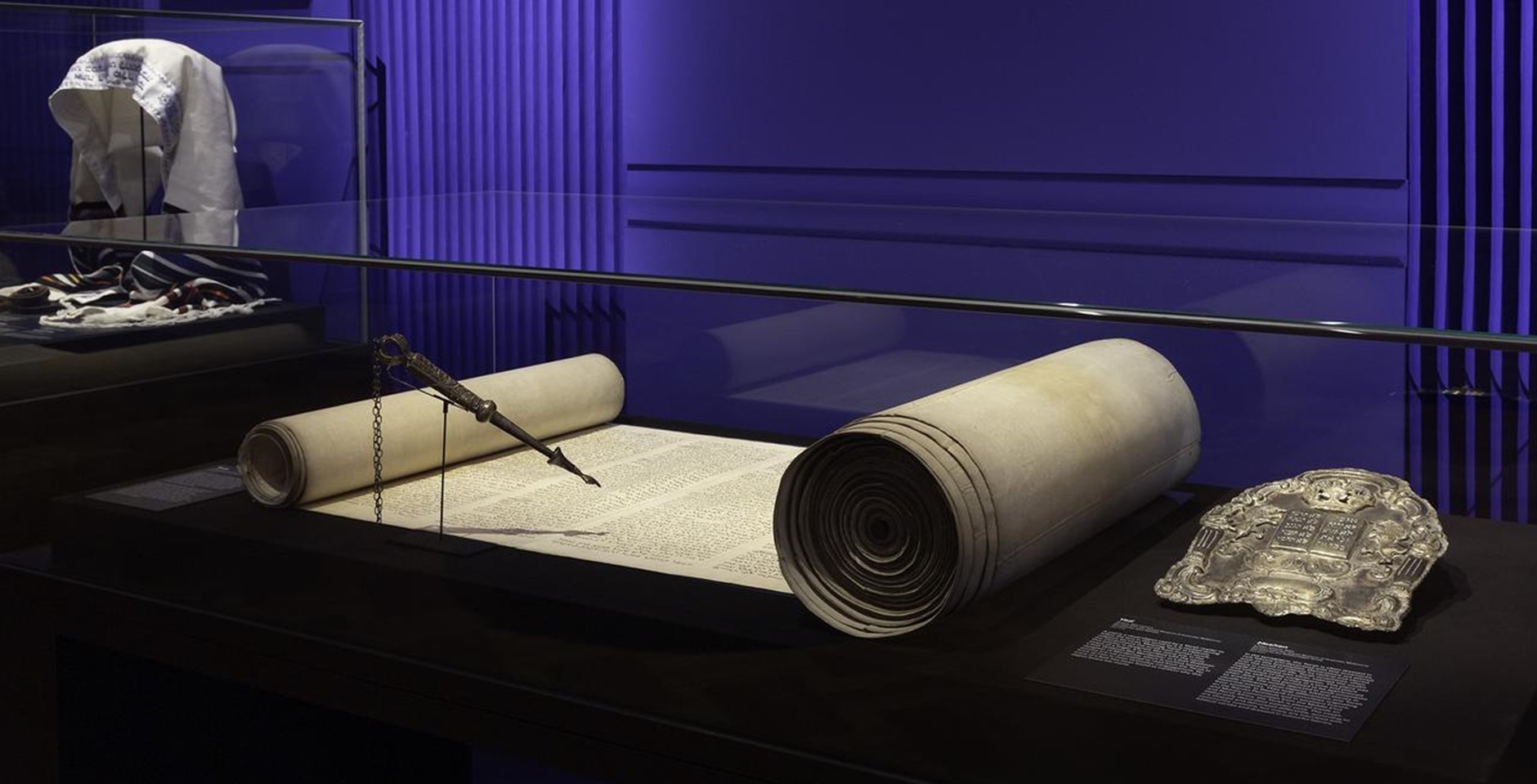
The biblical scriptures were represented by a handsome Torah scroll which spoke of the global spread of Jewish culture: it was copied in the C17th in Kaifeng China, where a C10th Jewish community migrated from the Middle East. There were no images, but several displays showed how the sac­red scriptures were used in everyday life.

Torah scroll, 
Kaifeng China, 17th century, 
British Library
 
The exhibition also showed that marginal ill­ustrations-micrography could be acceptable if they took the form of fig­ures composed of tiny words, of textual commentary. In an C18th collection of prayers books, less sacred than the Torah itself, some remark­able illuminations included a view of Moses bring­ing Tablets of the Law from Mt Sinai.

The exhibition offered insights into the complex cultural int­eractions and exchanges between the Jews and others among whom they liv­ed, often in the East. Thus there were stories and poems in Judaeo-Persian, Judaeo-Arabic and Judaeo-Urdu, all written in Hebrew.

A maths treatise was written in Judaeo-Arabic and annotated in the mar­gin in Arabic, showing the importance of linguistic and cult­ural exchange here. Hebrew itself had only been read by scholars since Hellen­istic times, but the translation of Avicenna’s Canon medic­inae into Heb­rew endowed the language with a new medical and scientific vocabulary.

 Astronomical tables, 
Southern France or Spain, C15th, 
British Library 

All of these Sephardic texts were from Oriental, North African and Ib­er­ian au­thors. But after the expulsions from Spain and Portugal in the 1490s, the texts were later relocated to England and Holland. The central and eastern European Jewish tradition was called Ash­kenazi. One Ashkenazi book was written in Hebrew letters but used Yiddish-German words.

There were works by the clever medieval Jewish philosopher, Maimonides. But Jew­ish intellectual life leant more to legalistic commentary than to philosophy, and over time commentaries accum­ulated. But unlike the Mus­l­ims, the Jews embraced printing when it was invented (C15th) and one dis­play showed the ingenious way that the main commentaries were laid out around the sacred text itself.

In this exhibition several Jew­ish books were on mystical kab­bala which fascinated Ch­ristian intellectuals. And there were import­ant texts that bore witness to the Hebrew texts being subject to censors’ exam­ination; they made sure the texts did not contain any anti-Christian ideas. Ce­n­sorship was usually carried out by Jews who’d con­verted to Christ­ianity, since reading Hebrew was diffic­ult for Christ­ians. See some Hebrew texts annot­ated with censors’ signatures.

Sloan Haggadah for Passover
Germany, 1740
State Library Victoria

image created from micrography
quirkbooks

Micrography was an art form unique to Judaism that developed during the Middle Ages, when illuminations were frowned up. Here reading, writing, and imagery come together in one, particularly in Spain and Portugal. Each letter might have been only 1 mm high.

Many thanks to Christopher Allen in The Australian and Vic­torian State Library.