28 June 2011

Flushed with success: Thomas Crapper

Who was the first successful toilet designer? Not the most important question in modern history, I realise, but interesting nonetheless. My immediate response would have been the plumber Thomas Crapper (1836 - 1910).

Flushed with pride: The Story of Thomas Crapper, by Wallace Reyburn

Sir John Harrington is credited with inventing the first flushing water closet, "the John", back in the 16th century. He installed one at his country house at Kelston near Bath, and described it in his A New Discourse of a Stale Subject 1596. Wealthy households might have had a close-stool, which had a padded seat with a metal or porcelain container beneath it, but a close-stool still had to be emptied. Harington’s device emptied itself - it had a pan with a seat and water was pumped up into a cistern above. When a handle on the seat was turned, the water swept the pan’s contents into a cesspool underneath. Although Queen Elizabeth I was impressed and ordered a flush toilet from Harrington, his invention did not catch on.

Things did not change quickly until the mid 19th century when the British Public Health Act of 1848 required that every new house had to have a w.c. The Antique Victorian Furniture Blog  noted that a Mr Jennings had already taken out a patent for the flush-out toilet in 1852, when Thomas Crapper was still a teenager in Yorkshire. And a British patent for the "Silent Valveless Water Waste Preventer", a siphon discharge system, was issued to Albert Giblin.

Was the Mr Jennings referred to above the George Jennings (1810-82) who installed his monkey closets in the retiring rooms of Crystal Palace, just in time for The 1851 Great Exhibition at Hyde Park? The Great Exhibition toilets were certainly very popular! People had never seen public facilities like this before, and during the exhibition some 800,000 visitors paid their penny and received clean, efficient services. George Jennings definitely continued to innovate – he also designed the first underground toilets at the Royal Exchange, in the City, in 1854.

So the plumber Thomas Crapper clearly did not invent the toilet. In any case, most people did not have flushing toilets in their homes, even well into the Victorian era.
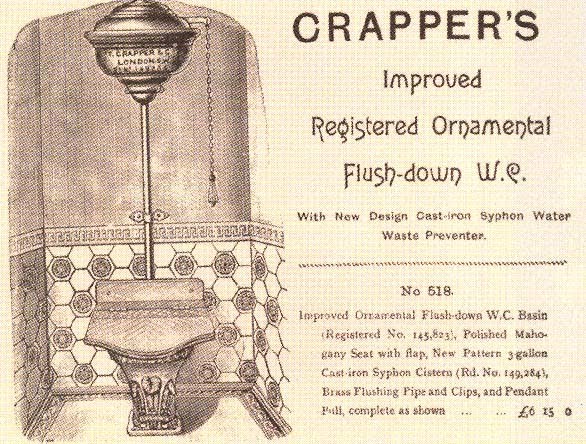
Thomas Crapper advertised in magazines, newspapers and on posters.

Yorkshireman Thomas Crapper was apprenticed to his brother, a master plumber, in 1853 and founded his own plumbing business only 8 years later. It was then, once he moved to London, that Crapper really DID develop some important inventions to made toilet technology run more smoothly. Crapper held nine patents, three of them for water closet improvements such as the floating ballcock, although none were for the flush toilet itself.

Crapper was both an innovator and a big advertiser!

In the 1880s, Prince Edward/later King Edward VII was given Sandringham House in Norfolk by his mother. Prince Edward pulled down the old home and built a new one, asking Thomas Crapper & Co. to supply the plumbing. It was a big project, since there were at least 30 toilets with beautiful cedarwood seats and surrounds; it gave Crapper his first royal warrant and was the turning point in his career. Thomas Crapper and Co. received further warrants from Edward as King and from George V, both as Prince of Wales and as King. Crapper's name quickly appeared on the toilet furniture itself and in advertising using every medium he could think of.

Thomas Crapper advertised on his products: Valveless Waste Preventer.

Apparently nephew George Crapper was also important to Thomas Crapper & Co. George was awarded the 1897 patent for improvements in automatic syphonic discharge systems. When Thomas Crapper later retired in 1904, he passed the firm on to this bright young nephew.

Why didn't the royals give Crapper a knighthood? After all, he had many dealings with royalty, all of them very satisfying. And Albert the Prince Consort had certainly presented George Jennings with the Medal of the Society of Arts at the height of Jenning's career. I suppose Crapper will have to rest in peace, knowing that his work helped to bring about a change in public attitude about buying sanitary wares.

One last thought. The word crap is said to have derived from Dutch (krappe meaning to separate), and first came into use in medieval English, centuries earlier. If that is true, it is a remarkable coincidence. It seems that crapping went into the English language, not invented by the Yorkshireman, but in honour of him. Nonetheless, if I was the nephew George Crapper or one of the next generation of Crappers, I would have changed my surname.

Read Lawrence Wright’s book Clean and Decent, published by Viking Adult in 1960 or Wallace Reyburn’s book Flushed with pride: The Story of Thomas Crapper, published by Trafalgar Square in 1998. Then if there is any other question you still have about toilet history, visit an original crapper in The Science Museum in London.

Lawrence Wright’s book

This post was written a year ago, but not scheduled for publication until later this year. Then this morning I found an advertisement for Thomas Crapper and Co's authentic period bathrooms. Having held four royal warrants and having existed through five reigns over 148 years, Thomas Crapper & Co. is once again in business, manufacturing  historically accurate Victorian and Edwardian sanitaryware.


25 June 2011

Coco Chanel - from neglected orphan to world famous designer

I had imagined that Gabrielle Chanel (1883-1971) was a neonate when she and her sib­lings lost their mother. Actually she was a young teenager when her impoverished father dumped them all in a Catholic orphanage, where she lived a rather horrible life until liberated six years later. The only advantage Chanel reported from orphanage life was learning to sew well.

Coco Chanel in her own outfit

Then I read Justine Picardie’s book Coco Chanel: The Legend and the Life which was published by Harper Collins in 2010. Justine Picardie’s is not the first biography of Coco Chanel and each author has faced the same problem: what was the truth about Coco Chanel anyway? Certainly some aspects of Chanel's life were confusing: she herself gave so many different accounts to friends and biographers.  She was so desperate to reinvent herself that she destroyed her own birth certificate and carefully hid her past.

On the other hand, it may not matter. She changed the world for style-conscious women. In 1910 Chanel opened a small business at 31 Rue Cambon, in Paris’ 1st arrondissement, and sold mainly hats. Within a couple of years, and still before WW1 broke out, Chanel expanded to Deauville, where she began selling casual resort outfits, jersey being an intelligent and flexible fabric for the cashed-up working women. Post-war Chanel established her fullblown couture house at the same 31 Rue Cambon, below her old flat and workshop.

Chanel’s lushly decorated flat could not have been more different from the prison-like orphanage in which she grew up. The flat is still famous today and everything is preserved just as it was left (photo below).

Chanel's shop, 31 Rue Cambon Paris

Chanel associated with endless numbers of important people, I am assuming for professional reasons in the first instance and later for more social reasons. But she could not have slept with every aristocrat, film star & musician, male and female, in Europe. From my perspective the most surprising relationship occurred when Chanel and Igor Stravinsky met, for a second time, in 1920. Stravinsky had emigrated to France following the Russian Revolution, with his wife and children, but that didn’t stop him moving the younger woman right into his marital home.

It is interesting to speculate on why Chanel never married. Not from lack of admirers. She seemed to have been attracted to people who could help her career or who were wheelers and dealers in their own lives: the Duke of Westminster, Pablo Picasso, Christian Dior, Elsa Shiaparelli, Yves Saint Laurent, Greta Garbo and Marlene Dietrich.

During the 1920s, Coco Chanel actively promoted further the freedom of women's fashion. She invented or popularised:
-the little black dress,
-arguably the most famous perfume on the planet,
-short hair,
-elegant slacks,
-the rather boxy Chanel suit and jacket, made from wool,
-strings of pearls and
-the most successful fashion brand of the era.

In short Chanel was a designer and dealer of elegance, an individual who helped change the way women wanted to look.

I am not at all clear on why a seamstress and fashion designer became involved with perfume, but she did. In 1922, the Chanel No 5 perfume was launched. Soon Coco needed someone with extensive experience in commerce, international business connections, and access to large amounts of capital to market the perfume professionally. In 1924, businessmen Pierre & Paul Wertheimer became Coco Chanel's partners in the House of Chanel perfume business.  During their partnership, Wertheimer owned 70% of the Chanel perfume company.

Chanel's friendships just before and during WW2 seemed rightwing and very nasty. After the Germans occupied France in 1940, Chanel lived with the Nazi officer Hans Gunther von Dincklage in the Ritz Hotel in Paris. And she became a very close friend of Nazi General Walter Schellenberg. Chanel wanted to benefit from the law banning Jews from owning businesses, in order to take over 100% of the Chanel perfume company. She apparently forgot that the Jewish Wertheimer brothers were the very people who had saved her in the 1920s... or she did remember it perfectly well. Perhaps her friends the Duke and Duchess of Windsor encouraged her anti-Semitism. 

Actually Hal Vaughan suggested that she became fiercely anti-Semitic, long before it became a question of pleasing the Germans. Chanel had become rich by catering to the very rich, and shared their dislike of Jews, trade unions, socialism, Freemasons and communism."

Like quite a number of French women, Chanel was later charged as a collaborator with the Germans, but it isn't clear why the case wasn't pursued in court.  It is telling however that post-war, her new collection did not have much success in Paris.  Presumably this was explicitly because of her war-time relationship with the Nazis. The British and American public didn't care; they continued to buy up her new range with fervour.

The world was a different place in the 1950s and 1960s, so my story would have stopped here. But I want to mention two more Chanel success stories. In 1953 she collaborated with French jeweller Robert Goossens to design a special line of jewellery to go with the Chanel suits. He successfully blended artificial jewels with semi-precious gems, and made the outfits look splendid.

And in 1957 Chanel visited Dallas and whilst there, won the Award for Distinguished Service in the Field of Fashion given by Stanley Marcus, owner of Texan retailer Neiman Marcus. Karl Lagerfeld thought the French press had treated Chanel's WW2 activities abominably and was delighted when her career kick started in the USA.

In Dec 2013 there are some reminders of Chanel's happy connection with Dallas - Karl Lagerfeld is showing the latest Chanel Metiers d'Art collection at Dallas' Art Deco exhibition venue Fair Park. It begins with the premiere of a film written and directed by Lagerfeld titled The Return, that retraces the steps of Coco Chanel as she reopened her Paris couture house in the 1950s.

There are many beautiful photos throughout the book, images which told a great deal about the life and times of Coco Chanel. It is difficult to imagine how one scared, lonely 12 year old girl, abandoned in an austere and very tough orphanage, turned into to leading designer of the fashion world and a companion of the rich and famous. But the book and the photos managed the task very well.

Lounge room, Chanel's own beautiful design

At 87 Coco Chanel was still working as normal, preparing for the spring collection. She died in harness in January 1971.

Read Sleeping With The Enemy: Coco Chanel's Secret War by Hal Vaughan (Knopf 2011).


21 June 2011

St George’s Memorial Church and School in Ypres, Belgium

Established by Royal Charter in 1917, the Imperial (now Commonwealth) War Graves Commission was established in tribute to the 1,700,000 men and women of the British Empire forces who died in the two world wars. It is a non-profit-making organisation founded by Sir Fabian Ware.

The Menin Gate site in Belgium was chosen as a memorial site by the Commission because of the hundreds of thousands of men, from all British Empire nations, who passed through it on their way to the WW1 battlefields. The Ypres Menin Gate Memorial now bears the names of more than 54,000 officers and men whose graves are not known. The memorial, designed by Sir Reginald Blomfield with sculpture by Sir William Reid-Dick, was unveiled in July 1927.

Soon after the Great War ended, British families also wanted an Anglican church in Ypres. Parents and widows had not received their sons and husbands’ bodies back for a proper burial, so it was important to have a safe, peaceful and Christian place for mourners to visit. It took some time, but in 1924 a fund was finally launched, with the intention of building a church possibly next to the old Menin Gate. The choice of architect (Sir Reginald Blomfield) was a good one since he was already involved with a number of the British and Commonwealth military cemeteries in the Ypres area.

St George’s Memorial Church, Ypres, opened in 1929

The foundation stone of St George's Memorial Church was laid in 1927 and building started on the simple brick church. The interior, which was to serve as a memorial to the young men who lay in the soil near Ypres, had enough room only for 200 people. Families, schools and military units donated pews, plaques, windows, the font and the altar. The Bishop of Fulham dedicated the completed church in 1929 and soon there were regular services and a Sunday school.

What I hadn’t realised, until I saw the BBC4 film The Children Who Fought Hitler, was that it was decided to open a school in Ypres as part of the same project. It was to be funded from donations by Old Etonians who needed to build a memorial to the 300+ old-Etonians who had lost their lives in the Ypres area from 1914 on.

The tiny school opened in April 1929. There were 62 pupils learning at the school at the beginning, most of whom were the children of British workers who had moved to Ypres with the Imperial War Graves Commission. The Commission's bus brought the children to school each day, from their homes in the villages all around Ypres.

Imperial War Graves Commission workers who lived in Ypres in the inter-war years.

Eventually more teachers and a headmaster arrived from Britain until, by 1933, 130 pupils were enrolled. The original principal was delighted to introduce a full curriculum, along the lines taught in schools in Britain. In 1934 the new principal changed the name from Eton Memorial School to the British Memorial School and also introduced a British school uniform.

It was appropriate that the Belgian King Leopold III visited, given that he had himself studied at Eton college during the Great War. But eventually, during WW2, the school had to close. In May 1940 all the British students returned home and the Germans took over the church buildings; they used them as their officers' club.

So from 1929 on, the school had served a special community of ex-servicemen and their families who cared for the WW1 graves in Ypres. Steeped in ideals of patriotic service and sacrifice, many pupils and ex-pupils refused to surrender to the invading Nazi forces and went on to make names for themselves in missions across Europe. As that is another, huge story in its own right, I recommend the book by James Fox and Sue Elliott called The Children Who Fought Hitler: A British Outpost in Europe, published by John Murray in 2009.

Children of the Ypres British colony celebrate Empire Day, 1933. The Telegraph

Post-WW2, the church's chaplain was paid for by the Imperial War Graves Commission. The British community of Ypres had so shrunk that there was a much smaller number of people to attend the church on a regular basis. Furthermore there were hardly any British children based in Ypres who would attend the school, even if it ever tried to open again.

In recent years there has been a renewed interest by British families tracing a relative who fought in the First World War. Many visitors to Ypres now visit St George's church, specifically to look at the special memorials and to locate the graves. And to add memorials to their relatives who died in the Second World War. Services are still held at the church by the chaplain. But these days, the most special annual services are held for Armistice Day (11/11).

St George’s Memorial Church, Ypres today. Memorial windows and plaques

18 June 2011

George Frideric Handel - Georgian gentleman

George F Handel (1685-1759) had been a court musician in Hanover and didn’t travel to London until 1710, when he was 25. Apart from a brief return to Hanover where he regained the position of court musician in 1712, London became his permanent home. Fortunately Handel had no trouble finding homes of British friends and patrons who would allow him to lodge with them.

Handel, 1727, by Balthasar Denner, National Portrait Gallery London

His timing was perfect. The newly established Italian opera company at the Queen's Theatre in Haymarket was searching for a composer, so Handel’s Italian opera career in London quickly got up and running. They had loved him in Hanover and, largely, they loved him in London.

What a flexible chap he was. During his early years in London, Handel started to attract people interested in English church music, people who would have heard his music at St Paul's Cathedral in those early years. And later oratorio, as well.

What was the difference between opera and oratorio? Like an opera, an oratorio included the use of a choir, soloists, an ensemble, various distinguishable characters and arias. But opera was musical theatre, complete with characters, costumes and scenery. Oratorio, on the other hand, was just a concert piece.

Handel's Georgian terrace house in Lower Brook St, Mayfair

In 1723 Handel finally moved into his own place: a newly-built Georgian terrace house in 25 Lower Brook St Mayfair, three storeys high as you can see from the image, plus garret rooms for the servants. Despite the fact that Handel never married and had no children, he also took the upper floors of the adjoining house at 23 Brook Street.

The two nicest rooms for were quiet composing, towards the rear, and performing /rehearsing with guests, towards the front. His home was close to the theatres in which he would be working, yet in a neighbourhood filled with people of substance.

During the 1730s he performed in the newly-built Covent Garden theatre, giving both operas and oratorios there. In the 1740s, Handel started to prefer English oratorios; for these, Covent Garden theatre remained his favourite venue.

Because he lived in Lower Brook St for most of his decades in London, the house naturally became the location where his wrote his most beloved pieces. Two of his best known oratorios, Messiah and Samson, came out of the Lower Brook St study in 1741, as well as Zadok the Priest and Music for the Royal Fireworks.

Even in his later years, Handel seemed to have attended the oratorio performances, and even occasionally performed in them. Although he didn’t have many social engagements during his later years, people could still visit him at home. He died in 1759.

I am not sure what happened to the house between 1759 and the Edward­ian era, but I do know that in 1905 the house was bought by an antiq­ues dealer for himself, his children and his grandchildren. The chan­g­es the Edwardian dealer made to the house were naturally incompatib­le with the Handel era.

When, in 2000, the Handel House Museum Trust took over the job of returning the house to how it would have looked in Handel's day, there were some problems. No original architectural interiors remained from the early 18th century, except for the staircase. And because none of Handel's original furniture has been found, a contemporary inventory had to be used as a guide for installing age-appropriate furniture back into the house.

It is wonderful that this very house has recently become Handel House Museum, opened to the public to celebrate Handel’s life and works. Since music was always played in this house during Handel’s residence in the mid 18th century, music is again played there now. The museum offers a programme of weekly concerts, music rehearsals and educational events throughout the year. And since it was after all a home and not a conservatorium, portraits of Handel and his contemporaries are now displayed in finely restored Georgian interiors.  Exhibitions in the House Museum bring this very English world of Handel's to life.

Front room, used for musical performances and rehearsals

Of the 76 years that Handel spent on this earth, 49 of them were in London, living as a proper English gentleman, albeit with a strange German accent. So Britain's love afair with Handel continues today. Founded by musical director Denys Darlow in 1978, the London Handel Festival has been part of a Handel revival, specialising in the performance of his lesser-known works. In 1981 the London Handel Orchestra and London Handel Singers made their debut at the Festival.

**

I wasn't going to mention this but in 1968 Jimi Hendrix moved into the top floor flat in 23 Brook Street with his English girlfriend. The flat is now the administrative office of Handel House Museum. To mark the 40th anniversary of Hendrix’s death in 1970, Handel House presented an exhibition called Hendrix in Britain. With images, music and objects, the exhibition followed his impressive career in London and his lasting impact on rock music universally. And the connection between Handel and Hendrix will continue to be marked... by an English Heritage Blue Plaque on the facade of Hendrix’s (and Handel's) residence.

Now the flat will be turned into a Hendrix Museum. Following the Dec 2013 news of Handel House Museum’s £1.2 million grant from the Heritage Lottery Fund, music fans can follow the Hendrix project in a blog called Hendrix at Home. The new museum should open in late 2015.


14 June 2011

Of Gods and Men - monks and Islamists

The film “Of Gods and Men” (2010) is a true story set in the Atlas Mountains of Algeria.

The Algerian Civil War was an ongoing and tragic conflict that continued throughout the 1990s, fought out between the Algerian government and various Islamic military groups. The conflict began in December 1991 when the Islamic Salvation Front (FIS) party was gaining popularity. The National Liberation Front (FLN) party, fearing a FIS victory, cancelled elections after the first round. As a result, the country's military took control of the government in a 1992 coup. The guerrillas had initially targeted the nation’s army and police, but by the time of this story, 1996, some groups had started shooting civilians as well. A truce of sorts was eventually declared in 1999, but by then some 200,000 citizens had been murdered.

I wish the director Xavier Beauvois had written something about the year and geographic location at the beginning of the film, to set the scene. Before seeing Of Gods and Men, I thought that the film was set in the 1950s and that it described the conflict between France and the Algerian independence movements. And since there were constant references to French colonial power in the power, it seemed to this viewer that Algeria was still trying to gain its independence from France. [Trappists live an ahistorical life, so it wasn't until I noticed a flat screen tv and attack helicopters in the film that I realised the 1950s War of Independence was not the setting]. Needless to say the setting looked totally authentic - the film was created in the very old, long-deserted Benedictine monastery of Tioumliline Morocco.

Eight Roman Catholic French Trappist monks lived quietly in their monastery in mountainous country, serving God and the people who lived in the impoverished villages beyond the monastery walls. Life was quiet, predictable and religious. They spent endless hours praying, reading spiritually uplifting stories, cooking, gardening, washing dishes, chopping wood and singing. The film opens with Psalm 82 being read: "I have said, Ye are gods; and all of you are children of the most High. But ye shall die like men, and fall like one of the princes."

The monks being faced by soldiers, inside their monastery

The monks were ordinary human beings, of course. They missed their families back in France and they were fearful of the future; they may even have been keen to taste fine food, wine and classical music again. But led by the abbot Brother Christian (Lambert Wilson), they were committed to poverty, simplicity and living the life of Christ. David Stratton called their approach to life almost mystical.

The monks were not out of contact with the real world. They looked after the sick from the local villages, gave out clothing to needy families, sold their food products in open markets and helped with agricultural tasks in the villages. In return the Muslim locals seemed to have a true love for these elderly gents in their funny Christian uniforms, especially the doctor Brother Luc (Michael Lonsdale) who was superb.

Peace continued in its normal way until the monks and villagers heard about the murder of Croatian labourers on a nearby construction site. Why were the Croatian men murdered? Who would be next? The Algerian government certainly made it clear to the Trappists that their own lives could not be protected and that they should rush back to France on the first ship. Yet even when rebel soldiers invaded the monastery itself, armed to the teeth, the monks were reluctant to leave.

The most telling part of the film came, quietly, towards the end. The monks sat at their normal refectory table, enjoying a last bottle of wine and a last session of Tchaikovsky music. Despite the inevitable catastrophe about to befall them, the viewer could see their outer joy and could start to understand their inner peace. If it were me, I would NOT have been smiling. But then I wouldn't have stayed in Algeria during the Civil War, had there been an opportunity to escape back to France.

Monks voting whether to stay or leave

Richard Brody believed that at the end, the monks didn’t just salute the worldly in the abstract sense; they affirmed that their faith was that of secular European ideals of individual liberty and self-expression. As the monks were marched off to their death, they presented their readiness for sacrifice with not a thought of vengeance. Perhaps their monastic meekness might even be seen as a symbolic purging of the sins of colonialism. I disagree. I thought at the very end, we learn that bad men with guns will destroy good people who are pacifists.

But what is the take-home message to historically minded viewers? Not whether the tension between the monks is well shown, nor the relationships between the monks and the outsiders - the film is indeed filled with faith, austerity and the responsibility of the men to God and to other humans. My interest would be how accurately the film  engages itself in this modern tragedy, the Algerian civil war.

Would it have made any difference if Beames On Film is correct. At the time, 1996, the killings were claimed by The Armed Islamic Group of Algeria. But Beames wrote French secret service documents now suggest it was the Algerian army who had really killed the monks, as a result of some ghastly error. Would film reviewers have been talking about the nightmare of religious fundamentalism if they had known the national army did the murders?


11 June 2011

Vienna Art and Design exhibition, in Melbourne

Vienna Art and Design: Klimt, Schiele, Hoffmann and Loos

In Vienna, it is often said that artists were used to a very traditionalist public life style based on Ringstrasse values: economic prosperity and artistic dependence on a classical past. These values had been core to ideal middle-class homes in mid-late C19th. But by the late 1890s, young Viennese artists resented the Ringstrasse mentality and felt that they could not create their own artistic visions.

In April 1897 Viennese architects Otto Wagner and his students Josef Hoffmann and Josef Olbrich joined with artist Gustav Klimt, designer Koloman Moser, Max Kurzweil and others in an arts and crafts renewal. Modelled on the Munich Secession of 1892 & the Berlin Secession of 1893, the Vienna Secession broke with the local Art Academy and declared their independence.

Gustav Klimt, Portrait of Emilie Flöge, 1902. 
Historical Museum of Vienna

Gustav Klimt, Egon Schiele and Oskar Kokoschka used their good connections with Vienna’s New Money, to establish a new world for the arts. And they interacted with other Viennese intellectuals like Alma Schindler, Gustav Mahler, Walter Gropius & Stefan Zwieg. Berta Zuckerkandl was the the group's main patron. Her home was entirely kitted out by Josef Hoffmann and in turn she got other architectural commissions for the young men. Her salon was The Centre!

To pursue their goal, Secessionist artists planned to create their own exhibition space. A site along the Ringstrasse was originally chosen, but it was only after a space became available on Friedrichstrasse, just off Ringstrasse, that the Council gave permission for a temporary pavilion. This building announced the arrival of The Secession publicly AND enabled modern artists to exhibit their work.

So why does turn-of-the-century Vienna draw us back repeatedly? Guest exhibition curator at the NGV in Melbourne, Christian Witt-Döring, made three main suggestions. Firstly by 1890, Vienna’s population was so large that it became the fourth largest city in Europe after London, Paris and Berlin. Secondly as capital of the Austro-Hungarian Empire, Vienna was the bustling cultural capital of a diverse, multinational and multi-lingual population of 51 million people. Finally, and not to be dismissed lightly, Vienna had a long-standing café culture second to none. At a time when the English were still supping on milk tea and sponge cake, the Australians and Germans were drinking beer, the French were drinking wine and the Americans were eating something awful, the Viennese had a passion for splendid coffee houses and patisseries.

Egon Schiele, Self Portrait with Hands on Chest, 1910. Kunsthaus Zug, in Zug Switzerland.

The 240 works in the Melbourne exhibition represent the best Viennese artists of the early 20th Century. They have been brought together from The Belvedere Museum in Vienna and the Wien Museum, predominantly, and also from other collections. I was not familiar with the Kunsthaus Zug in Switzerland. But I was pleased to read their home page which says the museum has amongst the most extensive collections of Vienna's modern art outside Austria. Zug includes works by some thirty artists including Josef Hoffmann, Gustav Klimt, Oskar Kokoschka and Egon Schiele.

The Melbourne exhibition focuses on the main art forms of the 1890-1928 era: paintings, architecture and all the decorative arts (furniture, jewellery and textiles). This exhibition’s own curators say the objects explore and display modernism, individualism, the rise of the Secession movement and the creation of a new style concentrating on the use of colour, design and opulent glamour. If you didn’t know from the exhibition’s name, Gustav Klimt, Egon Schiele, Josef Hoffmann and Adolf Loos were central to an artistic revolution that modernised Vienna, creating a dynamic and trend-setting metropolis.

Although I personally don’t know much about modern music, friends are looking forward to musical connections to the art exhibition. “Jewish Music in Vienna at the Turn of the C20th” will be held in the NGV’s galleries (Sun 26/6/2011), presented by the Chief Cantor of Vienna’s Jewish community. “Mahler to Schönberg and the Expressionists” (Wed 27/7/2011) promises to develop an enriched understanding of the cultural environment that Mahler, Schönberg and other Viennese musicians experienced.

Thankfully this winter blockbuster will run for a decent length of time: 18/6/2011 - 9/10/2011. The scholarly catalogue called Vienna: Art and Design: Klimt, Schiele, Hoffmann and Loos was published by the National Gallery of Victoria in 2011, to coincide with the exhibition.


07 June 2011

Mary Slessor - a religious feminist in Victorian Nigeria

I would not, I think, choose a woman missionary worker as a role model for young women today, if religion was her only contribution to feminism. But Scottish missionary Mary Slessor (1848-1915) was different.

Mary Slessor (centre) and some of her charges

Mary was born in Aberdeen and moved to Dundee in her pre-teens when her dad was looking for work. Times were tough in 1859 so young Mary had to work as a labourer at a jute mill. Luckily she worked only half of each day, and attended the mill school run by the company for the rest. Old Mrs Slessor was deeply religious and it was not surprising when young Mary followed her mother’s values.

Mary joined a local mission teaching the poor and decided to dedicate her life to Spreading The Word for the Presbyterian Church. She was trained up at the Foreign Mission Board in Edinburgh and was shipped out to Africa in 1876. I was particularly impressed that she learned to speak Efik, the language of the Calabar people, and in time mastered it. Most of us struggle learning French and German in school, relatively easy languages in comparison with Efik.

Calabar region of Nigeria

Mary Slessor went to live among the Efik people in Calabar, now in Nigeria (on the west coast of Africa). The colonial power, Britain, maintained control of the country. But Britain seemed to be more interested in the maintenance of trade for importers and exporters back home, rather than in the welfare of the Nigerians.

This White Queen of Calabar, as Mary became known, took huge risks. She successfully fought against the killing of twins at infancy, adopting them instead, banned the eating of human flesh and tried endlessly to improve the status of women. Most important from my point of view, Mary  established hospitals for small pox patients and later made vaccinations available to the children.

In 1891 the British government set up a system of vice-consular justice in Calabar. Mary Slessor had established such an influence over the locals that consul-general Sir Claude Macdonald made her a vice-consul, the first woman to be so appointed in the British Empire. Justice was certainly done, though her court could be a little bit personalised and eccentric.

Mary Slessor Church in Calabar

In 1898, Mary Slessor returned to Scotland, touring the Edinburgh churches and talking endlessly about the horrors she had seen. Although slavery had been banned by the British in the Nigerian Protectorate in 1848, well before Mary’s missionary work started, she still moved Scottish worshippers to tears with tales of slave markets and cannibalism fifty years later.

It is said that the land and people of Calabar were changed by her heroic efforts. I am certain that her legacy IS remembered in Scotland because I have read all the reviews of her life. But it is also said that she is fondly remembered in Nigeria as The White Queen of Calabar or Mother of All the Peoples. I haven’t read any African reviews of her work, but I do know that when she died in Nigeria in 1915, Mary given a state burial. She had spent 39 years there.

Ten pound note with Slessor's portrait

The Mary Slessor Journal of Medicine is an official publication of the University of Calabar Teaching Hospital in Nigeria. The University of Calabar Teaching Hospital is housed in the former Saint Margaret Hospital in Calabar, a health care facility established in 1897 as the first centre of secondary health care in Nigeria. Mary's grave still stands on a hill some 200 metres from this teaching hospital.

It actually took some time before Britain recognised her contribution. Mary was the first woman to appear on a Scottish Clydesdale Bank ten pound note, in 1998; her portrait appears on the obverse of the £10 note, replacing David Livingstone’s. On the reverse, Slessor is depicted holding children in her arms alongside a map of Nigeria.

Slessor with some of her adopted children

04 June 2011

Australia rode on the sheep's back

The National Film and Sound Archive of Australia created a historical film for students called Riding On the Sheep’s Back. From the very beginning of colonial settlement here, the selective breeding of Merino ewes resulted in sheep that adapted well to Australia’s arid interior. Merinos produced wool that was soft, plentiful and appealing to Britain's mills. So from the first boom of the Napoleonic Wars, which largely destroyed the Spanish Merino industry, the pastoral industry in Australia enjoyed a long period of prosperity. There were c2 million sheep in Australia by 1830.

In summary the wool industry gave Australia one of the highest living standards in the world for over 100 years. It was no exaggeration to say that the Australian economy rode high on wealth from primary exports, especially sheep.

Sheep grazing

A culture grew out of the practice of sheep shearing, most publicly exhibited in state-wide agricultural shows and shearing competitions. In the early decades, wool was shorn, carded and washed by hand. After 1888 machine shearing was introduced, reducing second cuts and shearing time. By the time World War One took all the abled bodied men off the land, most large sheep station sheds in Australia had installed machines, driven at first by steam and later by internal combustion engines.

It is not surprising that one of the all-time favourite Australian paintings was and is Shearing the Rams 1890, a large painting by the nation’s favourite Impressionist artist, Tom Roberts. Shearing the Rams has been reproduced in stamps, posters, history books and art folders ever since Federation, the day (1/1/1901) the separate states came together as a unified, modern nation.

Nothing says "Australian Rural Life" as much as Robert’s rams. And no agricultural show booth is as enticing as those selling local wool products. To give one example, Bennett & Gregor hold sales stalls at agricultural shows and fairs - spouse and I bought matching scarves for all the grandchildren.

Tom Roberts. Shearing the Rams 1890
122 x 183 cm
National Gallery of Victoria, Melbourne

By the 1950s Australia ‘rode on the sheep’s back’; those who raised the sheep and gathered the wool had come to symbolise and epitomise what it was to be Australian. In fact the struggle to survive in the rugged bush environment was said to have moulded the very character of the Australian battler. Of course the ruggedness also reflected the need to survive droughts, bush fires and infestations of small and large animal life, but that doesn’t diminish the back breaking work of shearing sheep in the heat.

Yet within a decade, coal, iron ore and other minerals had replaced wool as the basis of Australia’s economic future; wool farmers struggled to sell their product on world markets and the people of the bush now found themselves marginalised and out of touch with city-based Australian citizens. Young people of my children’s and grandchildren’s generation had never seen millions of sheep being grazed, dipped or sheared.

Turlee Station Stay is a working sheep, cattle and wheat station located next to Mungo National Park, in outback New South Wales. Situated within the Willandra Lakes World Heritage Area, the station is huge by any standards: 145,000 acres.

wool products at Bennett & Gregor stall, at agricultural shows

Accommodation ranges from basic tents and caravans to lovely cabins and cottages. But the parts of the station-life that children love most are a] the demonstrations of fantastic Australian sheep dogs rounding up the sheep and b] shearing the sheep in the long sheds. Adults are said to enjoy the fully licensed restaurant, aptly titled Woolshed Baa Bar :)

One kelpie dog controlled 20 sheep


02 June 2011

Urban photographic art of the 50s and 60s: Wolfgang Sievers and Mark Strizic

Leonard Joel Auctioneers here in Melbourne are having their Annual Photographic Auction on Sunday 19th June 2011 at 2pm. I don’t normally get involved in promoting or advertising private companies, but the stars of the auction are “my” photographic artists.

Other bloggers will understand that I feel quite territorial about Wolfgang Sievers (1913-2007) and Mark Strizic (b1928).  Sievers left Germany in 1938 and Strizic left Germany via Croatia in 1950 - and luckily for photography and for Australia, they both chose Melbourne as their home.

Mark Strizic, Under Matthew Flinders at St Pauls, 1954,
silver gelatin photograph, 22 x 15cm,
Leonard Joel auction.

Readers may remember The Paris End of Collins Street: Photography, Fashion and Glamour Exhibition at the National Gallery of Victoria (2006). This exhibition showcased the work of some of Melbourne’s best-known photographers from the period up to the 1960s, including Athol Shmith, Jack Cato, Julian Smith, May and Mina Moore, Ruth Hollick, Helmut Newton, Henry Talbot and Wolfgang Sievers. All of them had established studios in the glamorous, Paris End at the top of Collins St.

Helmut Newton is well represented at the Leonard Joel auction, while Athol Shmith and Julian Smith are involved in just one auction lot each.

Emma Matthews, writer, curator and art historian, has worked with Melbourne photographer Mark Strizic over the past ten years. On Wednesday 15th June 2011, she will present a discussion on Strizic's images which documented Melbourne's citizens and cityscapes in the 1950s and 1960s. Emma Matthews wrote Mark Strizic, Melbourne: Marvellous to Modern, published in 2009.