
Aberdeen Art Gallery, 72 x 92 cm
How did artists depict the South Downs during the inter-war era? Examine Paul Nash’s painting Wood on the Downs, 1929, Aberdeen Art Gallery. Paul Nash (1889-1946) was trained at the Slade School before serving in the First World War with the Artists' Rifles at Ypres on the Western Front. He was invalided home in 1917 and appointed as a war artist for the last two years of the war. This painting, from the inter-war years, had cool yet strong colours that were replicated just a few years later by Ravilius. The trees added a geometric boldness and exaggerated perspective that made the work somewhat mysterious.
In 1921 war artist-poet David Jones (1895-1974) joined Eric Gill's Roman Catholic Art Guild in Sussex. In 1925 Jones often visited Gill at Capel-y-ffin on the Welsh border where Gill and the other artists lived in the former monastery. Capel-y-ffin was a pen, watercolour and gouache painted in 1926-7, and given by the artist to Eric Gill. These were the years in which Jones was trying to come to terms with his terrible WW1 experience, a task in which he ultimately failed. Still, this work reminds the viewer very much of Paul Nash.

David Jones, Capel-y-ffin 1926-7,
National Museum of Wales
And think about Chalk Paths, done by Eric Ravilius (1903-42) a London artist, designer and illustrator. Ravilius' artist friend Peggy Angus (1904–93) lived in a house near Firle on the Sussex Downs, just outside Brighton - it was here that Ravilious painted Chalk Paths and John Piper painted as well. Ravilius' South Downs landscapes were almost always of the land having been well used: the paths had been regularly stamped down by people, the fences zigzaged their way across the canvas. The springy hills left almost no space in the painting for sky!
 Ravilius, Chalk Paths 1935,
Pallant House Gallery Bookshop
Ravilious was an official war artist in WW2 and received a commission as a Captain in the Royal Marines. Tragically he was killed in 1942 while accompanying a Royal Air Force air sea rescue mission off Iceland. Ravilius was still in his 30s.
As I examined rounded and rolling forms with firm grass lands, other landscapes started to emerge in the inter-war era, landscapes that had nothing to do with South Downs.
Harry Epworth Allen (1894-1958) was born in Sheffield in the UK and did his art studies at the Sheffield Technical School of Art. In 1915 Allen enlisted in the British Army and soon after was posted to France where he sketched troops and equipment in the battlefields. After WW1, he painted with a number of art societies, including the Sheffield Society of Artists. His name may not be very well known to most art historians but he exhibited at the Royal Academy over 23 years from 1933, and he had dozens of paintings accepted by those scholarly academicians. Fortunately Allen created many fine landscapes which survive till now, in public and private collections.


Reuven Rubin (1893-1974) was born in Romania into dire poverty. In 1912, still in his teens, he travelled to Palestine to study art at Bezalel Academy of Art and Design in Jerusalem. Since Paris was the centre of the art world, Rubin took himself to France in 1913 to pursue his studies at the École Nationale Supérieure des Beaux-Arts.
In 1921, this well travelled young man went to the USA and met the well known and well connected artist Alfred Stieglitz, who played an important role in organising Rubin’s first art exhibition in the USA. In 1923, Rubin finally emigrated to Palestine, permanently. There his paintings often depicted the biblical and modern landscape, dotted with agricultural workers on kibbutzim and Arab fishermen. Many of his paintings were sun-bathed, parched depictions of Jerusalem and the Galilee.


In mid-1927 Dorrit Black went to London and spent three months at the Grosvenor School of Modern Art, where she liked colour linocut printing as an original art form. Next year she studied at André Lhote's academy in Paris and at his summer school, and worked briefly with Albert Gleizes in 1929. Now a disciple of Cubism, she returned to Sydney late that year, held the first of her six one-woman shows in 1930. Dorrit exhibited with some of Australians finest inter-war painters, Roy de Maistre, Roland Wakelin and Grace Crowley. In the 1930s she ran the Modern Art Centre, Margaret Street and produced most of her linocuts in the 1930s. In 1934-35 she settled in Adelaide and painted landscapes of the Adelaide hills and the south coast.


How did it happen that the landscapes of these artists started to feel like the South Downs and like each other? Sheffield, Jerusalem and Adelaide were certainly not the most important art centres in the world. So there seem to be several possibilities.
Firstly they might have seen each other’s work, in galleries or in reproductions. Secondly they might have both been influenced by a third party from the past. If this is true, I would suggest Paul Cezanne as the most likely candidate. Thirdly the artists were expressing a shared passion for clean living and fitness. Peyton Skipworth (Apollo Magazine May 2006) suggested that Modernism was strongly associated with the interwar cult of getting city dwellers out into the countryside, sunshine, fresh air, hiking, fitness and riding bikes. Finally there is the possibility that the artists had nothing whatsoever in common; 80 years later, I am selecting out commonalities that didn’t really exist back then.
Art Inconnu has the finest collection of Harry Epworth Allen paintings. Art from Israel has an interesting selection of Reuven Rubin paintings. Landscape Painting References has a couple of Dorrit Black paintings. For Eric Ravilious paintings, go to That's How The Light Gets In or read Ravilious in Pictures: Sussex and the Downs by James Russell (The Mainstone Press, 2009).
A Crisis of Brilliance by David Boyd Haycock traces the lives of five British artists of this era – Stanley Spencer, Dora Carrington, Paul Nash, Mark Gertler and Richard Nevinson.
This topic continues to surprise. Let me add Rita Angus (1908–70), a New Zealand painter born in Hastings but lived mostly in Christchurch. Her landscapes of Canterbury and Otago were somewhat cubist, clear, flat, simple and sharply-defined. It is said that Angus carefully considered every colour, line and shape, linking each detail in a design of graceful curves and interlocking forms
Angus didn't travel to England until 1958 but she could have easily seen paintings by John or Paul Nash, for example, during the 1930s and 40s.


Pallant House Gallery Bookshop
Ravilious was an official war artist in WW2 and received a commission as a Captain in the Royal Marines. Tragically he was killed in 1942 while accompanying a Royal Air Force air sea rescue mission off Iceland. Ravilius was still in his 30s.
As I examined rounded and rolling forms with firm grass lands, other landscapes started to emerge in the inter-war era, landscapes that had nothing to do with South Downs.
Harry Epworth Allen (1894-1958) was born in Sheffield in the UK and did his art studies at the Sheffield Technical School of Art. In 1915 Allen enlisted in the British Army and soon after was posted to France where he sketched troops and equipment in the battlefields. After WW1, he painted with a number of art societies, including the Sheffield Society of Artists. His name may not be very well known to most art historians but he exhibited at the Royal Academy over 23 years from 1933, and he had dozens of paintings accepted by those scholarly academicians. Fortunately Allen created many fine landscapes which survive till now, in public and private collections.

Allen, Crowlink Sussex,
37 x 55 cm, date?
37 x 55 cm, date?

Allen, Haddon Hall Derbyshire,
date?
In 1921, this well travelled young man went to the USA and met the well known and well connected artist Alfred Stieglitz, who played an important role in organising Rubin’s first art exhibition in the USA. In 1923, Rubin finally emigrated to Palestine, permanently. There his paintings often depicted the biblical and modern landscape, dotted with agricultural workers on kibbutzim and Arab fishermen. Many of his paintings were sun-bathed, parched depictions of Jerusalem and the Galilee.
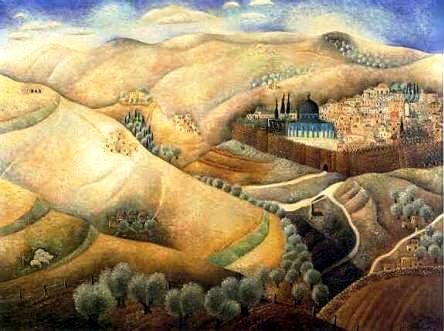
Rubin, Jerusalem, 1925

Rubin, Safed in Galillee, 1927
Another painter of the interwar era was Dorrit Black. Dorothea Foster Black (1891-1951) was born and raised in Adelaide, daughter of an engineer/architect and an artist. From 1909 she studied at the South Australian School of Arts and Crafts and painted landscapes in watercolours. After spending two years (1911-12) in Britain and the Continent, Dorrit returned to Australia and continued studying at Julian Ashton's Sydney Art School. By the middle of the war, she adopted oils as her main medium.

Black, Coast Road 1942,
Art Gallery of South Australia
Art Gallery of South Australia

Black, In the Foothills 1942,
Queensland Art Gallery
In all these landscapes, the boldly presented hills & roads emphasised their treatment as mass & form. And like cubist painting decades earlier, the mountains became inter-connecting planes of varying depth. In fact the simple, strong and bold lines were quite cubist in feeling. Bright sunlight and cast shadows in all the landscapes helped define the natural forms. And importantly, for all the artists, the springy hills left almost no space in the painting for sky.
Firstly they might have seen each other’s work, in galleries or in reproductions. Secondly they might have both been influenced by a third party from the past. If this is true, I would suggest Paul Cezanne as the most likely candidate. Thirdly the artists were expressing a shared passion for clean living and fitness. Peyton Skipworth (Apollo Magazine May 2006) suggested that Modernism was strongly associated with the interwar cult of getting city dwellers out into the countryside, sunshine, fresh air, hiking, fitness and riding bikes. Finally there is the possibility that the artists had nothing whatsoever in common; 80 years later, I am selecting out commonalities that didn’t really exist back then.
Art Inconnu has the finest collection of Harry Epworth Allen paintings. Art from Israel has an interesting selection of Reuven Rubin paintings. Landscape Painting References has a couple of Dorrit Black paintings. For Eric Ravilious paintings, go to That's How The Light Gets In or read Ravilious in Pictures: Sussex and the Downs by James Russell (The Mainstone Press, 2009).
A Crisis of Brilliance by David Boyd Haycock traces the lives of five British artists of this era – Stanley Spencer, Dora Carrington, Paul Nash, Mark Gertler and Richard Nevinson.
This topic continues to surprise. Let me add Rita Angus (1908–70), a New Zealand painter born in Hastings but lived mostly in Christchurch. Her landscapes of Canterbury and Otago were somewhat cubist, clear, flat, simple and sharply-defined. It is said that Angus carefully considered every colour, line and shape, linking each detail in a design of graceful curves and interlocking forms
Angus didn't travel to England until 1958 but she could have easily seen paintings by John or Paul Nash, for example, during the 1930s and 40s.

Angus, Central Otago, 1940,
Auckland Art Gallery.



%20%C2%A9%20La%20Fabrique%20de%20patrimoines%20en%20Normandie,%20Antoine%20Cazin%20(wecompress.com).jpg)



.jpg)








.JPG)
.jpeg)


27 comments:
Hello Helen:
But how fascinating it is to speculate about possible connections between these very different artists and yet whose work bears remarkable similarities. And, yes, it is true that it is possible to see a very strong Cezanne influence in all of the paintings which you show here.
This is a period in art history which we particularly enjoy, increased we are sure by living, at least for part of our time, so very close to the South Downs.
A fascinating post for its quality! I live in the South Downs and can relate to all these beautiful paintings which each translate in their own style the soft beauty of the region. Thank you!
Lovely paintings. There are so many modern and Victorian painters (I love Kate Gilbert) that the Downs inspired. There was a good programme on the BBC talking to modern writers and composers. There is a lot of mileage in looking at how landscapes (like the Lake District) influences artists.
Jane and Lance
The inter-war period has been largely unknowable to me in the past, but I can absolutely understand why you would enjoy it so much. Clearly modern, yet not so abstract that you stare in bewilderment at a black painted canvas called Study In Confusion #83.
I had trouble finding a common source of inspiration. The shapes of the hills and the colours reminded me of Cezanne to be sure. But it wasn't until I read that Reuven Rubin idolised Cezanne and wanted to "copy" his late career landscapes that I felt comfortable about a possible Cezanne linkage.
DeeBee
It is interesting that you used the words "soft beauty" to describe the Downs. I had been thinking about "rounded", "rolling"
and "springy hills, but you are right. Grandeur and beauty can of course be soft.
Hermes
*nod* a lot of trees have been cut down for PhDs that analyse how landscapes influence artists. The trick for the modern viewer is to cast that analysis very widely.
Dorrit Black is a perfect example. She grew up in the Adelaide hills and loved the area. So it makes sense that she would employ strong and bold Cubist-like lines to show the influence of the Adelaide landscapes on her life as an artist.
Have a look at the Gallery of Grant Wood's Works. There are at least five American landscapes from the 1930s that could have come from your post. I liked at Landscape, Stone City Iowa, New Road and Young Corn.
I have been visiting the South Downs regularly since my teen years. My first ever holiday outside of Ireland was a family trip to Worthing in 1975, and I have been returning with regularity ever since. I've explored the areas links with the Bloomsbury group, but your post has just opened a new world of connections for me. Thanks a million.
Bill
you are a genius!
Grant Wood is an artist I did not know but Stone City, Iowa could be Jerusalem, Safed or Crowlink Sussex. I love his colours and shapes in Near Sundown which remind me of Haddon Hall Derbyshire.
I feel another post coming on :)
http://xroads.virginia.edu/~ma98/haven/wood/gallery4.html
Mr Doolan
This post has taken 12 months to write, on and off. I started with Rubin, Black and Allen, none of whom had painted the South Downs as far as I knew. But until Ravilius and Nash popped into my middle aged brain, I couldn't get the artists to cohere in any sensible way.
Now I will have to RE-visit, but with new eyes.
Ditto about Grant Wood and nothing to do with this but I had never seen this gorgeous stained window before:
http://twilightstarsong.blogspot.com/2011/01/arty-farty-friday-grant-wood-american.html
Anything that upset the Daughters of the American Revolution (or as he called them "those Tory gals") is good for me.
Hermes
thanks for that great reference. Grant Wood, poor soul, must have had a lonely life in the art world of Iowa in the inter war period.
Yet his landscapes and portraits, at least from the two references we have seen, were to be admired and not pitied. I think both Allen and Nash would have been delighted with Wood's rural and urban landscapes.
I'm not sure what the strange attractor of the South Downs are for artists and writers but there is a continuing one not limited to inter-war artists. Only last week I saw an exhibition of paintings at Gallery Smith in North Melbourne of paintings of the South Downs by Ian Friend.
Mark
not necessarily a strange attraction, but certainly powerful and ongoing. You see the influence of the South Downs as far back as Jane Austen and as recently as the Bloomsburies (as Mr Doolan noted).
I don't know Ian Friend's art, but I can certainly seek him out. Thank you.
I have had a good look at Dorrit Black's work called The Olive Plantation, 1946 and urge you to compare it to Grant Wood's earlier work, Fall Plowing 1931. I reckon they worked on their paintings together.
Ok ok they were in different continents and in different decades! But have a look anyhow:
Wood http://xroads.virginia.edu/~ma98/haven/wood/fallplowing.html
and Black http://www.artaustralia.com/article.asp?issue_id=175&article_id=71
Jim
I'm on a roll now - I am finding inter-war landscapes everywhere. My husband is worried we won't be eating dinner together any more ha ha.
Wonderful blog, and thanks for putting me onto these interwar painters. Jeronimus (from the Landscape Painting References blog).
jeronimus
Thank you. Analysing a single artist is relatively easy, isn't it? But making links takes more effort. I really love blogging :)
What fascinating paintings, the Modernist qualities really shine through, very enjoyable!
Thomas
I mist agree with you. Even though my preference had, in the past, been for Victorian and Edwardian paintings.
I love the detail in Allen's Haddon Hall Derbyshire. Those trees are beautiful. I liked the paintings of South Downs and the chalk paths too. I've noticed chalk paths in this area before (I live in Kent) and never really took notice of them.
I recognised Rubin's work from a previous post of yours! It feels like yesterday that you posted it but it was already a year ago!!
Emm
I am so glad you remembered Rubin's landscapes from the last times (27/11/08 and 19/9/10). I think, analyse and write endlessly, but it is good to know people actually take notice of the art :)
Harry Epworth Allen was a real surprise. His work seems to have had less study than he deserved; certainly less than his more famous contemporaries. I too am finding huge pleasure looking at Allen's paintings.
I have added a 1940 landscape painting by New Zealand artist Rita Angus. I would not have known her work except that the Auckland Art Gallery mounted an exhibition called Rita Angus: Life and Vision, 2009.
You mentioned Peggy Angus' house Furlongs at Firle, a place Ravilious liked to visit. Have you seen his 1939 watercolour, Tea at Furlongs? This South Downs painting has been donated to the Fry Art Gallery in Saffron Walden in Essex.
See Book Snob https://bookssnob.wordpress.com/2012/05/09/eric-ravilious-sussex-and-the-downs-by-james-russell/
Joe
Good reference, thanks. And the painting is typically Ravilian, isn't it? I would recognise his style at 100 ms.
What a tragic shame to be killed in 1942 when he was working as an official war artist.
Could you please add some examples of David Jones' inter-war work. The David Jones exhibition will continue at Pallant House Gallery, Chichester until 21st February 2016.
Done! many thanks.
Post a Comment