27 September 2011

Maharaja splendour in Canada

In conjunction with the Victoria and Albert Museum in London, the Art Gallery of Ontario hosted an extraordinary exhibition in 2010-2011. The exhibition explored in depth the opulent world of the maharajas, from early 18th century until Indian independence in 1947. Maharaja: The Splendour of India’s Royal Courts allowed Canadians to see for the first time 200+ spectacular works of art created for India’s great kings — including paintings, furniture, decorative arts and jewellery. These magnificent objects chronicled the many aspects of royal life and celebrated a legacy of cultural patronage by generations of maharajas, both in India and in Europe.

Golden thrones

The jewellery was stunning. Just one example will do... very nicely indeed. The Maharaja of Patiala bought the most fabulous De Beers Diamond from Cartier of Paris who set it as the centre piece of a ceremonial necklace in 1928. The five rows of diamonds encrusted in a platinum chain became known as the Patiala Necklace, holding the seventh largest cut diamond in the world and the largest single commission in Cartier’s history. In recent years, Cartier re-found the necklace, bought it and spent four years restoring it.

2,930 brilliant diamonds in the Patiala Necklace.

Should the viewer be proud of the maharajas’ amazing patronage of all the arts? Or cringe at the outrageous distribution of scarce resources in India back then? I personally think I would be angry.

But the Ontario museum was very clear. It was the first exhibition to celebrate the opulent world of the maharajas and their unique culture of artistic patronage. The curators and interpreters did a wonderful job of presenting the treasures in a historical context, learning how the rulers lived, what they valued, the political role they played and how, ultimately, the forces of history circumscribed their powers.  I suppose their influence partially depended on how many Princely States there were in India proper. Wiki estimates that the number ranged from 160 in 1872 to 202 in 1941.

One element of colonial history need not have worried the Canadians. When the V&A showed the same exhibition in London, they made a serious attempt to put the myth of the maharajas in its proper courtly context, to explore the visual and artistic expressions of Indian kingship before and after the maharajas' Victorian heyday. As a result, the V & A show was haunted by the sad story of the princes and the British, telling how the British first bullied the princes into submission, schooling them in western tastes, then both  mocked and envied the monsters they had created. Finally, the British quit India, leaving the maharajas to be abolished. The Ontario exhibition was presumably not haunted by colonial guilt.

1934 Rolls Royce Phantom II, custom-built

Processions in India during the 1800s were complex events that celebrated various kinds of power and prestige. They revealed tensions in political authority, social hierarchy and religious tradition. And the British representatives had to assert their colonial role without appearing to endorse or participate in the worship of Hindu deities who formed the focus of much of the event. So company-paintings were produced by Indian artists, presumably for British buyers, many of whom would have been employed by the East India Company.

Mysore Scroll, mid 1800s, now 6 ms long

Paintings of Indian architecture, occupations, castes, rituals and festivals in India were fascinating eg The Mysore Scroll with its 1,250 individuals portraits in mid-1800s dress. The British often used company-paintings as illustrations for publications, or sent them home as souvenirs. This type of painting declined in popularity around the 1840s with the introduction of photography.

A less arty but perhaps more spectacular exhibit was Star of India, an amazing 1934 Rolls Royce Phantom II custom-built for His Highness Thakore Sahib of Rajkot. Built with a polished aluminum hood and wing panels, the Star of India was expected to fetch a mind-boggling £8 million when it went on the open market in 2009! Even a German museum page that is normally blase about the top end of the Rolls Royce range became a drooling mess when examining the Star of India. It was not just a car; rather it was a symbol of a bygone era, when the maharajahs reigned in India and displayed their unfathomable wealth in the shape of fanciful and ever more lavishly designed cars. Unfathomable seems to be an appropriate word.

For those who couldn’t get to the exhibition, I have three recommendations. See the stunning images in Maharaja: The Splendour of India’s Royal Courts at The Victoria & Albert Museum, in Alain Truong's blog.

Anna Jackson and Amin Jaffer, Maharaja: The Splendour of India's Royal Courts, 2009

Or read Maharaja: The Splendour of India's Royal Courts (2009) by Anna Jackson and Amin Jaffer. Their goal was to examine the real and perceived worlds of the maharaja from the early 18th century to 1947, when the Indian Princes finally ceded their territories into the modern states of India and Pakistan. Or read Maharaja: The Spectacular Heritage of Princely India (1988, 2009) by Andrew Robinson and Sumio Uchiyama. Both books show that the Maharajas spent their lives in extravagant expenditure and unparalleled splendour. The authors created quite a picture, full of throne rooms, gilded ceilings, crystal fountains, gardens with strutting peacocks, treasures made of precious metals, bejewelled elephants, weddings, celebrations and festivals.

See a splendid film on the Maharaja Collection,  recorded  while the treasures were still in the Victoria and Albert Museum in London.


24 September 2011

Anti-Fascist Art Exhibition, Melbourne 1942

When he opened the new Victorian Artists’ Society exhibition in 1937, Robert Menzies (Australian prime minister from 1939-41 and 1949-66) said: “Great art speaks a language which every intelligent person can understand, the people who call themselves modernists today talk a different language”. The metaphor that Menzies chose to protest about the incomprehensible visual coincided with the complaint by Anglophone Australians thatthe “Refujews jabbered away to each other in their own tongues, plotting sabotage for all one could tell”.

In response to Menzies and his conservative supporters, modernist artists formed the Contemporary Art Society in Melbourne in July 1938.

Bergner, Pumpkins, 1942,  
National Gallery of Australia, Canberra

In 1939, a Melbourne newspaper sponsored a show of the very best of modern European art. Called The Herald Exhibition of Modern French and English Painting, the works were exhibited in Melbourne, Adelaide and Sydney. It gave Australian audiences the opportunity to view original and modern works by Cezanne, Picasso, Seurat, Van Gogh, Vuillard, Gaugin, Matisse, Dali, Ernst, Leger and others. Modern yes, but it was politically neutral and not really radical in artistic terms.

However just one year later, in 1940, an exhibition of the Contemporary Art Society evoked a virulent attack upon foreign artists via a letter from Sir Lionel Lindsay to the Sydney Morning Herald. And it was reiterated in Lionel Lindsay’s book Addled Art. The art Establishment could be very vicious indeed to Jews, foreigners and refuges, even in the middle of a hideous world war.

I read about the 1942 Anti-Fascist Exhibition, held in Melbourne’s Athenaeum Gallery, in two separate sources. The first was Melbourne Art & Culture Critic. This source provoked a question - why did this exhibition move on to Adelaide and not, for example, Sydney or Brisbane? Perhaps because the Angry Penguins (a group of modern literary scholars) were founded in Adelaide in 1940. Or perhaps it was because Lionel Lindsay had become a Trustee of the Art Gallery of New South Wales and was soon knighted for his services to Australian art. He may have been influential enough to ruin the Anti-Fascist Exhibition, had it attempted to open in Sydney.

The second source was Painting the Town: A Film About Yosl Bergner 1987. Bergner, a Polish Jew, arrived in Australia in 1937. Bergner had grown up in Warsaw where he took painting lessons and was inspired by European modernism. In Melbourne, he sought out and befriended painters like Albert Tucker, Jim Wigley, Joy Hester, Arthur Boyd, Sidney Nolan, John Perceval and Danila Vassilieff. He continued his studies at the National Art School in Melbourne and joined the new Contemporary Art Society.

Counihan, 
The New Order, 1942

Presumably, by 1942, influential figures in the social realism movement were horrified by the hardship caused by the Depression and the war. Bergner and his fellow artists were determined to paint the life of cities and the ordinary people around them, which brought them into opposition with both the art and political establishments of the day. They were painters with a message who wanted to deal with the injustices of the world in their work. But more than that. By 1942 news of the extermination of Jews, gypsies and communists in Europe was becoming available in the West.

In his paintings, Bergner used his memories of Warsaw and observations and experiences of Australia. His depiction of refugees, ghettos and the destruction of Europe were exceptional, but most extraordinary were those of urban Aboriginal people. When the Contemporary Art Society of Australia mounted the anti-fascist exhibition in Melbourne and Adelaide, Bergner drew parallels between the dispossession of urban Aboriginal people and that of the Jews in Eastern Europe.

Finding details about the Anti Fascist Exhibition has been difficult. I have included paragraphs from each artist’s biography, if he/she participated in the exhibition, but I would love to have seen a contemporary, published catalogue.

Sidney Nolan, 
Going to School, 1942

The first 3 publicly exhibited paintings by John Perceval were shown at Melbourne's Contemporary Art Society in 1942. John Reed loved the 19-year-old's audacious work and published them in the Angry Penguins magazine .  Perceval's work was included in the Anti-Fascist Exhibition in Melbourne later that year, helping to establish the young man's reputation in the national art scene!

The exhibition had pieces from other artists who saw their work as having an important social and political role in documenting the suffering of the oppressed. James Wigley (1918–99) participated in the exhibition after he became friends with Noel Counihan and other social realist painters and writers. Noel Counihan and James Wigley clearly shared Bergner’s social conscience.

A founder of the Contemporary Art Society in 1938, Noel Counihan (1913–86) initiated its 1942 anti-Fascist exhibition. The New Order, one of the few paintings that he preserved from the show and perhaps the best of them, was influenced by one of William Gropper's paintings also entitled The New Order (1942). Later Counihan helped organise an Artists' Unity Congress, receiving awards for his paintings of miners in the Australia at War exhibition in 1945.

Other young contemporaries in Melbourne had already asserted the intellectual and imaginative freedom of the artist and his/her independence from political doctrines. But we can say that matters came to a head with the Anti-Fascist Exhibition produced by the Contemporary Art Society.

Reason in Revolt noted that Albert Tucker had been called up in April 1942. It was a critical time for him since he held deeply anti-war sentiments. It was the Communist Party's shift to an all-out support of the war effort after the invasion of Russia that placed him at greater odds with the party. Yet four months after the invasion, he still cited himself as a member of a neo-realist group that included Bergner and Counihan. Although he was doubtful about the wisdom of the Anti-Fascist Exhibition when it was first mooted, he did contribute 6 paintings and several drawings to the show. He was in fact, with Counihan and O'Connor, one of the three major contributors to the exhibition.

The Herald Sun said Sidney Nolan's reputation rests on a handful of masterpieces, including the famous Going to School 1942, shown at the anti-Fascist exhibition.

Once embarked on her art course, Ailsa O'Connor became involved in all the highly charged meetings of the period. She identified with the radical forces supporting modern art against Menzies' push for a traditionalist Art Academy and joined the Contemporary Art Society at its first meeting in 1938. She became increasingly politicised and was the only woman to exhibit in the 1942 Melbourne Anti-Fascist Exhibition, where she showed crayon drawings.

Tucker, 
Death of an Aviator, 1942

June Tuck and Dorrit Black certainly participated in the same exhibition the next year when it moved to the RSASA Gallery in Adelaide. And one of Jacqueline Hick’s paintings from this period, Landscape, 1943, was exhibited at this exhibition in Adelaide, and subsequently purchased by the National Gallery of SA.

I wonder if the Australian artists had seen a 1942 poster painted by Ben Shahn and printed by the USA Government Office of War Information. Shahn was referring to Lidice, a Czech mining village that was obliterated by the Nazis in retaliation for the June 1942 shooting of a Nazi official by two Czechs. All men of the village were killed in a 10-hour massacre; the women and children were sent to death camps. The destruction of Lidice became an anti-fascist symbol everywhere.

Shahn, 
This is Nazi brutality, 1942, poster

After all this time, I cannot be sure if the Australian Anti-Fascist Exhibition was directed to the fascists plundering their way across Europe, Africa and Asia OR to the right wing artists, thinkers and publishers in Australia. Clearly the Contemporary Art Society had been created by young radical artists to loosen the grip of the conservatives who dominated the Australian art establishment of the time. To me, these artists were stating that art had a role in expressing political and social criticism; this was a time when the conservatives HERE bitterly opposed the exhibiting of art inspired by social concerns. Yet Reason in Revolt thought differently. They said that most of the paintings exhibited in the Anti-Fascist exhibition of 1942 had been urgent responses to events in Europe, grounded in feelings of political outrage.


20 September 2011

Inter-war landscapes: global comparisons

"The South Downs stand like a line of gigantic beached whales guarding the southern foreshore of England. Rounded and rolling, they merge into each other to create a series of graceful forms. Modest in height yet possessing an undeniable grandeur, the Downs can be bleak. But even when the prevailing wind blows sudden storms across the summits, they are never forbidding. The Downs were never a frontier, but a pastoral range and crossing place, their easy gradients, dry tracks and firm grasslands making them a natural highway for Man and his herds".

Paul Nash, Wood on the Downs, 1929, 
Aberdeen Art Gallery, 72 x 92 cm

How did artists depict the South Downs during the inter-war era? Examine Paul Nash’s painting Wood on the Downs, 1929, Aberdeen Art Gallery. Paul Nash (1889-1946) was trained at the Slade School before serving in the First World War with the Artists' Rifles at Ypres on the Western Front. He was invalided home in 1917 and appointed as a war artist for the last two years of the war. This painting, from the inter-war years, had cool yet strong colours that were replicated just a few years later by Ravilius. The trees added a geometric boldness and exaggerated perspective that made the work somewhat mysterious.

In 1921 war artist-poet David Jones (1895-1974) joined Eric Gill's Roman Catholic Art Guild in Sussex. In 1925 Jones often visited Gill at Capel-y-ffin on the Welsh border where Gill and the other artists lived in the former monastery. Capel-y-ffin was a pen, watercolour and gouache painted in 1926-7, and given by the artist to Eric Gill. These were the years in which Jones was trying to come to terms with his terrible WW1 experience, a task in which he ultimately failed. Still, this work reminds the viewer very much of Paul Nash.

David Jones, Capel-y-ffin 1926-7,
National Museum of Wales

And think about Chalk Paths, done by Eric Ravilius (1903-42) a London artist, designer and illustrator.  Ravilius' artist friend Peggy Angus (1904–93) lived in a house near Firle on the Sussex Downs, just outside Brighton - it was here that Ravilious painted Chalk Paths and John Piper painted as well. Ravilius' South Downs landscapes were almost always of the land having been well used: the paths had been regularly stamped down by people, the fences zigzaged their way across the canvas. The springy hills left almost no space in the painting for sky!

Ravilius, Chalk Paths 1935, 
Pallant House Gallery Bookshop

Ravilious was an official war artist in WW2 and received a commission as a Captain in the Royal Marines. Tragically he was killed in 1942 while accompanying a Royal Air Force air sea rescue mission off Iceland. Ravilius was still in his 30s.

As I examined rounded and rolling forms with firm grass lands, other landscapes started to emerge in the inter-war era, landscapes that had nothing to do with South Downs.

Harry Epworth Allen (1894-1958) was born in Sheffield in the UK and did his art studies at the Sheffield Technical School of Art. In 1915 Allen enlisted in the British Army and soon after was posted to France where he sketched troops and equipment in the battlefields. After WW1, he painted with a number of art societies, including the Sheffield Society of Artists. His name may not be very well known to most art historians but he exhibited at the Royal Academy over 23 years from 1933, and he had dozens of paintings accepted by those scholarly academicians. Fortunately Allen created many fine landscapes which survive till now, in public and private collections.

Allen, Crowlink Sussex, 
37 x 55 cm, date?

Allen, Haddon Hall Derbyshire, 
date?

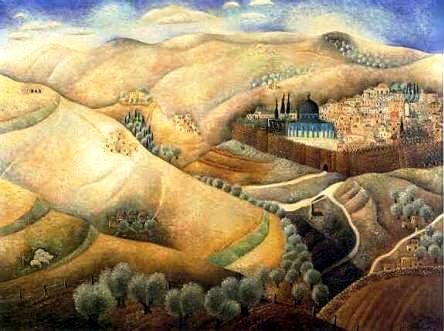
Reuven Rubin (1893-1974) was born in Romania into dire poverty. In 1912, still in his teens, he travelled to Palestine to study art at Bezalel Academy of Art and Design in Jerusalem. Since Paris was the centre of the art world, Rubin took himself to France in 1913 to pursue his studies at the École Nationale Supérieure des Beaux-Arts.

In 1921, this well travelled young man went to the USA and met the well known and well connected artist Alfred Stieglitz, who played an important role in organising Rubin’s first art exhibition in the USA. In 1923, Rubin finally emigrated to Palestine, permanently. There his paintings often depicted the biblical and modern landscape, dotted with agricultural workers on kibbutzim and Arab fishermen. Many of his paintings were sun-bathed, parched depictions of Jerusalem and the Galilee.

Rubin, Jerusalem, 1925

Rubin, Safed in Galillee, 1927

Another painter of the interwar era was Dorrit Black. Dorothea Foster Black (1891-1951) was born and raised in Adelaide, daughter of an engineer/architect and an artist. From 1909 she studied at the South Australian School of Arts and Crafts and painted landscapes in watercolours. After spending two years (1911-12) in Britain and the Continent, Dorrit returned to Australia and continued studying at Julian Ashton's Sydney Art School. By the middle of the war, she adopted oils as her main medium.

In mid-1927 Dorrit Black went to London and spent three months at the Grosvenor School of Modern Art, where she liked colour linocut printing as an original art form. Next year she studied at André Lhote's academy in Paris and at his summer school, and worked briefly with Albert Gleizes in 1929. Now a disciple of Cubism, she returned to Sydney late that year, held the first of her six one-woman shows in 1930. Dorrit exhibited with some of Australians finest inter-war painters, Roy de Maistre, Roland Wakelin and Grace Crowley. In the 1930s she ran the Modern Art Centre, Margaret Street and produced most of her linocuts in the 1930s. In 1934-35 she settled in Adelaide and painted landscapes of the Adelaide hills and the south coast.

Black, Coast Road 1942, 
Art Gallery of South Australia

Black, In the Foothills 1942, 
Queensland Art Gallery

In all these landscapes, the boldly presented hills & roads emphasised their treatment as mass & form. And like cubist painting decades earlier, the mountains became inter-connecting planes of varying depth. In fact the simple, strong and bold lines were quite cubist in feeling. Bright sunlight and cast shadows in all the landscapes helped define the natural forms. And importantly, for all the artists, the springy hills left almost no space in the painting for sky.

How did it happen that the landscapes of these artists started to feel like the South Downs and like each other? Sheffield, Jerusalem and Adelaide were certainly not the most important art centres in the world. So there seem to be several possibilities.

Firstly they might have seen each other’s work, in galleries or in reproductions. Secondly they might have both been influenced by a third party from the past. If this is true, I would suggest Paul Cezanne as the most likely candidate. Thirdly the artists were expressing a shared passion for clean living and fitness.  Peyton Skipworth (Apollo Magazine May 2006) suggested that Modernism was strongly associated with the interwar cult of getting city dwellers out into the countryside, sunshine, fresh air, hiking, fitness and riding bikes. Finally there is the possibility that the artists had nothing whatsoever in common; 80 years later, I am selecting out commonalities that didn’t really exist back then.

Art Inconnu has the finest collection of Harry Epworth Allen paintings. Art from Israel has an interesting selection of Reuven Rubin paintings. Landscape Painting References has a couple of Dorrit Black paintings. For Eric Ravilious paintings, go to That's How The Light Gets In or read Ravilious in Pictures: Sussex and the Downs by James Russell (The Mainstone Press, 2009).
A Crisis of Brilliance by David Boyd Haycock traces the lives of five British artists of this era – Stanley Spencer, Dora Carrington, Paul Nash, Mark Gertler and Richard Nevinson.

This topic continues to surprise. Let me add Rita Angus (1908–70), a New Zealand painter born in Hastings but lived mostly in Christchurch.  Her landscapes of Canterbury and Otago were somewhat cubist, clear, flat, simple and sharply-defined. It is said that Angus carefully considered every colour, line and shape, linking each detail in a design of graceful curves and interlocking forms

Angus didn't travel to England until 1958 but she could have easily seen paintings by John or Paul Nash, for example, during the 1930s and 40s.

Angus, Central Otago, 1940, 
Auckland Art Gallery.


17 September 2011

Regency furniture: metamorphic, clever

Rooms organised during the Regency (loosely defined as 1795-1837) as libraries often had floor-to-ceiling bookshelves. The upper shelves were difficult to reach, so movable library stairs were invaluable.

Enter the Regency era metamorphic library chair!

Clive Taylor has shown that the tables, chairs and stools containing library steps were patented in Great Britain by Robert Campbell in 1774 but this innovative chair-based design did not become immediately popular. Once the Regency was established, a neo-classical interpretation of Campbell’s Metamorphic Library Chair concept started to become popular in London. Any early attributions rely heavily on two contemporary sketches. The first image, by Rudolph Ackermann in 1811, showed a Morgan and Sanders chair, while the second was of a Gillows chair in 1834.

English library chair cum ladder, 1820

What does metamorphic mean, in this context? The word was used to describe a piece of furniture where the same structure could be reused in an alternative form. In the case of a small staircase, the library chair could be turned upside down and steps pulled out. In the case of the small writing desk, the library chair could be turned upside down and part of the chair would be reconfigured into its new role as a desk top.

And just as they were fascinated with mechanical curiosities and dual-purpose furniture during the Regency, so we are today. The design was clever, compact, saved space in the library and looked good.

Metamorphic/mechanical furniture had been used elsewhere. There was plenty of discussion in the antiques literature about clever cabinet makers who designed and made lovely objects for the courts of Louis XV and Louis XVI in France.

Furthermore it was common for French, German and British military officers to order comfortable furniture while travelling behind their armies to battle fields. Sean Clarke has shown that at least for JW Allen Co and John Shepherd Co, campaign furniture it was a natural addition to their trunk making role. If this was true, the majority of makers of campaign furniture were to be found under trunk makers as opposed to cabinet makers in the trade directories. Ordinary cabinet makers, asked by army officers to adapt their standard work, would also make travel furniture as one-off bespoke pieces.

Of course the designs of these officers’ objects had to be light, easily packed and small enough to fit into military camps. As well as elegant! As you can see from the British Lieut General's example, he wanted portable trunks that could be reassembled into a beautiful mahogany and brass chest of drawers.

a Lieut General's brassed edged mahogany campaign chest, British army, c1840

Christie’s described their library chair as follows. A Regency mahogany metamorphic library open armchair, after a design by Morgan and Sanders, early C19th. Note the curved tablet toprail above a horizontal bar splat, the downswept reeded scrolled arms, the caned seat and reeded sabre legs, opening to form a four-tread set of library steps.

Kenneth Hutter Auctions’ Regency mahogany metamorphic library chair was similar. The hinged seat falls forward to form four steps, the highest being 28". Note the reeded frame with caned seat and scrolled arms. In chair form, the object is 36" high.

Antiques Now showed a similar Regency metamorphic library chair made in c1811 and attributed to Morgan and Sanders. As with the other neoclassical style Trafalgar chairs, this one could be converted into a small set of library steps. But here was something different. Apparently Morgan and Sanders offered upgrades to their standard design; this rare example included over-scrolled uprights and a caned back.

Antiques Atlas agreed that dual-purpose chairs and tables became fashionable as wealthy merchants and landowners revelled in the novelty and ingenuity of space-saving mechanical furniture. And they agreed that most metamorphic chairs of this type concealed library steps. What was exciting about the Antiques Atlas example was that the chair opened to reveal a small library table. It was presumably designed and built in France during the reign of Louis XVI or during the early years of the Napoleonic Empire (1790-1805). The chair was made of walnut with a carved, demi-lune or fan-shaped backrest.

French library chair cum table, 1790-1805


13 September 2011

John Constable and his Suffolk landmarks

In the immediate vicinity of Flatford Mill in Suffolk there were a few sites that John Constable (1776-1837) knew very well and painted often. The mill itself was owned by the artist’s father Golding Constable and was their first home, although the family soon moved to a bigger and better home in nearby East Bergholt. These were the places that were central to Constable’s concept of home. As he wrote in a letter to his friend Archdeacon Fisher in 1829 "painting is with me but another word for feeling, and I associate my careless boyhood with all that lies on the banks of the Stour. These scenes made me a painter and I am grateful.”

Flatford Mill, painted by Constable in 1816-7, Tate

Flatford Mill/Scene on a Navigable River 1816-7 was a rich evocation of his Suffolk boyhood and his father's professional interests, especially the navigation system of the river Stour. John was already 40 when he finished this substantial work (102 x 127cm). It displayed a pair of barges travelling upstream that were about to be disconnected from the towing-horse, so that they could be pushed by pole under Flatford footbridge. The viewer can easily detect Flatford Mill on the river, a facility that lay at the heart of the corn milling business run by Constable's dad. Today Flatford Mill is Grade I listed, as is the 17th century miller's cottage next door.

Flatford Mill today

Dedham Vale was at the centre of a successful wheat-growing region during John Constable’s time, so the more land dedicated to cultivation, the richer the growers and millers would be. As a result, Dedham Vale was a busy working area, lovely enough but not drop dead gorgeous.

John Constable’s painting of The Hay Wain 1821 is very well known, a work that was probably painted from Flatford Mill. The viewer can readily identify a hay wain on the River Stour. The house on the left side of the canvas belonged to the tenant farmer neighbour, Willy Lott, whose family had lived there for several generations. And in the centre we can see a harvest wagon crossing the shallow stream near Flatford Mill.

Willy Lott's Cottage, today

When The Hay Wain was first displayed at the Royal Academy in 1821, it wasn’t warmly received. It was actually better received in France where was exhibited with other works by Constable at the 1824 Paris Salon. In that exhibition, The Hay Wain was awarded a gold medal by King Charles X and praised by the most modern of the French painters, including Eugène Delacroix.

Sold at the Paris exhibition with three other Constables, the painting made its way back to England via a dealer and was sold on several times. It wasn’t until 1886 that The Hay Wain was given to the National Gallery in London, where it remains today. I have been on a tour of enchanting Constable Country and in my humble opinion, the painting is an interesting but not his best piece of art.

Nonetheless it was very important, according to Kevin Andrew. Although the lifestyle Constable depicted had already become out of date by 1821, our impression of this entire part of the English countryside is still informed by Constable. He has created it, and at the same time he was created by it. (Thank you Kevin. I stumbled around trying to express this thought and you put it very elegantly).

Did it matter that Constable tweaked the scenes he painted, making Flatford Mill bigger and the river Stour wider? Not at all, according to Art Finder; Constable was simply ensuring that his landscapes withstood comparison with those by old masters.

The Hay Wain 1821, Nat Gall London, Willy Lott's Cottage appearing on the left

But I must be the only art person in the entire Western World not to have realised that the lovely white house in East Bergholt is the very same 16th-century cottage from Constable’s painting. Renamed Willy Lott's Cottage to fit in with Constable’s label, this is real life copying art.

Willy Lott's cottage has survived largely intact. It was restored but not altered in the 1920s after a revival of interest in John Constable's paintings. It is now Grade I listed and, appropriately, owned by The National Trust. As in the painting, the cottage is located near Flatford Mill which, along with neighbouring Valley Farm and Bridge Cottage, are now used as residential locations for arts-based courses. An art-led recovery!

***

By this stage I was right in the swing of real life properties and Constable landscapes. So imagine my surprise in finding a real estate ad for Glebe Farm in 2010. The farm house is in Langham near Dedham, on the Suffolk-Essex border.

When his good friend and patron, Bishop Fisher of Salisbury died in 1825, Constable painted an image of St Mary the Virgin Church at Langham, in the Bishop’s honour. This was where Fisher had been rector when Constable met him in 1798. To the right of the painting, the viewer can see the neighbouring farmhouse called The Glebe Farm. The image of Glebe Farm must have been a favourite with Constable since he painted four versions of it between 1826-30.

Constable, The Glebe Farm c1830, 60 x 78cm, Tate Gallery
St Mary the Virgin Church appeared on the right of the painting

Langham farmhouse today with the same church tower that Constable depicted in 1830.


10 September 2011

Meissen vases with superb landscape paintings: 1870

The Meissen Company, near Dresden, was the first European factory to discover the formula of hard paste porcelain, at a time when the Chinese had been making a fortune importing this very desirable product. But the discovery wasn’t easy. Augustus the Strong, Elector of Saxony and Chinese porcelain fanatic, was desperate to crack the code. He imprisoned the chemist Johann Friedrich Boettger (1682-1719) at Albrechtsberg Castle and probably would have kept him there for life, in order to find the magical formula. Fortunately for Boettger, he found it!

The Meissen Company was founded in early C18th and delivered porcelain of the quality and purity that made that small town famous.

Dresden scenes on Leuteritz vases, 1870, Meissen (Country Life photo)

From 1720 on, the fame of Meissen depended largely on the painter Johann Gregorius Höroldt (1696-1775). It seems impossible to overstate Höroldt’s influence on much of Europe’s developing porcelain makers. He used Chinese exoticism, European landscapes and naturalistic birds and flowers, sublimely painted.

Meissen also had the sculptor Johann Joachim Kändler (1706-1775). Kändler was appointed court sculptor by Augustus II the Strong in 1731. He was responsible for the introduction of new forms for porcelain sets, including a wide range of figurines.

Wealthy families couldn’t buy up Meissen porcelain fast enough. And rival companies couldn’t get Meissen’s secrets fast enough, to develop their own porcelain lines. Naturally Meissen became a symbol of wealth and status, and in the 19th century the factory earned both Royal commissions and medals at the various World Exhibitions.

Leuteritz vase, 1880, Meissen, based on a painting by Caspar Netscher. 69 cm high

I have some good 19th century Meissen pieces in my own collection, which I thought were rather lovely. Then I saw a pair of Meissen vases, dating from about 1870, in David Brower Antiques. I am quoting them. Born in 1818, Ernst Leuteritz joined the factory in 1836 as an apprentice and by 1843 he was engaged as a modeller. This impressive pair of topographical vases was created by Leuteritz and are one of the most important and valuable works of 19th century Meissen porcelain available on the market today. Standing at 61cms high and produced in 1870, the vases show two different scenes of Dresden rendered in exquisite detail, a view of Pilnitz and a view of Schloss Weesenstein. Leuteritz first created the design for these vases in 1856, and in 1862 they were selected as one of the key pieces at the World Exhibition held in London.

Vases of this scale and detail are rare as they were only made for exhibition or special commission. One reason is because large objects of this nature (61 cm high) were very difficult to make and decorate. Minor imperfections in the structure of the piece or faults in the decoration and glaze were unforgiving, often causing failure during the firing processes. These monumental pieces are a testament to the experience and skills of the Meissen craftsmen.

Scene of Wesenstein, Meissen reticulated plate c1879

Another lovely, tall Meissen vase was created by Ernst Leuteritz, this time exquisitely painted with Dutch-style images from the C17th.  The 1880 vase was decorated on a cobalt blue ground, heightened by detailed gilded scroll work and embellishments. The panel on the front was  based on a painting by Caspar Netscher (1639–1684) while the reverse was based on a painting by Gabriel Metsu (1629–1667) which depicts the artist with his wife Isabella DeWolff in a tavern.

Far easier, for both the porcelain maker and the artist, were smaller flat plates that rarely broke in the kiln. Christies had a reticulated Meissen plate from c1879, painted with a view of Wesenstein inside a gilt scroll cartouche. The dark-blue-ground well gilt had scrolls suspending swags of flowers and the border was pierced with trellis pattern sections between panels of flowers, moulded with flowerheads. The scene was beautifully painted, but I have to admit that the entire plate was only 25 cm wide.


 Meissen, 22 piece coffee set with individual landscape paintings, c1880


The Arcanum: The Extraordinary True Story is a super little book, written by Janet Gleeson and published by Little, Brown and Co. in 1999.  It tells the convoluted story of the invention of European porcelain and the founding of the Meissen Porcelain Company.


05 September 2011

Folies Bergere, naked dancers and boxing kangaroos

The Folies Bergère began in 1869, opening as one of the first major music halls in Paris. Once a hall for operettas, ballets and pantomime, the Folies Bergère became the premier nightspot in Paris and had elaborate and colourful revues that featured dozens of sets and costumes. Montmartre was becoming a hopping and jumping suburb, except for the nightmare of the Franco-Prussian War period (1870-1).

Boxing Kangaroo poster

Then in the 1870s, after the war ended, the Folies Bergère staged vaudevillian acts, displaying varied and exotic talents including trained elephants, snake charmers  and strange clowns. There were "unusual" performances put on by Miss Loie Fuller and Little Tich, very talented English music hall stars and comic dancers. The more exotic, the better! In fact the Folies Bergere shows actively played up the exoticness of persons and objects from other cultures, stretching the boundaries of good taste wherever necessary.

Acrobat crossing Niagra, poster

But most interesting of all, at least to an Australian, was the boxing kangaroo. See the poster Folies-Bergere/Le Plus Nouveau Spectacle /Le Kangourou Boxeur which appeared on Paris walls. It featured a kangaroo boxing with a man in blue tights, red boots, a red waist band and a striped shirt.  Stupid.com told an amazing, if bizarre story. A man from Australia arrived in Paris with an adult kangaroo named Lester. When the Australian claimed Lester could out-box anyone in the ring, people packed into the Folies Bergere; they were keen to watch something so exotic that no-one in Paris had ever seen before. It may not have been High Culture, but it certainly was popular.

When did all this reach its peak? In 1886, the Folies Bergère went under new management which was responsible for staging the biggest revue-style music hall shows.  Fortunately we can still read their programme: the Isola brothers (illusionists), Nala Damajenti (snake charmer), a troupe of real Zulus, our favourite boxing kangaroo, wrestlers, Ira Paine (American marksman), Sampson (a chain breaker!), Captain Costentenus (tattooed with 325 animals), the Scheffers (acrobats), Baggenssen (eccentric clown) and Little Tich (the famous English music hall star). Most of the stars of 'Car Conc' sang at the Folies, namely Paulus, Polin, Yves Guilbert, Polaire and Gaby Deslys.

That same year, 1886, new management introduced Place au Jeunes, a revue featuring chorus girls. It was a great success largely because the chorus girls wore little more than feathers and a smile. In Ambassadeurs Cabaret in Paris, one chorus girl didn't even have feathers. Just a big picture hat, as you can see in Belle Epoque Vintage Posters!

 African animals poster, by Jules Cheret

The audience drank in the theatre’s indoor garden and the bar area, as we can see from the well known paintings by Toulouse-Lautrec, Degas and Manet. But even more importantly, the special nature of the performances was captured on posters that were pasted on the city walls. This exuberant image of the American dancer Loie Fuller captured the spirit of sensuality and excitement in the cabaret culture of fin-de-siècle Paris.  Print-maker and poster designer Jules Chéret made Folies Bergere, and the delectable Loie Fuller, very inviting.

Poster for Folies Bergere, by Jules Cheret, 1893.


02 September 2011

Machu Picchu in Peru - luxury exploration

Cuzco (pop 360,000) is located 1089 ks south east of Lima. The gateway to Machu Picchu and the Sacred Valley,  Cuzco was an administrative, military and holy city, capital of the Inca Empire (1200s-1532).  Over the centuries, Cuzco has come to display several different cultures - pre-Inca, Inca, Colonial and Republican.

The first Spaniards arrived in the city in Nov 1533. Francisco Pizarro named it the "Very noble and great city of Cuzco”. The Spanish destroyed many Inca buildings, temples and palaces, and used the remaining walls as bases for the construction of a new city. It became a beautiful colonial city, filled with European monasteries and cathedrals. As a result, you can expect to see many splendid but diverse styles of architecture, layers of cultures in one town.

Many travellers now spend several days in Cuzco itself, seeing the most important sites eg the Cathedral of Santo Domingo 1654 in the main square. The Cathedral, as well as its official status as a place of worship, has become a major holding site of Cuzco's colonial art and artefacts. UNESCO World Heritage status was granted in 1983.

The Hiram Bingham train, climbing the Andes
*

Hiram Bingham was the American explorer who revealed the remains of the Inca citadel, Machu Picchu, in July 1911. He had traced Simon Bolivar’s footsteps, including the historic trade routes through Venezuela, Columbia, Peru, Bolivia and Argentina, funded largely by his wife, an heiress to the Tiffany jewellery fortune.

He and his party hit pay-dirt when they heard in Cuzco that there were extensive ruins high in the mountains nearby. He excitedly wrote that “suddenly I found myself confronted with the walls of ruined houses, built of the finest quality of Inca stonework. The ruins were overgrown but the white granite walls were carefully cut and exquisitely fitted together. The scene fairly took my breath away”.

How does the modern traveller get to Machu Picchu? There is no direct road between Cuzco & Machu Picchu and although there are many ordinary trains, there is only one luxury train: The Hiram Bingham!

The Hiram Bingham departs from Poroy Station (20 minutes outside Cuzco) at 9am. Travellers are greeted with a fun display of traditional dancers and musicians, and Orient Express employees serve champagne. Inside food and drinks are served in the bar car.

The blue and gold carriages are filled with elegant decoration, a la 1920s Pullman trains. Note the polished wood, gleaming cutlery and glittering glass. The train consists of two dining cars, an observation bar car and a kitchen car, and can carry up to 84 passengers. 

Machu Picchu ruins in the mist

The scenery is always different, always fascinating. From the agricultural plains of the Sacred Valley, to the crashing waters of the Urubamba river, and the soaring mountains. The Hiram Bingham travels slowly enough to see everything. The train arrives into the tiny town of Aguas Calientes where private minibuses await passengers to escort them on the trip up to the citadel. A guide tells speaks about Inca history.

Machu Picchu, the Lost City of the Incas, is one of the most famous examples of Inca architecture and is located 112km from Cuzco, 2,350 ms above sea level. The ruins, probably built in the mid-C15th by the Inca Emperor, are surrounded by lush jungle. The ruins are situated on the eastern slope of Machu Picchu in two separate areas - agricultural and urban. The latter includes the civil sector (dwellings, canals and sophisticated irrigation systems) and the sacred sector (temples, mausoleums, squares and royal houses). The Machu Picchu citadel combines stunning natural scenery with a historic treasure trove, and is now recognised as one of the New 7 Wonders of the World.

During the Inca Empire, Ollantaytambo was the royal estate of the Emperor who conquered the region. At the time of the Spanish conquest of Peru, it served as a strong-hold for Inca resistance. The region was only abandoned by the Incas some time after the Emperor’s death in 1472. Now it is an important tourist attraction because of its stunning stonework Inca buildings. And as one of the most common starting points for the 3-day, 4-night hike called the Inca Trail. Trains run between Ollantaytambo in The Sacred Valley of the Incas and Machu Picchu.

The Incas built several storehouses out of fieldstones on the hills surrounding Ollantaytambo, complete with ventilation systems. Their location at high altitudes, where there is more wind and lower temperatures, defended their contents against decay. The guide said they were used to store the production of the agricultural terraces built around the site. Grain would be poured in the windows on the uphill side of each building, then emptied out through the downhill side window.

Moray is a small village, c50 km NW from Cuzco, down the road leading to the town of Urubamba. Moray is quiet and a nice way to reach Moray is by Peruvian Paso-style horseback riding. Riders travel across the hilltops above the stunning Sacred Valley backed by the distant snow-capped Andes. Here the Mares salt mines are a great spectacle, worked since pre-Inca times and still in use today.

Hiram Bingham train, dining car

In the evening, The Hiram Bingham leaves Machu Picchu at 6PM. Guests are welcomed back on board with pre-dinner cocktails and music served in the Bar Car. Later a 4-course, à la carte dinner is served in the dining cars. The train returns to Poroy station near Cuzco at 9.30 PM.

My husband did this trip years ago but there have been two changes since. Firstly the hordes of tourists these days cause so much damage that apparently a limit will have to be put on their numbers. Secondly Yale University has signed an agreement that will return to Peru of some 5,000 artefacts taken from Machu Picchu by Hiram Bingham and his party. The objects have been in the possession of Yale University’s Peabody Museum for 100 years.