29 September 2015

Spain: Chipiona's religion, gorgeous beaches and fish dinners

Chipiona (pop 18,000) is a Spanish village in the southern province of Cádiz, near the cities of Cádiz, Jerez and not far from Seville. The town had a fortress that had belonged to the Ponce de León family. In 1251 Chipiona was reconquered by King Fernando III who soon rebuilt the old fortress into a more modern structure. Over time, the fortress became a monastery for different Catholic orders.

The town's famous statue of the Virgin was possibly commissioned by St Augustine and was possibly brought by Saint Cyprian during an invasion of the Vandals into Spain. The statue was placed in Chipiona and was venerated in the local monastery by the Augustinians. Times were good. The Virgin enjoyed a peaceful life in her Augustinian hermitage for three centuries; then it was time to flee again. This time the invaders were Muslim Saracens and she went under ground. The monks hid her in an underground cistern next to a fig tree where she remained for 500 years.

Only in the C13th did Our Lady finally reveal where the precious treasure was to be found. Rediscovery of the statue, chalice and lamp encouraged new devotion to Our Lady of Rule and the first known miracles were being recorded by 1330. Pilgrims flocked to see her from all across the country. The Black Madonna apparently freed prisoners, saved sailors from shipwrecks, prevented children from drowning in wells and healed the sick.

Although devotion to Our Lady of Rule reached its peak in the C18th, the monastery and sanctuary fell somewhat into decline and were not restored until the middle C19th. A small chapel near the great sanctuary marks the place where Our Lady of Regla was found centuries ago, and the cistern and fig tree are still looked after carefully.

Today 8th of September is still celebrated each year as the feast day of Our Lady of Rule, the birthday of the Virgin. Festivities begin with a vigil the night before, followed by fireworks, processions and wine.

 Our Lady of Rule Sanctuary

Our Lady of Rule statue

Our Lady of Rule's influence lasted! Today Chipiona is still only a small seafaring town on the Atlantic coast, yet it is boxing above its weight. The key facilities still have a connection to the sea and are mostly found close to the beaches. The port, for example, is located in the west of the town and has moorings for hire, as well as a sailing school. The long stretches of white sandy beaches are very attractive, and full of Seville-ites topping up their city tans.

Apparently there was an old Roman lighthouse situated near the mouth of the River Guadalquivir, built by Quinto Sevilius, 40 years before Christ. It was located on Punta del Perro, a projection of land into the Atlantic Ocean, only 6 kilometres south-west of the river mouth. Even that far back in history, the lighthouse was built to warn ships of the large rock named Piedra de Salmedina. So why did ships approach the river? Because it led to the important centre of Seville.

Chipiona lighthouse, 69 ms tall 
set right on the beautiful beach
Note the keeper's house and facilities, at base of lighthouse tower

Modern Chipiona’s lighthouse stands on the exact spot where the Roman lighthouse stood. It was designed by Jaime Font and built between 1863-7, still with the goal of warning ships away from a large dangerous rock. The only time the light was turned off since the 1860s was during the years of the Spanish Civil War.

The round cut stone tower with lantern and gallery on top is mounted on a 4-storey square stone base. As you can see in the photos, the tower rises from the front of a 2-storey keeper's house. The lighthouse itself is unpainted; the keeper's house is partially painted white. The lighthouse is 69 metres high and there are 344 steps to climb to reach the top. Although the beacon still has a formal role, the lighthouse is open to visitors; those who climb all the steps will be rewarded with magnificent views stretching for 40 ks on clear days. All of Chipiona's architectural treasures, eg the cloister of the Sanctuary and the Cuzmán el Bueno Castle, can be beautifully photographed from the top.

But be warned: wear sensible shoes! This is the tallest lighthouse in Spain and it is claimed to be the third tallest in all of Europe.


On the map of the Costa de la Luz, in the very south of Spain, press to identify Cadiz and Seville. Chipiona is located 35 kilometres from Cádiz on the coast, and 150 kilometres from Seville.

Fishing is the oldest trade in Chipiona; the citizens have been making a living from the sea for a very long time. The industry in this town is is characterised by its traditional fish traps, expertly built stone walls that begin at the coast and become higher as they stretch out to sea. The fish are trapped here by the tide. 

The city's own home page says Chipiona produces a wide variety of products, from fish and crustaceans to fruit and vegetables. Shrimps are farmed in the rivers and the area yields huge white claw crabs. Chipiona is famous for its lobsters and nowhere in Spain will you find lobsters quite like here! At the seafront, particularly during the summer months, the bars and Mediterranean seafood restaurants are very popular. The main agricultural activities in the region are tomatoes and wine growing. Since spouse and I don’t eat meat, we can assure you we tested the fish meals many times, just to be certain. They are very very good!

This is my type of coastal city: clean beaches, seafood, wine, fruit, vegetables, preserved medieval architecture, religious parades and sea views, not necessarily in that order.


26 September 2015

Old Saigon emerged into beautiful Ho Chi Minh City

I have not been to North or South Vietnam because of what the Aus­tralian government did to both Vietnam’s civilian population during the Vietnam War (1962-75) and to our own young men via conscription. My husband's and school friends’ names went into the conscription bar­rel in 1967 and 1968, and my brother faced the same crisis in 1970.

But now an old friend has sent me an article about the new, renovated Ho Chi Minh City and I may well change my mind about visiting. Loc­at­ed in the heart of the city, the Rex Hotel is a building still assoc­iated with Saigon during the Vietnam War. But it was actually built in 1927, for French businessman Bainier, during France's colonial rule of Vietnam. The building started out as a two-storey car dealership and garage complex, called Bainier Auto Hall. Not unlike the French Michelin Tyres Centre in Fulham Road London which opened for business just before WW1, the Rainier building show-cased Citroën and other European cars to wealthy Vietnamese citizens after WW1 finished.

And not just in one city. Saigon’s Bainier showroom was apparently just one of car display centres throughout Indochina at the time, including Ha Noi and Phom Penh.

Bainier Auto Hall
Saigon, 1927

In 1959 the building was purchased and renovated by a Vietnamese family who were relatives of the last Vietnam king, King Bao Dai. So the old car showroom started to work as a six storey hotel, The Rex Trading Centre, complete with one-hundred guest rooms and every other facility they could think of: cinemas, eateries, a dance hall and library. The timing could not have been worse. When war broke out against the North Vietnamese, the hotel was leased by the Americans and used as a billet for Am­er­ican military personal and the Joint US Public Affairs Office pers­onal. The first guests in the Rex came in December 1961, before the renovations were totally completed. They were 400 American Army soldiers, the first company-strength units to arrive in Saigon. They were bill­eted at the Rex for a week or so while their camps were being built.

The American Public Affairs staff had to provide reporters with short but detailed summaries of widely scattered military actions. So daily brief­ings were held each evening at 5pm at the Rex hotel. Alas these briefings were dis­astrous; the American army was seen to lie to journal­ists and the Australian government merely parroted the same stories. The ridiculous briefings became known as the Five O'clock Follies, based at the Rex Hotel. In the meantime, despairing and angry university students were filling the streets of Melbourne, Sydney and every other city, to protest against civilian murders in Vietnam and conscription in Australia. 
 
The Rex Hotel, 2015
Ho Chi Minh City

The Rex’s rooftop bar and restaurant became a favourite watering hole with both the soldiers fighting in the war and the journalists sent to cover the war. With drinkies in hand, the men could watch the bombing of the city in relative safety.

My generation will never forget the war; Australia’s last two battalions to serve in Vietnam arrived in 1971 and our last personnel and aircraft left early in 1972. The last American combat troops departed Vietnam in August 1972.

Some time after the Vietnam War ended, the state's Saigon Tourism Bureau took ownership of the hotel and changed the European name to a Vietnamese name: Ben Thanh.  And the Abraham Lincoln Library of the American Cultural Centre during the Vietnam War was renamed as Paradise Coffee Lounge.

By 1986 the hotel was sold once again, expanded and renamed. By ab­sorbing the surrounding buildings on Pasteur St, The Rex could in­crease the size of the hotel and once again provide every luxury facility that a large 5 Star hotel would need to offer. Perhaps its most picturesque facilities are the lush vertical gardens that rise from the atrium. And the rooftop restaurant that once again offers stunning views of the entire city (oh the irony!). Lastly it is important to mention the sepia prints that hang in the public spaces, providing historically-minded visitors with a visual version of old Saigon.

The Rex Hotel,
Vertical gardens

Lastly let me note that the cruise ships that travel along the Saigon River to Ho Chi Minh City invite guests to visit Reunification Hall, the National History Museum, Thien Hau Temple, Notre Dame Cathedral, the French Colonial Post Office, Ho Chi Minh Park and the Rex Hotel! Normally the expression would be Rooster One Day, Feather Duster The Next. This time it is the exact opposite: from a very functional car showroom ..to a luxury hotel.


22 September 2015

Peter Levi - Jewish son, Jesuit priest or married Oxford scholar?

The students were analysing Gustav Mahler's (1860–1911) and Arnold Schoenberg’s (1874–1951) decisions to convert from Judaism to Christianity (Catholicism and Lutheranism respectively). I set them the task of finding a famous person who converted from religious conviction, rather than from a pragmatic desire to advance his career or to avoid anti-Semitic violence.

The best response was the poet and Oxford scholar Peter Levi (1931-2000). Levi was born in Middlesex. The Jewish family of his father (Herbert Simon Levi) were carpet traders from Istanbul and while his mother (Edith Mary Tigar) was English. His mother was a devout Roman Cathol­ic and his Jewish father converted to that religion; their three children all joined religious Catholic orders.

Clearly there was differences. Firstly Mahler and Schoenberg were adults, and made adult decisions for themselves. In the Levi case, the decision was made by Peter’s father. Secondly whereas it is easy to find the con­se­quences of the two musicians’ decisions, on themselves and their families, I can find no discussion about Herbert Levi’s family and friends. However I do note that Peter never changed his surname to a more suitable Catholic name – presumably he knew that the tribe of Levi historically held the second most important rank within Jewish tradition, after the Cohens.

Peter was educated in private Catholic schools run by the Christian Brothers at Prior Park near Bath. At 14 Levi discovered Oscar Wilde and soon required a school with more Greek; he changed schools to Beaumont College, a Jesuit school in Windsor Berkshire. While at Beaumont, he joined the Society of Jesus as a novice.

Peter Levi: Oxford Romantic 
written by Brigid Allen and published in 2014.

Levi trained for the priesthood at Heythrop College and read Clas­s­ics at Campion Hall, joining a small Jesuit intellectual elite. During his late teenage years he suffered from two near catastrophes - polio and a car accident. 

His first collection, From the Gravel Ponds, was the Poetry Book Society's choice for spring 1960. But there was a cost to pay. When his Jesuit superiors declared that he had broken so many rules that he could not be ordained as expected in 1963, he visited his beloved Greece instead. It did not matter; he was ordained as a Jesuit priest in 1964. And then Levi became a classics tutor at Campion Hall Oxford from 1965-77, where the undergrad students thought he was cool.

Like other English upper class eccentrics, Peter had made his mark as a character at Oxford and was a good friend of other scholars like Iris Murdoch. But he could not have it both ways. A literary and passionate personality with dilettante interests might endear him to the students and colleagues, but it was not going to endear him to the Jesuits with whom he lived. I think they would have preferred him to be a more theologically focused scholar.

In his career Levi wrote 60+ books, fic­t­ion as well as biography, poems and travel writing. He travelled with one of my favourite novelists, Bruce Chat­win, always retaining his love for Greek literature and archaeology. But trouble followed here too. Twice he was banned from Greece because he publicly criticised the junta.

Because  maintaining an adequate income stream was problematic, Levi rarely turned a literary commission down; he even seemed happy to be involved in popular works and coffee table books eg Atlas of the Greek World. His books like The Noise Made By Poems ranged over European poetry beautifully, but possibly did not pay him very much. His mode of reviewing was unique, as readers understood from Poetry Review, and he continued to write by hand throughout this career. Could he not afford access to a type writer?

Atlas of the Greek World 
by Peter Levi
and published in 1981 

Appropriately Levi was made Oxford professor of poetry from 1984-89. And some of his more famous works from this era included: Boswell, James and Johnson, Samuel (1984); Boris Pasternak (1985); A History of Greek Literature (1985) and A Journey to the Western Islands of Scotland and the Journal of a Tour to the Hebrides (1990).

When he was seriously middle aged, Peter Levi married Deirdre Con­nol­ly in 1977, 3 years after her first husband Cyril Con­nol­ly had died. Levi had been in love with Deirdre for many years; nonetheless he had struggled long and hard with his decision to leave the Jesuits. But it was a great decision; married life turned out to be a delightful revelation to the previously celibate man.

In later life Levi suffered from diabetes and lost his sight. He died aged 68. I liked the Guardian’s obituary:  Levi’s reviews were always passionate and blended life and art in an often intoxicating cocktail. Levi gave the impression that he really was star-struck about literature and at his best he conveyed this to his readers. His own assessment of "the most useful and pleasurable work I've done" was Marco the Prince: Serbian Heroic Poems that he co-translated. He was a romantic, eccentric and complicated Man about Oxford.

Bloggers might like to read a valuable book called Peter Levi: Oxford Romantic, written by Brigid Allen and published by Signal Books in 2014.

**

I had thought these changing religious roles might have been problematic to Levi. But in an interview in 1977, just after he had left the Jesuits and married, he said: "I am half-Jewish and also I am a Roman Catholic. Therefore I am very much on the edge of ordinary English society, of any kind and of any level of that society. But clergymen can move between classes and be accepted, always with a difference, by whatever class they are talking to. So I’ve had access to more parts of English society than most people do."


19 September 2015

World Fairs come to Melbourne - 1870, 1880 and 1888!

John Twycross (born in Hampshire UK in 1819) did not move to Australia until after gold had been discov­ered in central Victoria in 1851. John and two of his siblings arrived in Dec 1853 but found Melbourne to be boiling hot, prone to devastating bushfires and lacking visual culture. Fortunately Melbourne’s population boomed in the 1850s so Twycross became a successful merchant and a land owner. Commercial opportunit­ies were everywhere. In the early years the two brothers concentrated on exporting wool and animal hides, and eventually brother James re­turned to Britain to direct the Australian imported goods into Brad­ford’s woollen mills. Then James expanded into London, Basing­stoke in Hampshire and Wokingham in Berkshire.

The book Visions of Colonial Grandeur: John Twycross at Melbourne’s Internat­ional Exhibitions was written by Charlotte Smith and Benjamin Thomas (Museum Victoria Publishing, 2014). It explores the history of this city’s international exhibit­ions via the art collection of C19th merchant John Twycross.  We will start in 1869.

That year the trustees of the emerging National Gallery of Victoria wanted to hold an exhibition that “could not fail to stimulate the interest already felt by the community in the culture of the fine arts”. Since the gallery’s collection was still small in 1869, the trustees requested that community-minded citizens loan their pictures, curiosities and articles of vertu for display. And since 1869 was a happy time for merchant John Twycross, he was very happy to respond. He lent least 17 works of art to the exhibition of "Works of Art, Ornam­ental and Decorative Art" held at Melbourne’s Public Library that year. The exhibition was a hit, with both Victoria’s colonial collectors and the viewing population.

Smith and Thomas' book, 2014
Top row of images: Chinese ivory, Royal Exhibition Buildings, Twycross and daughter

As a result of the exhibition’s success, the Victorian Academy of Art was founded in 1870. Their first exhibition was held in 1870, their second was held in 1872 and their third in 18723. John Twycross immediately secured life membership and promised further financial support for the organisation. The academy also enabled close contact between Twycross and Melbourne’s very best artists, especially Louis Buvelot and Eugene von Guerard.

John Twycross was now a happy and prosperous man. Aged 51, he married the very young window Lizzie Burrell Clutterbuck in 1870 and adopted the two children from Lizzie’s first marriage. In 1871 and in 1874 they had two more babies together.

The family soon moved into a grand, single storey, 13-room brick house they had built on the corner of Glenhuntly Rd in Caulfield called Emmarine. After Emmarine had been designed and completed, Twycross added a two-storey art gallery onto the house, specifically to house and display his art treasures. When Emmarine's portrait was painted in 1875 by architectural artist William Tibbitts, the art wing could clearly be seen, over Glenhuntly Rd.

In this boom period of the 1880s, Melbourne proudly hosted two int­ernational exhibit­ions so that the very latest in trade and culture could be seen by huge crowdss in the city’s newly-built Royal Exhibition Building. It is hard to imagine just how exciting it must have been to see goods brought to Melbourne for sale from all over the world. Most people know about the 1851 Crystal Palace Exhibition in London and perhaps the 1878 and 1889 Expositions Universelles in Paris . But as the authors of Visions of Colonial Grandeur point out, the Melbourne International Exhibitions of the 1880s had not really been on anybody’s radar. It is therefore excellent that the book includes many photos of pavilions from other countries: clearly Germany, France, India and other countries were excited to participate.

Successful the exhibitions were! They brought huge numbers of vis­itors from within Australia and abroad, creating opportunities for new businesses. It gave Melbourne a place on the world stage and exposed Australian pro­d­ucts to the trading world. Manufacturers loved these exhibitions because visitors came from all walks of life

I had imagined that Melbourne’s 1880 and 1888 International Exhib­it­ions were a chance for collectors to display Australian art objects to the world, not for wealthy collect­ors to buy up more Australian art for themselves. Yet that is exactly what happened to Twyc­ross. During his many visits to Melbourne’s beautiful Exhibition Building, he purchased hundreds of exquisite fine art objects and paintings, building his collection to ever greater size.

Watercolour painting of the Twycross family home Emmarine, 
painted by William Tibbits in 1875.
Source: Museum Victoria

Mrs Twycross must have been a tolerant wife indeed for he not only spent a great deal of money on things that took his fancy, he also built an entire tower beside the family house Emmarine to store it all. He bought paintings, statuary for the garden and endless decorative art objects like vases and glassware. Being a porcelain fan myself, I most loved Meissen porcelain and Japanese porcelain, but I must admit that the Chinese ivory pieces are just gorgeous.

The book shows the modern reader excellent photo­graphs of the most significant art works in the Twycross coll­ection. The chapters are well struct­ured: 1. Portrait of a collector; 2. Melbourne's 19th century exhib­itions; 3. Experiencing the exhib­it­ions; 4. Courting collectors and 5. A collector's legacy. For me, the book gives a contemporary analysis of the cultural tastes and collecting habits in Melbourne in the later C19th. So I would have liked a chapter on Twycross’ collection at home, but I realise this book was written to display public visions of colonial grandeur.

This book’s publication coincided with the 10th anniversary of UNESCO World Heritage listing of our Royal Exhibition, a building well-loved and much used by Melburnians of every generation. Students have always sat their final exams there, as I did, occasionally raising their eyes to the heavens for inspiration from stained glass windows and decorative walls. The Carlton Gardens which surround the building are beautiful.


15 September 2015

Music from beyond the grave - Tigersapp

It was on radio that I heard a very strange story. A home made CD with four song titles had arrived at EMI Music Co. and was simply labelled “Szymon”. There was no other information, no accompanying letter and only a return address for somewhere in Newcastle, New South Wales.

The music came from Szymon Borzestowski (1989-2012) whose family consis­t­ed of Polish parents Anna and Andrzej, and their Aust­ralian-raised children Eva, Kubush, Szymon and Dominik. All the children learned music; Eva was the singer, Dom learned drums and Kubush the guitar. But it was Szymon who was talented across many instruments - he had studied saxophone and clarinet, taught himself guitar and piano, and then got involved in composition.

Szymon became serious about music in his final year at high school and then devoted all his energies to writing and recording throughout the next year. The teen originally crafted every note in his bedroom, using whatever rudimentary equipment he could grab hold of. By the end of 2008 he had completed four excellent songs and sent them as a demo to various people. Brokenworld had lyrics; the other three were instrumentals.

There were a couple of rejection letters but he heard nothing more, so like every Australian before him, he flew out for a few months to Europe and Africa. It was only after he left Australia that father Andrzej sent the demo tape to EMI.

Szymon Borzestowski
on his overseas travel

EMI’s Mark Holland remembers the day in 2008 he and his EMI colleague Craig Hawker plucked this unsolicited demo tapes from a huge stack in the office. Record labels typically received hundreds of tapes a week and prob­ably had the time to listen to only a handful. Mark Holland was delighted when he heard the unknown teenager’s music - it was a seductive blend of folk, pop and electronica.

Mark Holland and Craig Hawker became the men who encouraged the singer to follow his musical dream. They helped Szymon Borzestowski get some better equipment with a development deal and across the next two years, Szymon agreed to send in the songs as he finished them. What they did not know was that in January 2010 Szymon had been hospitalised and medicated for the first time for depression. There were more hospitalisations where psychiatrists tried different combinations of medication but nothing helped.

In fact, Szymon’s mental state was fast deteriorating. He could not face the prosp­ect of finishing an album, of having to promote it on tours and in radio interviews. Sometimes he attempted to create new music but would immediately erase the files out of rage and frustration. He was destroying his own legacy. Even the tracks that did survive had been cast aside and neglected before completion.

When Szymon died at his own hand in late 2012, EMI had only one album’s worth of songs ready to be finished. The family searched for other works in Szymon’s bedroom, but they could not unearth his hard drive. So along with Holland and Hawker, the family agreed there was just enough care­fully crafted electronic folk-driven music which could be mixed and completed.

The family still listen to their late son and brother’s music. Sometimes it is a sad experience; other times they are delighted knowing that his musical gifts are finally being shared with the world. To hear some of Szymon’s beautiful, shimmering and ethereal music, go to Tigersapp which was released on August 21st 2015, nearly three years after his passing in December 2012.

**

I have heard of other musicians having their music released posthumously. In 1982, two years after John Lennon's tragic murder in the USA, The John Lennon Collection was a compilation of songs in memory of Lennon's amazing gifts. It was hugely successful in Britain and everywhere people loved Lennon music. And just a few months after Amy Winehouse's alcohol-related death in Britain in 2011, her posthumous album Lioness: Hidden Treasures was released. The album consisted of her demos and her previously unreleased songs.

There is a difference, however. Everyone on the planet knew John Lennon and Amy Winehouse. Who knew Szymon Borzestowski?


12 September 2015

Sonia Delaunay Paris: art, colours, shapes

Sonia Terk (1885-1979) was born north of Odessa in Southern Russia in 1885. But then she moved to St Petersburg; there she was cared for by her mother's brother, the lawyer Henri Terk, for the years of her primary and secondary schooling. And she was formally adopted by the Terks, assuming their surname and enjoying a privileged upbringing with her adoptive parents.

She became a student at the Karlsruhe Art Academy in Germany (1903-4), then went on to Paris in 1906 to join the emerging avant-garde. During her first year in Paris she met, and in 1908 married, German art gallery owner Wilhelm Uhde. Since Uhde was gay, I am assuming it was a marriage of convenience to escape the family’s demands for her to return home to Russia. Nonetheless Sonia certainly gained entrance into the art world via exhibitions at Uhde's gallery.

In early 1909 Sonia Terk met the Irish artist Robert Delaunay (1885-1941) at the Uhde Gallery, fell in love, got pregnant, divorced Uhde and married Delaunay in 1910. An extraordinary number of my favourite non-French artists moved to Paris before WWI, including the Delaunays. Artists like Pablo Picasso, Marc Chagall, Amedeo Modigliani, Joan Miró, Const­antin Brâncuși, Piet Mondrian, Chaim Soutine, Ossip Zadkine, Jacques Lipchitz, Mané-Katz, Moise Kisling and Jules Pascin learned French, created excellent art and lived for the rest of their lives in Paris.

Eventually the hub of artistic creativity moved across Paris from Montmartre to Montparnasse. Many newly arrived artists lived in La Ruche, a very cheap art­is­ts’ colony in Montparnasse. Most of them were from Eastern Europe and most were Jewish, so in the early years they kept homesickness and poverty at bay by socialising in Yiddish.

Sonia Delaunay was also Russian, Jewish and a Yiddish speaker, but she had one great advantage. Her wealthy family in Russia sent her money and food parcels every month, while the other young artists continued to live in dire poverty. The highlight of their week was when Sonia Delaunay arrived at La Ruche with food gifts (bottles of Russian herring and pickled cucumbers).

Prismes électriques, 
1913-14.

Husband Robert learned Cubism from Picasso, Braque, Gris and Léger. And by the time war started in 1914, he had distilled his art into a more abstract­ Cubism, where strong colours run into one another. Sonia concentrated more on the development of Orphism, a movement definitely based in Cubism but more lyrical and colourful than the rather severe Picasso and Braque taste. Just as war was starting, Sonia made for herself a dress of bright patchwork colours. When the couple show­ed at the Der Sturm gallery in Berlin, Sonia’s mixing of the decorative arts with painting confused her rather traditionalist critics.

But the time was right for fashion media. Fashion illustration and promotional graphics were changing, and commercial image-making was becoming a legitimate art form. Sonia was thrilled to join artists like Leon Bakst, Erté and Pablo Picasso in using their skills on clothes, textiles and stage costumes.

 Later the publisher Charle Moreau commissioned Sonia to author Tapis et Tissus, part of a series of volumes on decorative arts entitled L'Art International d'Aujourd'hui.

The couple spent WW1 in Spain and Portugal where Sonia became profession­ally involved in theatre, films and dance, and again in women’s fashion. And in 1918 she opened the Casa Sonia, a Madrid shop specialising in her own fashions and interior designs. Just as well! The monthly money from St Petersburg dried up during the Russian Revolution.

When the couple returned to Paris in 1921, Sonia set up a work shop in their flat. Covering the walls, furniture and furnishings with her colourful designs, she turned her home into a collage, modelling her design ideas in 3 dimensions. Sonia was very busy in early 1920s, focusing on painting, tapestry, textiles and mosaics.

Did the young Russian lass think she would bring a new taste into the Parisian world of high fashion, creating textiles that looked like artists’ canvases? Her colourful abstract designs must have been appealing; Diaghilev’s Ballets Russes commissioned their stage costumes from her and Liberty of London, hardly a bastion of radicalism, wanted her products.

In fact her textiles were so popular that she opened her shop, Atelier Simultané, in Paris. And my favourite moment in Sonia’s history was when she was invited to build and fill a pavilion at Paris’ Exposition Internationale des Arts Décoratifs et Industriels Modernes in 1925. This world fair, particularly her Simultaneous fashion models walking around the fairgrounds, was the launching pad for Art Deco for the rest of the world and an international launching pad for Sonia Delaunay as well.

Joyous colour was at the heart of Sonia’s world, in all her paintings, designs, posters, textiles, book binding and book illustrations. Her trademark concentric circ­les, fractured squares and misaligned rectangles and blocks were suffused with every imaginable hue, the bolder and brighter the better. Delaunay dedicated her life to experimenting with colour and abstraction, on the canvas and everywhere else.

In the 1930s she returned to a renewed focus on paint­ing, joining the Abstraction-Creation group in seeking to create an art based upon non-representational elements, geometrical and foc­used on colour as central to painting. The group was spread around Europe, and including among its members Jean/Hans Arp, Jean Helion, Barbara Hepworth, Wassily Kandinsky, El Lissitsky, Piet Mondrian.

**

Sonia became the first living female artist to be given a retros­pective at the Louvre in 1964. But it is just in the last couple of years that there has been a sudden surge in interest in her career. 

EY Exhibition: Sonia Delaunay
Tate Modern

In 2011 the programme called Colour Moves: Art and Fashion by Sonia Delaunay, was presented at the Cooper-Hewitt National Design Museum in New York. The best section showed 90 lively gouache studies and their equally vibrant commercial results: hand-printed silks, velvets and cottons, represented by 120 textile samples laid out in large vitrines.

In 2013 the Museum of Fine Arts of Liège presented an exhibition dedicated to Sonia’s work that was made in Paris at the Workshop Simultaneous, between 1923 and 1934.

From Oct 2014 until Feb 2015 the Musée d’Art Moderne de la Ville de Paris ran an exhibition called Sonia Delaunay: Les couleurs de l’abstraction. They presented three recreated environments and 400 examples of paintings, wall decorations, gouaches, prints, fashion items and textiles.

London's Tate Modern presented The EY Exhibition: Sonia Delaunay from April–August 2015. To demonstrate her strong belief that the Applied Arts are on a par with Fine Art, Tate Modern featured the ground breaking paintings, textiles and clothes she made throughout her career, as well as the results of her innovative collab­orations with choreographers, poets and manufacturers, from Diag­h­ilev to Liberty.

Readers may also enjoy the book The Modern Woman Revisited: Paris Between the Wars by Whitney Chadwick and Tirza True Latimer (Rutgers University Press 2003).

A Mistress of Simplicity and Disguise, by Frances Brent, discusses a 2024 show at Bard Graduate Centre NY illuminating the life and work of Sonia Delaunay. Her art of tasteful surfaces concealed the secret of her Jewishness. Delaunay’s work was abstract, with a kinetic and painterly quality. Even though the designs were printed on silk, it seemed as though there were traces of the artist’s hand in the application. The aesthetic was art deco, which was seen then the pinnacle of good taste. Abstraction was unsentimental, it was modern and utopian; it had clean lines and was disconnected from the upheaval of the past. 

08 September 2015

The Scopes Trial of 1925 - science Vs the Bible

My total knowledge of the Scopes Trial of July 1925 comes from the film Inherit the Wind (1960) starring Spencer Tracy. It was not until later in the 1960s that the Scopes Trial began to be mentioned in the history textbooks of American students and not at all, as far as I remember, in other nations’ history books. So I was interested to read an article called “The Monkey Trial”, written by Roger Hudson and published in History Today, July 2015.

Evolution and religion went head-to-head in a landmark case of 1925. In the stifling heat of a Bible Belt July, a court was sitting in Dayton, Tennessee to put on trial a young supply teacher called John Thomas Scopes (1900-1970), accused of teaching evolution in a local high school.

Religion seemed pitted here in a straight fight against science, the Bible v Darwin, and it turned into one of the first modern media circuses. 200 journalists came to cover the story, filing over 165,000 words a day, dispatched to their papers by telegraph. It was the first trial to be broadcast on national radio in the USA and film footage of it was also regularly being flown out.

William Jennings Bryan, thrice a presidential candidate, a fer­v­ent Presbyterian and leader of the prosecution side, condemned evolution. He said it taught that humans were merely one of 35,000 types of mammal, descended not even from American monkeys but from old world ones. America's most famous journalist, HL Mencken, christened this the Monkey Trial.

George Washington Rappleyea and John Scopes
June 1925
photo credit: Smithsonian Institution Archives

Once the background to the trial was examined, it emerged things were not quite what they seemed. Tennessee had indeed recently passed an act making it illegal to teach evolution in state schools, but the governor had signed it merely to get the rural vote and did not think it would be enforced. The primary motive of those pressing for the trial was apparently to attract publicity to Dayton. The textbook from which Scopes was required to teach, Civic Biology, did cover evolution and did endorse it, though Scopes later said he was not even sure he had taught it to his class.

However encouraged by the American Civil Liberties Union, Scopes was prepared to go on trial and even urged his pupils to testify against him. The prosecution had the backing of the World Christian Fundam­ent­als Association. Clarence Darrow, who led for the defence at the prompting of Mencken without charging a fee, had become famous across America the previous year when he defended two Chicago teenagers, Leopold and Loeb, after they had kidnapped and murdered a young neighbour.

The judge ruled that Clarence Darrow's expert biblical witnesses were irrelevant! So Darrow sprang a surprise by calling William Bryan himself as a witness and then attacking his literal interpretation of the Old Testament and ignorance of other religions. Bryan's answers to Darrow's quest­ions showed plainly that he was not the full-blown fundam­ent­alist his team took him to be.

John Scopes himself never testified because it was never an issue that he had taught evolution. He was found guilty, fined $100 and then let off on a technicality, frustrating the Civil Liberties Union which had hoped to see the case ending up in the Supreme Court.

Scopes Found Guilty
July 1925
Which newspaper? 

Fundamentalist anti-evolution rumbled on, though William Bryan was not there to lead it: he died 5 days after the trial. It found a rival in the so-called Creation Science movement, which based itself on pseudo-science rather than religion. Then in the 1950s Soviet Russia's successful Sputnik satellites set off a scare that the US was falling behind in scientific studies. The National Defence Ed­uc­ation Act was passed and new textbooks were published by the American Institute of Biological Sciences, which stressed the imp­ortance of evolution. Tennessee's act was eventually repealed in 1967, after the Supreme Court ruled that it violated the Constit­ut­ion's prohibition of the establishment of religion.

**

Even acknowledging that 1925 Dayton Tennessee was a very different place and time, I can still understand why the trial was seen as a legitimate battle between the Fundamentalists and the Modernists within Tennessee’s education system. The Fundamentalists accepted the word of God, as revealed in the Christian Bible, as the absolute truth. This truth would take priority within Christians’ homes and churches of course, but also within public schools and universities. The Modernists believed that religion was a private concern for fam­ilies and not a state-controlled belief system. Thus private relig­ious revelations had nothing to do with any evolutionary theories that were taught in science classes.

Look at the date when State Representative John W. Butler, head of the World Christian Fundamentals Association, lobbied Tennessee’s leg­isl­atures to pass anti-evolution laws for state schools. Success came when the Butler Act (prohibiting the teaching of the Evolution Theory) was passed in Tennessee in March 1925! So I do not un­d­erstand why Hudson believed the Tennessee governor Austin Peay signed the law ONLY to gain support among rural legislators. Governor Peay, Hudson noted, did not believe the law would be en­forced, nor did he believe the new law would interfere with Tenn­es­see’s public school education programme. Who passes a new law with the specific expectation that the new law will not be enforced??

Since the Scopes Trial took place in July 1925, only four months after the Butler Act was passed into law, we have to assume that the Tennessee governor and his men were actively waiting for the first opportunity to enforce the new law in court.

But I also note that the engineer-manager of the Cumberland Coal and Iron Company, George Washington Rappleyea, convinced a group of Day­ton businessmen to sponsor a test case of the Butler Act. And that the American Civil Liberties Union offered to defend anyone accused of teaching the theory of evolution in a state school. Thus it is possible that Rappleyea and the American Civil Liberties Union were also waiting for the first opportunity to challenge the offen­sive law in what they hoped would be a famous trial. In either case, poor John Scopes seemed like a bit of a pawn.

Since the jury found that John Scopes was guilty in 1925, and since the Butler Act was not repealed by the Tennessee legislature until 1967, was the young teacher ever allowed to work in his profession again? Apparently not - he chose to work as a geologist for the rest of his career.


05 September 2015

Rabbit Hole: a film about grief

I saw the film Rabbit Hole (directed by John Cameron Mitchel in 2010) while my parents were both alive, alert and very active members of their family and community. Now my parents both died this year, I wanted to review the film with new eyes.

Becca (Nicole Kidman) and Howie Corbett (Aaron Eckhart) lost their pre-school aged son less than a year ago, from a needless, senseless accident. Their son was chasing a dog who ran onto the road in front of the house and was hit by a passing car. There was no fault.

I personally would not have persisted with the support group, had I been in their appalling situation. The group was not supportive; indeed it was insensitively religious and very repetitive in their own, individual pain. But I suppose the Corbetts had to do something with their horrible lives.

Becca’s working family tried very hard to be supportive, but they were even less helpful than the support group. To have lost a son in both generations of the family seems more than just bad luck - it seemed like a family in permanent crisis. Only once did Becca’s mother (Dianne Wiest) make any headway with her daughter; she explained the management of grief and of normal life over a very long, 11 year period. Perhaps the clearing of Danny’s cupboards represented the first step en route to “managing” the crisis.

Becca and Howie

Becca practically stalked the adolescent whose car was responsible for Danny’s death, not to berate him but to find some understanding. I did not understand her relationship with Jason (Miles Teller), nor did I enjoy the interactions, but I suppose a grieving parent will do anything to talk about their deceased child. Jason was stunningly patient – more than one would expect from an adolescent whose world would normally consist of passing exams and hanging out with girls. Nor did I understand the reference to Parallel Universes, scientist fathers and rabbit holes.... and probably Becca didn’t either. Finally I did not understand the frequent appearance of cartoony collage art.

Perhaps in retaliation, Howie considered an affair with Gaby (Sandra Oh), the longest standing mourner in the support group. Gaby had returned to something approaching normal life, many years after her own child had died. Gaby’s husband, presumably, had not.

TheVine was put slightly offside by the film's visual blandness, as if to visually represent the suffocating expectations of upper middle class life. The expression “terminally tasteful” was telling, since there is absolutely nothing tasteful about grief.

But I disagree with TheVine. The fact that a family lived elegantly in a lovely home on the lake did not make the viewer insensitive to their plight. Becca and Howie had not had sex for almost a year, and for that alone, their pain was palpable. The raging anger by Howie and the resentful silences by Becca were EXACTLY what I would have expected. Both of them had meltdowns, but mostly they preserved a brittle stability, at least on the surface.

Two other film blogs made interesting comments. Cinema Autopsy valued the soft, sometimes washed out light that gave the film a melancholic glow that was oddly comforting, despite the great sadness that it elicited. E-Film Blog didn’t expect the film to provide any answers; to even try would have been pretentious. But the questions were still vital.

Seven months after my beloved mother's death and one month after my beloved father's death, I am finding the mourning period to be filled with despair. There is self-blame of course but there is also resentment about the other family members' behaviour and rage about the doctor and hospital's behaviour. A world that seemed perfectly predictable and stable has now become a world of a lost past and a fearful future.


01 September 2015

France or Britain - where was photography invented?

Many thanks to “Introduction to Photography”, published by Niilm University, in Kaithal in the Indian state of Haryana.

William Henry Fox Talbot (1800-77) studied the classics and math­em­at­ics at Cambrid­ge, was elected a Fellow of the Royal As­tronomical Society in 1822, and a Fellow of the Royal Society in 1832. It was his inability to draw which caused him to experiment with a mech­an­ical method of capturing and retaining an image, the camera obscura. In 1833 he was on the lovely shores of the Lake of Como in Italy, taking sketches with a camera obsc­ura when he then thought of re­try­ing an old method. So he threw the image of objects on a piece of paper in the camera obscura’s focus. They were brief images to be sure, doomed to quickly fade away. But it led Talbot to wonder if it were possible to cause his natural images to remain on paper!

The earliest surviving paper negative is of the now famous 1835 Oriel window in the South Gallery at Lacock Abbey, Wiltshire, where Talbot lived. Talbot’s apparatus was armed with a sensitive paper, taken out in a summer afternoon, and placed 100ms from a sun-lit building. Later he opened the box and found a very dist­inct representat­ion of the illuminated building on the paper.

At the same time or slightly earlier, and completely unknown to Talbot, two Frenchmen were struggling with the same prob­lem. The first was Joseph Niépce (1765-1833) who had began research in 1814. He was fasc­in­ated with lithography, but being unable to draw, had to look for another way of obtaining images. Niepce also bought a camera obscura which he loaded with a pewter plate coated with bitumen. Hours later, he removed the plate and washed it with white petroleum and lavender oil. The first ever photograph had been born in 1827, and the prod­ucts were called heliographs.

So Niepce travelled to England and sought to prom­ote his invention via the Royal Society, then the lea­d­­ing learn­ed scientific body. However the Royal Society had a rule that it would not publicise a secret disc­ov­ery i.e. a discovery without all the scientific information attached. So when Niépce died in 1833, leaving examples of his heliographs but no description of his method, he still had not received professional credit from the Royal Society of Science.

Has history underestimated Joseph Niépce’s vital contribution to the invention of photography? If only he had provided a detailed description of his method to the Royal Society when he had the opportunity back in 1827! If only he had taken out a patent on his process! Niepce and France would have been paid their rightful dues as the inventors of photography.

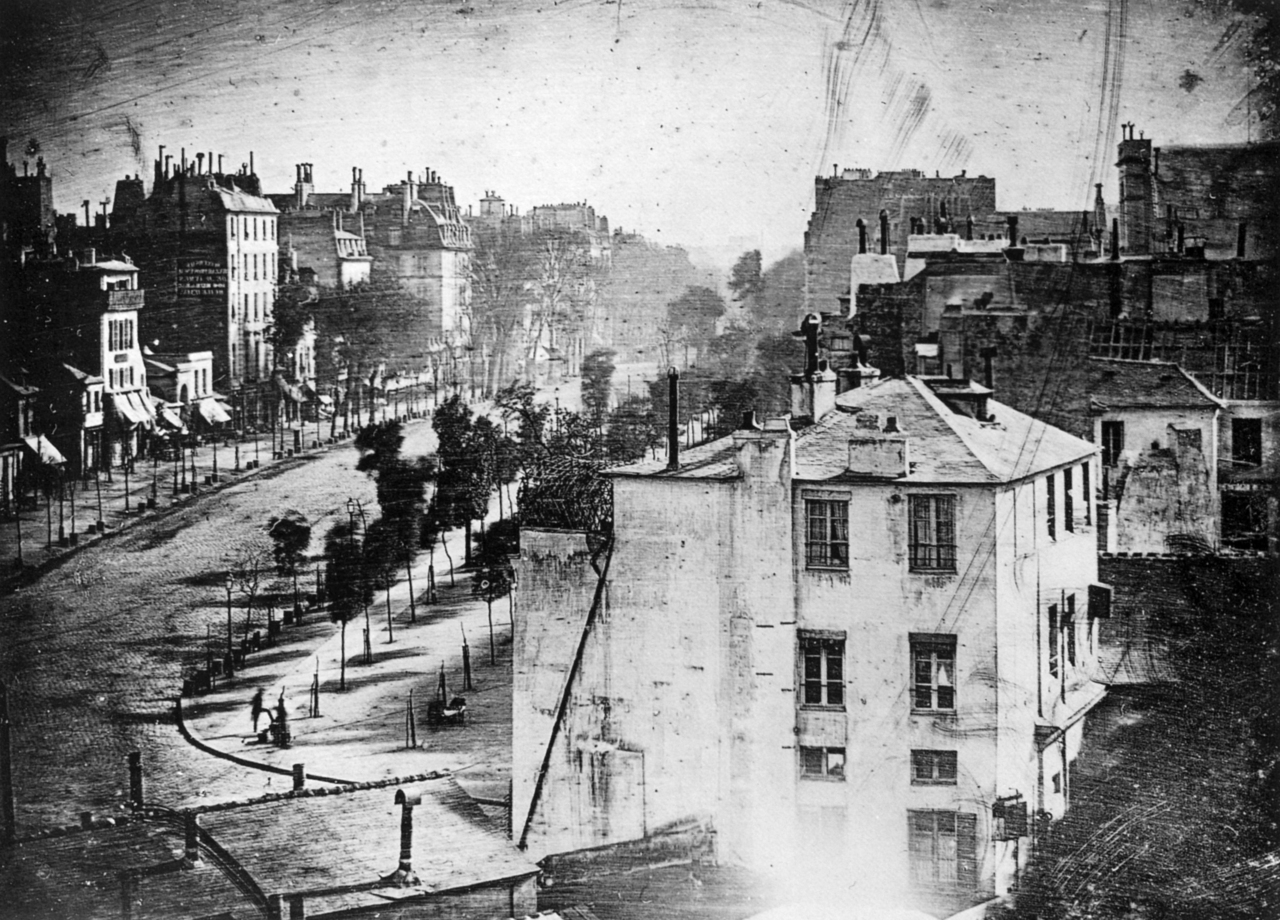
Daguerre
Boulevard du Temple Paris, 1838
The original photo was destroyed in 1940

The second Frenchman was Louis Daguerre (1787-1851) who began work as an apprentice architect, and became a successful stage designer in a Paris theatre. He developed a Dior­ama i.e a picture show with chang­ing light effects and huge paintings of famous places. In 1826 Daguerre learned of Nicephore Niépce’s work, and in 1829 the two men became partners. The partnership was a short one because Niépce died in 1833, but Daguerre continued to experiment with photographic images frozen in time.

Daguerre made an important discovery by accident. In 1835 he put an ex­posed plate in his chemical cupboard, and some days later was amazed to find that the latent image had de­veloped, due to mercury vapour from a broken thermometer. Discovering that a latent image could be “developed” made it possible to reduce the exposure time from some 8 hours to 30 minutes. Though he now knew how to produce an image, it was not until 1837 that he was able to “fix” them. This new process he called a Daguerreotype.

Daguerre announced the development of his proc­ess in Jan 1839 and sought sponsorship, but few seemed interested. So he turned to the French politician Francois Arago who immediately saw the implications of this process and vigorously promoted it. In Jan 1839 the French government announced the discovery, but details were not divulged until August. It was then that the French government, having bought the rights to the process from him, gave it freely to the world.

The Literary Gazette of January 1839 wrote: “We have much pleasure in announ­cing an important discovery made by M. Daguer­re, the celeb­rated painter of the Diorama. This disc­overy promis­es to make a revolution in the arts of design. Dag­uerre has dis­covered a met­hod to fix the images which are repres­ented at the back of a ca­mera obscura; so that these images are not the temp­orary refl­ec­tion of the object, but their fixed imp­ress".

William Talbot was furious. He wrote to Francois Arago, suggesting that it was he and not Daguerre, who had invented the photographic process and deserved all the credit. Arago disagreed so Talbot began to pub­l­icise his own processes. Talbot quickly exhibited some of his Photogenic Drawings to the scientists meeting in the library of the Royal Institution.

Talbot
The Open Door, 1844
The J. Paul Getty Museum

The early daguerreotypes had limits. 1] The length of the exposure necessary made land­scapes and still lifes ideal but other images less so. 2] The image was laterally reversed. 3] The image was very fragile. And 4] it was a once-only system; copies of the photograph were impossible.

British astronomer Sir John Herschel (1792–1871) was very involved with the founding of the Astronomical Society in 1820. He was awarded the Royal Society of London’s med­al for his work on math­ematics. In Jan 1839 Herschel heard of Daguerre's work on photography and without knowing any details, Herschel was soon able to take photo­gr­ap­hs himself. Appropriately the term photography was first used by Sir John Herschel in 1839, the year the photographic pro­cess became public.

At that time, the sensitivity of the process was extremely poor. Then in September 1840 Talbot accidentally discovered the phenomenon of the latent image. This was a major breakthrough which led to short exposure times: from one hour down to a few minutes. By this time Talbot had learned to be pro-active; he gave a paper to the Royal Society of London ent­itled "Some account of the Art of Photogenic drawing, or the pro­cess by which natural objects may be made to delineate themselves without the aid of the artist's pencil." And Talbot patented this invention in 1841.

Hill and Adamson
Deed of Demission (etching of)
1843


Because Talbot chose not to extend his patent to Scotland, he acc­identally made it possible for outstanding photographs to be produc­ed in Edinburgh. Daguerre and Talbot had both announced their processes back in 1839. Just four years later, in 1843, the part­nership of David O. Hill and Robert Adamson blossomed. Their timing was perfect - 400 clerics signed a Deed of Demission, re­signing their livings and establishing the Free Church of Scotland. The photo­graphers captured this critical moment in the nation’s history, just before the good ministers went to their new parishes.

In 1844 Talbot began issuing a book entitled The Pencil of Nat­ure, the first commercial book to be illustrated with actual ph­otographs. But Talbot's process in general never reached the pop­ularity of the daguerreotype process, partly because the lat­ter produced such amaz­ing detail.

**

One last thought. Consider the important dates in photographic history (1835-45) and compare them with the arrival of the railways for pass­enger trav­el. The rail­way was THE means of inland trans­port over any dist­ances in the late 1830s and 40s, and by 1850, the nat­ional network was complete. The arrival of railways was unlinked to that of photography, but the impact of each on travel­lers and tourists was limitless. It was now possible to photograph archaeological sites and ant­iq­u­ities in Greece, Egypt, Italy, Turkey and the Holy Land. Travelling Vict­orians could capture mount­ains, rivers, forts, castles monuments and cities in their photographs.