28.12.10

The Cairns-Kuranda Railway in tropical Queensland

In the late 1870s, Kuranda was the middle crossing on the Barron River for prospectors and labourers on the Cairns track. In the prolonged North Queensland wet seasons of the 1880s, desperate tin miners on the Wild River were unable to obtain supplies and were starving. The boggy road leading inland from Port Douglas was proving impossible, and a railway to the coast was urgently needed.

Barron Falls

The Kuranda Scenic Railway history tells that in March 1882, the Minister for Works and Mines announced the search for a route from the Atherton Tablelands to the coast. Port Douglas, Innisfail and Cairns all formed Railway Leagues, getting involved in a long and bitter fight for the right to the railway.

Kuranda in Far North Queensland

There were several possible routes from the coast up to the Tablelands. In March 1884, a surveyor submitted reports from investigations carried out on all the routes marked by the explorer Christie Palmerston. And a decision was made: the Barron Valley gorge route was chosen. Port Douglas and Innisfail citizens were devastated; Cairns citizens (see map) were thrilled.

In May 1886, the Premier of Queensland used a silver spade to turn launch the project which was always going to be a truly major engineering feat. Construction of the Cairns-Kuranda Railway was by three separate contracts for lengths of 13km, 25 km, 37km. The line was to total 75km across the vast Atherton Tablelands leading to Mareeba.

Kuranda Scenic Railway today

Section One of the line ran from Cairns to just beyond Redlynch. The contract was won and work started, but progress was dogged by bad luck and a possible lack of supervision. Sickness was prevalent amongst the navvies; working conditions in the swamps and jungles were almost unbearable. In Nov 1886 the contract for Section One was taken over by another crowd, but they too had given up by Jan 1887. Section One was finally completed by the Queensland Government.

In Jan 1887, a tender was accepted for Section Two. This ascent was very dangerous due to steep grades, dense jungle and aboriginals defending their territory. In all, this section included 15 tunnels, 93 curves and dozens of difficult bridges mounted many meters above ravines and waterfalls. They tackled the jungle and mountains not with modern equipment, but with dynamite, buckets and simple tools. Great escarpments were removed from the mountains above the line and every loose rock and overhanging tree had to be removed by hand.

Kuranda Railway Station, today

Earthworks proved particularly difficult. The deep cuttings and extensive embankments that were removed totalled millions of cubic metres of earthworks. The Barron Valley earth was especially treacherous. Slopes averaged 45 degrees and the entire surface was covered with a layer of disjointed rock, rotting vegetation and soil. Possibly hundreds of men died as they lay down the sleepers of the Kuranda Rail: 23 were confirmed dead through disease or accident. Others remain unaccounted for, perhaps buried under the sleepers.

During construction, navvies’ camps popped up everywhere. Small townships, complete with hotels, were thriving at #3 Tunnel, Stoney Creek, Glacier Rock, Camp Oven Creek and Rainbow Creek. At one stage, 1500 men, mainly Irish and Italian, were involved in the project.

Faced with poor working conditions in April 1888, a meeting of predominantly Irish workers at Kamerunga resulted in the formation of the Victorian Labour League. In August 1890, the great maritime strike spread to the railway workers and they formed The United Sons of Toil. They made a demand for 90 cents per day (or its imperial equivalent). By September differences had been resolved and the navvies’ wages were marginally increased.

In April 1890, Stoney Creek bridge was almost complete and the project was paid a vice-regal visit by the Governor of Queensland.

By May 1891, rail was laid to the end of the second section at Myola. In June 1891, one of three Railway Commissioners at that time opened the line for goods traffic only. Just a week later, the Cairns- Kuranda Railway line was opened to passenger travel. The Kuranda Scenic Railway was/is a spectacular journey comprising unsurpassed views of dense rainforest, steep ravines and picturesque waterfalls within the World Heritage-listed Barron Gorge National Park.

Close to the Barron Falls and a haven from the humidity of the coast, Kuranda was now open. 

With the railway being the only means of access, Kuranda remained a sleepy village throughout the 1920s and 1930s, visited mainly by timber and railway workers and a growing number of local tourists. Trade at Port Douglas died off rapidly and the town became a quiet little retreat. Innisfail prospered in its own right because of the growing sugar industry. With a reliable supply of goods and freight, the Tablelands bloomed with its rich grazing land. And Cairns boomed.

Victorian train interiors

Visitors who travel to Kuranda by train will enjoy the distinctive heritage carriages adorned with brass insignias - the most exciting part of spouse's and my trip. The Victorian-inspired interiors will remind modern tourists of their grandparents’ trips. So will the Kuranda Railway Tea Rooms at the station.

Today tourists can return from Kuranda by skyrail, the longest cable car in the world at 7.5km. The cable car drops visitors off at two stations within the forest. From the first there is a very short walking loop through the forest, with guides departing every 20-30mins. The second station has a slightly longer walk and viewing platforms over the Barron Falls. The torrents of water gushing over the falls in the wet season are an impressive sight.

Kuranda Skyrail, opened August 1995

25.12.10

Sherlock Holmes' martial arts 1890s - real life Vs fiction?

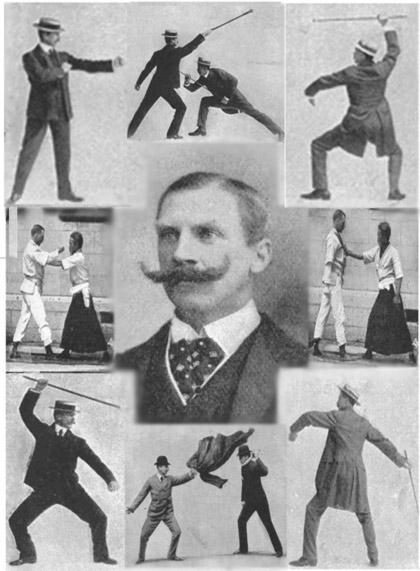
Bartitsu was a martial art form brought to Europe from Japan by Edward William Barton-Wright (1860-1951). Barton-Wright, an engineer, had spent considerable time in Japan during the 1880s and was keen to teach Britons non-aggressive self defence that did not require guns. He established a self defence club, called the Bartitsu Academy of Arms and Physical Culture, in Shaftesbury Ave London in 1898.

Like jujitsu, bartitsu used the weight and strength of the enemy being outbalanced by the hero. In a long article called "How to Pose as a Strong Man" published in Pearson's Magazine in 1899, Barton-Wright carefully analysed the mechanical and leverage principles involved - feasible even for an insurance clerk or a bank teller. Emelyne Godfrey showed that Barton-Wright’s exotic yet practical brand of self defence was much needed in 1890s Britain and certainly filled a gap in the market. Bartitsu was admired specifically because it used minimum aggression.

Baritsu needed only a walking stick, an overcoat and a knowledge of weights and balances. Barton-Wright was the gentleman with the very impressive moustache in the centre photo.

Meanwhile we will leap over to popular literature. By the 1890s Arthur Conan Doyle had created a monster with the adventures of his hero, Sherlock Holmes. So he killed off Holmes in The Final Problem (published 1893) at the hands of his arch-enemy, Professor Moriarty. The method chosen was rather ghastly and final - Holmes plunged to his death over the Reichenbach Falls while fighting.

However public opinion being what it was, Arthur Conan Doyle must have had a change of heart. In his book The Adventure of the Empty House (published 1901), Sherlock Holmes was brought back to life. Baritsu (note the different spelling) was the martial art that was used to explain how Holmes had managed to avoid falling into the falls with Professor Moriarty. Conan Doyle was himself a very keen boxer and had no trouble describing baritsu, in this 1901 book.

This came as a surprise to me, since I assumed Sherlock Holmes was a very intellectual fictional character. But the Bartitsu Society reported something very different.  As an athlete, Sherlock Holmes apparently focused on those exercises which strengthened the muscles and improved his cardiovascular system. He walked, hiked, wrestled and swam. He was an early advocate of both Hatha Yoga and scientific weight-training.  As a child in Yorkshire, he was informally schooled in traditional Gaelic stick fencing and was a natural at bare-knuckle fisticuffs. As an adult, Holmes was an expert singlestick player, boxer and swordsman!

Undoubtedly the Second Boer War (1899–1902) was a horrible time for the British and the reintroduction of a clever and successful Sherlock Holmes must have been good for the national morale. But it didn’t save Barton-Wright’s self defence academy which went into bankruptcy. Barton-Wright tried other adventures but none was hugely successful. He faded out of the limelight and eventually lived into obscure old age.

I can never tell if life imitates art or vice versa. Even if Barton-Wright was buried in a pauper’s grave unmarked and unlamented, bartitsu or baritsu became the basis for real martial arts that did so well in Europe in the 20th century.  But it was the fictional Sherlock Holmes' mastery of the mixed martial art that became legendary, not the real life academy in Shaftesbury Ave.

Masculinity, Crime and Self-Defence in Victorian Literature was written by Emelyne Godfrey and published by Palgrave Macmillan in 2011.

21.12.10

Christopher Dresser, porcelain and the laws of ornamentation

Dr Robert Wilson is one of the major donors to the National Gallery of Victoria’s Decorative Arts Department. An exhibition of objects from his collection of 19th Century Ceramics and Glass is being held during this, the 150th anniversary year of the NGV. Since I am a passionate collector of 18th and 19th century porcelain myself, I was very keen to see Wilson's pieces from Minton, Worcester, Copeland and Burmantofts. However there is a slight difference. My treasures are readily available in the auction hourses, of average quality and of average prices. Wilson’s treasures are rare, of superb quality and fetch top prices.

Dresser pattern, published in Studies in Design 1874 

In this post, I want to concentrate on Christopher Dresser 1834–1904, partially because the NGV exhibition has an entire case filled with his art objects. Dresser was one the most important and influential designers in the later Victorian decades. It is said that he championed design reform in Britain while embracing modern manufacturing in the development of wallpaper, textiles, ceramics, glass, furniture and silver art.

Dresser pail, 1874, by Minton, Art Gallery of South Australia

Everyone knows his wallpapers - his patterns were first published in his 1874 book, Studies in Design, and were used on walls and for ceiling decoration. The designs were complex, tight and varied, but the colours were more limited: cobalt, tan, mustard, teal blue, dull green, red-brown, variously combined. Even more importantly, he specified very intricate rules of colour harmony in his books.

Dresser's baluster vase, porcelain, painted in coloured enamels by Minton

Soon his designs for wallpapers and fabrics could be used on ceramics. Minton and Josiah Wedgwood Companies were delighted to use his work and both companies exhibited his porcelain at the 1862 London International Exhibition, the 1867 Paris Exposition Universelle and in the London Exhibition of 1871. People seemed to love them.

3 legged bowl c1870, bone china, Metropolitan Mus, 9cm high

Roberta Smith got it right. She thought Dresser probably dreamed in abstract patterns, his imagination fed by an eclectic range of sources - particularly Japanese, but also Persian, Egyptian, Indian, pre-Columbian and Assyrian. Dresser did actually visit Japan, published articles on Japanese art forms and wrote an important book called Japan, Its Architecture, Art and Art Manufactures, 1882.

The Aesthetic Movement took place in the late Victorian period from the late 1860s to 1900, coinciding almost exactly with Dresser’s working career. The movement privileged aesthetic values over moral or social themes in the decorative arts. In one sense, its post-Romantic roots did not reflect the more usual Victorian values and so the movement definitely anticipated modernism. A pair of Minton Aesthetic Movement vases c1870 will show you how Dresser interpreted the concept.

Dresser bowls, c1870, blue printed underglaze with sea birds and waves on gilded ground by Minton, 15 cm diam, Christie’s

Dresser’s books were important for another reason. This was not an unthinking craftsman, creating randomly. In search of a moral design vocabulary, and true to Arts and Crafts philosophy, Dresser established principles based on Truth, Beauty and Power. Truth criticised imitation of materials. Beauty described a sense of timeless perfection in design. Power implied strength, energy and force in ornament, achieved through Knowledge.

Over the years, Dresser worked with or for many companies, and had a directing hand in some of them eg Minton & Co., Wedgwood, Dresser & Holme of Bradford and William Ault's pottery. Dresser's designs for ceramics in the 1880s appeared from a new Yorkshire factory at Linthorpe near Middlesbrough. A loc­al businessman called John Harrison had been interested in Dresser's theories of art and couldn’t wait to work with him in a ceramics enterprise. The Linthorpe pieces were largely distinguished by their interesting shapes and their decorative glazes, not by finely designed patterns.

If Dresser separated himself at all from the Arts and Crafts Movement, it was by recognising the benefits of the industrial revolution. He was, for example, perfectly happy to design and decorate machine-made objects. The application of the gold floral band onto the U-shaped vase was produced by another industrial technique, that of transfer decoration.

Dresser's U-shaped vase, 1886-9, porcelain by Minton, bands of gold stylised chrysanthemums over a deep blue glaze, 19cm high, Metropolitan Mus

He remained committed to analysing good design, writing books and journal articles that dealt with the use of materials and the simplicity of form. For a Bauhaus fan like me, it is amazing that Dresser could have "discovered" the concept of form following function decades earlier in Britain, rather than post-WW1 in Germany.

The NGV exhibition will end 1st January 2011. If you cannot get to the NGV, I recommend you read Shock of the Old: Christopher Dresser's Design Revolution,  Victoria & Albert Museum, 2004

Dresser, ceramic vase, made for Linthorpe, c1890, 22 cms high

17.12.10

Delhi Durbar - grandly celebrating British colonialism

I was looking at Colonial Film for information about the welcome to, and education of Indian princes in Britain in the late 19th century. Instead I got involved in the Delhi Durbars and will cite Colonial Film as much as possible.

Queen Victoria's Durbar Room at Osborne House, created 1891

Durbar was a term used in India to refer to a ruler’s court, or to a ceremonial gathering at the court. Towards the end of the British Raj, three imperial Durbars were held in Delhi, each marking important royal events. The first, held in 1877, marked the proclamation of Queen Victoria as Queen Empress of India. The second, held in Jan 1903, marked the coronation of King Edward VII. The last, held in Dec 1911, marked the coronation of King George V, and was the only Durbar that the ruler attended in person.

Called the Proclamation Durbar, the 1877 Durbar was held in January 1877 to mark the coronation and proclaim Queen Victoria as Empress of India. The 1877 Durbar was largely an official event and not a popular occasion with mass appeal, as the later Durbars were designed to be. It was attended by the Viceroy of India 1st Earl of Lytton, maharajas, nawabs and intellectuals. Although it was several decades overdue, the event was supposed to represent the end of the transfer of control in India, from the British East India Company to the British Government. Inside Victoria Memorial in Kolkata is an inscription taken from the Queen’s message, presented to the people of India.

Delhi Durbar, 1903 (Life)

On New Year's Day 1903, newly crowned King Edward VII and Queen Alexandra were declared Emperor and Empress of India. The occasion was marked by a grand ceremony held at the Delhi Durbar, a spectacular festival organised by the British government via Lord Curzon, then Viceroy of India (1898-1905). This Durbar was intended to impress the outside world with British power and influence in India, and to reinforce Britain’s role as a unifying presence in India.

1903 Procession by Menpes

To highlight the glory of the monarchy and its Empire, the 1903 programme of events ran over 10 days. It began with the grand opening procession where the Viceroy, the Duke and Duchess of Connaught (brother and sister in law of King Edward VII), other British and Indian dignitaries paraded through the streets of Delhi. The most spectacular part was the line of Indian princes riding on bejewelled elephants.

Coronation Park, north of Old Delhi had been turned into a gigantic tent city, complete with temporary light railway to bring crowds of spectators out from Delhi. The tent city had its own post office, telephone facilities, shops, a police force, hospital, magistrate’s court, sanitation and lighting systems. Charlotte Cory was particularly impressed with Maharajahs who came with great retinues from all over India. The massed ranks of the Indian armies, under their Commander-in-Chief Lord Kitchener, held daily parades, band practice and polo matches. This Durbar included sports, music, a state ball, a huge display of Indian arts and crafts, and a review of 34,000 troops.

There is an Australian connection to the 1903 celebrations. Mortimer Menpes (1855–1938), an Australian artist, author and illustrator,  published the book "Durbar", which told the tale of the spectacular event and illustrated it in beautiful detail. In June 1903 Menpes also exhibited the pictures he had painted of the Durbar at a fancy London art gallery in New Bond Street.

Rabbiting On has the most wonderful paintings from the 1903 Durbar, with a particular focus on the central figure in the entire process – Lord Curzon. Old Indian Photos has stunning photos.

Delhi Durbar, 1911

The 1911 Durbar cost over £1 million to mount, and was over a year in preparation. Over 200,000 people were expected for the events taking place in Delhi’s Coronation Park. This Durbar was of course used for particular political purposes. King George announced the reversal of the unpopular 1905 decision that had partitioned Bengal, while also announcing the transfer of the capital of British India from Calcutta, in Bengal, to Delhi.

Royal ceremonials were a popular subject for early newsreels. Consequently this event was probably the greatest effort in news coverage that the young film industry had yet undertaken. Over a dozen cameramen from five different British film companies were despatched to cover the Durbar. Speed was of the essence, and the companies competed with each other to process their films and rush them back to Britain for viewing. The films were hugely popular in Britain, with interest being fuelled by incidences which had been covered in the British press. The films were also distributed widely abroad; to India and the Empire of course, but also to non-British countries elsewhere. The films included the unveiling of the King Edward Memorial Tablet, the Presentation of Colours and the Church Parade.

Delhi, (ex)Viceroy's House

In Dec 1911, King George V laid the foundation stone for India’s new capital, Delhi, rather than Calcutta as it had been. The decision to build a residence in New Delhi for the British Viceroy was taken straight away. This Viceroy’s House was to give the impression of a perpetual and rock-solid British Raj. The building and its surroundings were to be 'an empire in stone', 'exercising imperial sway'. And they were!

How impressed were the Indians with the Durbars, attended as they were by lines of Indian princes riding on bejewelled elephants, maharajas and nawabs? They seem to have been written out of Indian history because nationalists campaigning for Indian independence at the time and in later years did not want to be associated with princely rulers. Or durbars. The princes' perceived decadence was a source of some embarrassment. Nationalists wanted that part of the independence struggle to be be deleted from history because maharajahs were seen as too closely associated with the worst excesses of the Raj.

14.12.10

Modern art destroys British morals, 1910! Read all about it!

Modernist art from the Continent was not seen very often in Britain, at least in the years before World War One broke out. Durand-Ruel DID bring beautiful Impressionist art to exhibit at the Grafton Galleries in 1905; although people greatly admired the works, the paintings weren’t sold. An Exhibition of the Works of Modern French Artists was presented by Robert Dell at the Public Art Gallery of Brighton (in 1909?) but I cannot find its catalogue or list of paintings.

It should be noted that after the turn of the century, Impressionist art was hardly cutting edge any more, at least not in France. So Roger Fry, Bloomsbury art critic extraordinaire, decided he was going to launch modernist art on the unsuspecting public of Great Britain. With his many contacts in the art world, Fry asked leading collectors in Europe to lend him their paintings; they did! Better still, many of the works were for sale. Modern art dealers were more than eager to break into the British market, and willingly gave him paintings on consignment.

Edouard Manet, Bar at the Folies-Bergère, 1882, now at Courtauld.

Roger Fry asked another Bloomsburyite Desmond MacCarthy to become the secretary of the huge project. I know the Bloomsburies tried to help each other socially and professionally, but did literary critic Desmond MacCarthy have any knowledge of the visual arts?

Desmond accepted Fry’s offer. He and Clive Bell were soon travelling to Europe, visiting Parisian dealers and private collectors, arranging an assortment of paintings to exhibit at the Grafton Galleries. Even if Desmond had been familiar with C19th art, his was a tricky assignment, acquiring the work of modernists little known in Britain. The Art World said that Desmond’s biggest success was in negotiating with Van Gogh's sister-in-law, Madam Gosschalk-Bonger, for the Van Goghs they eventually exhibited.

Vincent van Gogh, The Starry Night, 1889, now in MoMA NY

Roger Fry was actually defining Modern Art by his selection process. The modern (post-1890) French masters and their colleagues eg Cézanne, Gauguin, van Gogh and Seurat, were clearly not Impressionists. But what were they? While preparing for the exhibition, Desmond MacCarthy noted that they had no shorthand way of describing the art era they were analysing. “Post-Impressionism” was the label quickly created by Roger Fry, the label subsequently adopted by art historians and gallery staff. For Clive Bell the term meant moving past Impressionism and denoted a careful move away from natural representation. Instead Post-Impressionism described a move towards symbolic meaning, bold, unrealistic colours and expressive brushstrokes. Pictorial structure and the symbolic use of colour and line became the themes of the 1910 exhibition.

In Nov 1910, Fry announced that The Manet and the Post-Impressionists Exhibition would open at the Grafton Galleries in Mayfair. He also commissioned a very smart poster, to attract interest. Fry feared that most British art critics in 1910 STILL thought that Monet couldn’t draw and that Renoir didn’t tackle serious subjects. What would they do when they saw the artists Fry, Bell and MacCarthy had brought over the Channel!

So there was certainly some awareness of the risk Fry and his Bloomsbury mates were taking. If I had been in Fry’s position, I might have concentrated more on the Fauvists (1905-7) who created brilliant, luminous colours and bold, spontaneous handling of paint. He did exhibit plenty of Matisses, but Derain, Vlaminck, Rouault and van Dongen may have been a more gentle introduction to modernism than, say, Picasso.

Paul Gauguin, Woman Holding a Fruit 1893, now in The Hermitage.

This exhibition had been pulled together quickly, but if ever there was a flashy art exhibition, this was it - Manet and the Post Impressionists was arguably the most significant and the most controversial show of paintings ever to be held in pre-WW1 Britain. In this landmark exhibition, there were more than 20 paintings by each of the most important artists – Manet of course, but also Gauguin, Matisse, Van Gogh, Cezanne, Seurat and Picasso. I would love to know specifically which of their paintings were displayed – only Manet’s A Bar at the Folies-Bergiere has been identified for me with certainty.

How did the professional critics respond? The reviews were mainly ugly. The critic for The Pall Mall Gazette described the paintings in the Post Impressionist Exhibition as the output of a lunatic asylum. The Morning Post critic Robert Ross thought that only psychiatrists interested in psychoses would be interested in the thoughts of this particular group of artists; Sir William Blake Richmond wrote in the Morning Post, “Cézanne mistook his vocation; he should have been a butcher”. The art critic of The Daily Telegraph had a hissy fit, throwing down his catalogue at the door of the catalogue and stamping on it. One traditionalist artist went as far as warning young men not to enter the gallery for fear of being horribly corrupted by what lay within.

The popular press almost universally supported this view: the exhibition was dangerous! According to the tabloids, the modernist artists couldn’t draw or paint; the colours were obscene and the works were an offence against British culture.

But ordinary art lovers seemed to love the sense of modernity that was finally coming to British shores. Over 25,000 paying customers crowded into the West End Gallery. Fellow Bloomsbury artists Duncan Grant and Vanessa Bell were of course very enthusiastic about the exhibition. More interesting for readers of this blog was that the exhibition powerfully affected the work of some of the painters in Walter Sickert's circle, the Camden Town Group. The paintings showed these young British artists that the use of strong, flat colours could be expressive.

Burlington Magazine concluded: “While the exhibition did not make its leading artists household names overnight, it prepared the ground for their eventual canonisation over the following decade. Gauguin, whose work escaped the worst excesses of critical abuse, became a figure of romance and rebellion; Van Gogh was the deranged genius of popular imagination; and Cézanne, from being an incompetent bungler, rapidly assumed shaman-like status in the development of Modernism”.

Paul Cézanne: Still Life with Watermelon and Pomegranates, c1903, Philadelphia Museum of Art

Despite the hostility expressed by traditionalist art circles, or because of it, Fry was soon hailed as a champion of modern art and he became a focal point for the avant-garde. He decided to follow up the first Post-Impressionist exhibition with a second one. Patronised by Bloomsburyite Lady Ottoline Morrell, The Second Post-Impressionist Exhibition opened in 1912, also in the Grafton Galleries. This was broader, more consistent and more modernist than the first, and included several Cubist works (perhaps for the first time in Britain). And two extra nations were represented. A local section, chosen by Clive Bell, displayed paintings by Bloomsbury artists like Duncan Grant and Vanessa Bell. And there was a Russian section organised by Boris Anrep. The 1912 exhibition was fortunate; the sense of outrage in Britain had become muted in the intervening few years since the first Fry blockbuster.

Fry also founded the Grafton Group in 1913, providing local artists with the opportunity to exhibit any work they were creating in the post-impressionist style. Even during WW1, Fry organised major exhibitions that brought modern works of art to London, like The New Movement in Art.

Read: Manet and the Post-Impressionsists. A centenary issue in Burlington Magazine, #1293, Vol 152, Dec 2010.


1910 poster(L)                                 Roger Fry biography (R) 

11.12.10

sharing caring Australian Railways: 1910-80

In 1882 the Victorian government decided to build a new central railway station in Flinders St, to replace the station that had made-do for the first decades of Melbourne's settlement. A design competition was held in 1899, asking contestants for a detailed design for the station building only; the location of the concourse, entrances, the track and platform layout and the type of platform roofing had already been largely decided.
*
Flinders St Railway Station Melbourne, 1910

Work began in 1900 on the rearrangement of the station tracks, while the design for the station building was still at the competition stage. Decisions were made rapidly, with work on the central pedestrian subway being started in 1901 and the foundations of the main building being completed by 1903. Within a couple of years (1907), Flinders St Railway Station had eleven platforms, and two more platforms were to be added in 1909. The main structure, featuring a giant arched entranceway that typified Federation era buildings, was indeed completed by 1909, and the verandas and booking office were completed in 1910. Space for shops was provided.

Clocks still over the main entrance today

The iconic clocks at the main entrance of the station were part of the original design plans, and today remain in almost the same place as they were originally placed. Many ticket windows were located at each entry, with services such as a restaurant, country booking office, lost luggage and visitors help booth at the platform level.

So Flinders St Railway Station represented an extraordinary example of a public building. But here is the important thing for this story: apart from its main purpose as a railway station, the top levels of the main building included many rooms that were available for a range of activities for railway staff and the general public. In fact much of the top floor was purpose-built for the new Victorian Railway Institute, an organisation which opened in 1910 as a social club and a training centre for railway staff.

The Institute's crowded lecture theatre, pre-WW1 (State Library photo)

Why would the state government and the State Railways care about the health, education and welfare of ordinary working families, particularly those who travelled to the city by train each day? Apparently the Victorian Railway Institute developed partly as a response to the railway strikes of 1903; morale amongst railway workers was low and it was hoped that educational and pleasure-filled facilities would increase stability and maintain loyalty. Everything that the Victorian Railway Institute could think of was provided: a large lecture hall (later a ballroom), a billiard room, classrooms, gymnasium, games room, reading room and a decent reference library.

Jenny Davies said its purpose was to provide extra curricular activities and self improvement classes to Railway employees as well as training for specific railway jobs. It was not compulsory, but it was recommended that employees try to learn new skills to enable them to gain promotion in the Railways. Classes in subjects like accounting and bookkeeping were provided.

So in a very real sense, the Institute operated like the mechanics’ institutes that dotted the Victorian countryside. There were lectures to raise the learning standards of people who could not go to a university or technical college; there was a serious library and pleasant games rooms. Only the gymnasium and ballroom marked the Victorian Railway Institute as a very posh social outlet in the heart of a big city. Even now, older Victorians remember the large ballroom very fondly; it was once used for elaborate dances that appealed to young couples before, during and after WW2.

The Institute's library (above) and
billiard room (below)

The most amazing gesture made by the State government towards working families was the children's nursery. It was established by the Railways Department in June 1933, to help mothers visiting the city. This nursery included a number of sleeping and play rooms, as well as a kitchen. An open air playground was on an adjoining roof. According to the Victorian Railway Institute’s records, five mothercraft nurses and an infant welfare sister had cared for some 50,000 children. Probably if it hadn’t been for WW2, the nursery might have continued offering its wonderful service to harried mothers.

The final straw for educational and social facilities inside Flinders St Railway Station came in the 1980s when Melbourne's transport management was restructured. The change of administration directly affected the role of the Victorian Railways Institute and, although it was given offices in nearby Flinders Lane, the heart and soul of the Institute was gutted. The library books disappeared, the gymnasium looks unused and the ballroom looks decrepit. The most amazing piece of community development in our 20th century history ended.

Read the definitive book by Jenny Davies called Beyond the Facade: Flinders Street. Many of the photos are due to the good archives of the Victorian Dept of Transport. Other great photos of the Railway Institute activities can be found in Melbourne Curious blog.

8.12.10

Kerala India: Christian and Jewish architecture restored

The Jews of Kerala State (on the SW coast of India), who arrived in India some 2,500 years ago, settled in and around Cochin/Kochi as traders. They were attracted to Muziris, which was a thriving port that had trade contacts with the Mediterranean, the Middle East, China and East Africa. By the 18th century, there were 8 synagogues in five different Kerala towns and villages: 3 in Cochin, 2 in Ernakulam and one each in Parur and 2 other towns.

The Kerala Jews lived in safety, but it seems that most opted to emigrate to Israel after the new state was established in 1948. Some 75,000 Indian Jews left their homes, synagogues, schools and cemeteries behind; few families remained to look after the communities’ resources which inevitably began to moulder.

Parur Synagogue, 1615

An American architect, Jay Waronker, recently documented 34 synagogues across India, including 7 that he found in Kerala. Fortunately his work and watercolour versions of the buildings have been published.

Michael Freund noted Kerala State was keen to celebrate its multi-religious heritage. The state cherishes its composite culture and wants the synagogues to be sites where locals and visitors can have memories of the Jewish connection. The state government of Kerala, along with the central government, has put aside a large amount of money to renovate and restore temples, synagogues, churches and mosques. The entire initiative is known as the Muziris Heritage Project.

The first synagogue in Cochin, located in the quarter of Old Cochin known as Jew Town, was destroyed in the Portuguese persecution of the Jews in the 1500s. The second synagogue, built under the protection of the Raja of Cochin along with Dutch support, is the present Paradesi (foreign) Synagogue. The most visible part of the synagogue is the 18th century clock tower, which, along with other parts of the complex, underwent repair work in the late 1990s. This lovely building is decorated with hundreds of 18th century hand-painted porcelain tiles.

Paradesi Synagogue, Cochin

Not far from Kochi, the Paravoor/Parur Synagogue 1615 was built on the ruins of a synagogue that had already stood for 500 years. Preservation plans for this Parur site were drawn up by an important Indian conservation firm, the same firm that had been commissioned by the Kerala office of the Indian Department of Archaeology to restore the nearby Synagogue of Chennamangalam. To reach the synagogue, turn from the main street of Parur onto Jews' Street. At the entrance to this street were two tall granite pillars, an indication that the Jews lived in a self-imposed ghetto.

The synagogue architecture must have once been very attractive; there's a colonnaded pathway that leads from the two rooms, at the street entrance, to the main entrance door of the synagogue in the small courtyard beyond. The stairs to the balcony have unusual flat, shaped supports for the railing and the balcony, with its decorated and gilded supporting beams, have already been restored.

But many important elements were removed. And as the synagogue had not been used since the 1970s, even the remaining elements required repair and restoration. On top of the neglect of 30+ years, the monsoonal climate had a harsh impact on the exterior base, windows, roof tiles and external doors.

Parur’s synagogue was built in the traditional style of Kerala. The style combines white-washed polished lime over a soft reddish-brown local stone walls, timber framing, deep eaved roofs covered with terracotta tiles, wooden latticed screens and large shuttered windows. Drawing from the vernacular design of the region, the influences of the Portuguese and Dutch imperialists, Hindu and other religious building practices, the Parur synagogue added its own Jewish liturgical elements, resulting in a distinct approach to synagogue architecture.
*
Kadavumbagam synagogue, with Parur's ark and reading desk

Because Kadavumbagam synagogue's original fittings were taken to Moshav Nehalim in Israel in the 1950s, the reconstructed Kadavumbagam synagogue in India had to be furnished with a Torah ark 1892 and bimah desk from the nearby Kerala community of Parur. So it is a bit sad that we can best see the carved and painted teak fittings of Parur synagogue, but only by visiting the Kadavumbagam synagogue. At least they were saved.
*
St Francis Church, Kochi, 1503

Let us compare Parur synagogue to local Christian architecture, built in approximately the same era. St Francis CSI Church 1503 in Kochi is the oldest European church in India and has great historical significance as part of European colonisation of the sub-continent. The Portuguese explorer, Vasco da Gama, died in Kochi in 1524 whilst visiting India. His body was, for some long time, buried in this very church.

Most importantly for this article, the casual visitor might not be able to tell the difference between St Francis Church's external architecture and Parur Synagogue's external architecture.

St Thomas Syrian Church, Parur, 1566

Examine St Thomas Jacobite Syrian Church 1566 in North Parur where the mortal remains of the Syrian Orthodox Archbishop of Jerusalem were entombed. When founded, the new church was consecrated in the name of St Thomas the Apostle; the event was inscribed in old Tamil script, in a granite plaque embedded in the wall near the church’s front door.

St Mary’s Church in Bharananganam was first built in 1004 AD, initially  a small church that may have looked like a local temple. When the Portuguese were in command of the affairs of the Christian communities, they wanted to rebuild churches in Christian style.  Finally in the very early 20th century, St Mary's had become large and Gothic, although still built with local materials. 

St Mary's Bharananganam

Bharananganam may not be the largest town in India, but St Mary's became very important when a local woman died and was eventually canonised. Pilgrims flocked to St Alphonsa's grave in the firm belief that illness could be miraculously cured there. The church was renovated just before Pope John Paul II arrived to honour St Alphonsa in 1986, the first ever papal visit to Kerala and India's first ever female saint.

Kochi, Kerala State, SW India

4.12.10

Alfred Felton, Melbourne's art patron extraordinaire

I was sitting in the members’ lounge of the National Gallery of Victoria (NGV) this week, reading the history of the gallery’s amazing collection. Certainly the NGV is the oldest and the largest public art gallery in Australia, starting in 1861. But the city of Melbourne had itself had only been founded in 1835, so how did such a new city have such a successful cultural life?

Rembrandt, Two Old Men Disputing, 1628, 72 x 60 cm, NGV. Bought by the Felton Bequest in 1936

Alfred Felton was born at Maldon, Essex, to an ordinary working family. Felton sailed to Australia in 1853, intending to try his luck in the Victorian goldfields but as a trader, not as a miner. Instead he set up in business in Collins St Melbourne, as a commission agent and dealer in merchandise, and by 1859 he was a successful importer.

In 1867 Felton went into partnership with Frederick Grimwade and founded Felton Grimwade and Co., manufacturing chemists. As the business grew over the years, the partners acquired interests in associated, but diversified industries.

Felton never married and lived rather modestly. Nonetheless he truly loved art and the bachelor flat in the Esplanade Hotel St Kilda, in which he spent his last twenty years of his life, was crowded with books, pictures and decorative art pieces.

When Alfred Felton died in 1904, he had no descendants. So in his will he established a bequest, with half the funding going to non-art charities and the other half to be used to acquire and donate art works to the National Gallery of Victoria. In the end, his estate was £378,033, a huge sum of money in Edwardian times. On top of that, the Gallery was allowed to choose works from Felton's personal art collection. The remainder were publically sold off, the proceeds being added to the Bequest.

Rupert Bunny, Endormies, c1904, 131 x 201 cm., NGV Melbourne. Bought by the Felton Bequest in 1911.

When the trustees couldn't be in Europe themselves, they felt they could appoint a London-based artist or dealer to spend Felton money carefully and wisely. The first important overseas-based advisors were Frank Gibson (an Australian expat artist in London) and Sidney Colvin (Slade Professor of Fine Art at Cambridge).

Ann Elias showed that the artist George Clausen was given an allocation of money from the Felton Bequest to spend in London. By July 1906 Clausen had spent the £1,951 on 13 paintings and 22 drawings, including some small French works (eg Corot)  and mostly contemporary British works. He reported enthusiastically that drawings by Burne-Jones, Lord Leighton, Ruskin and others would be of great value to students, and that the paintings he had acquired would make the Gallery's collection representative of the best work of the times.

The National Gallery of Victoria finally had a reliable acquisition fund, but one aspect I had never heard of before concerned Russian collections. In the years after the Melbourne gallery had gained its Felton resources, the October Revolution occurred in Russia. The Bolsheviks sold a significant part of collections from museums like The Hermitage; these works were snapped up by the Melbourne gallery. Timing is of course paramount, in all things.

A group of five august men sit on the Felton Bequest committee, making decisions. Felton himself said merely that “the Felton Bequests' Committee must be satisfied that the works purchased were of educational value, and would raise and improve public taste”. One assumes that blood has been spilled over the last century, in deciding how to use the money available for purchases. One committee member might have his heart set on Josef Hoffmann silver, icons of the Vienna Workshops. Another might want European Old Master paintings. A third might be holding out for modernist sculpture.

I am assuming there was always anxiety in Melbourne about how to spend the Felton fortune. We know the committee members were sometimes super-cautious, even when fine works were available. For example,  Pondering Art showed that there was a very tense relationship between the Felton Bequests Committee and the Council of Trustees, further complicated by their relationship with the director of the gallery, Bernard Hall. When the stunning Rembrandt work called Two Old Men Disputing 1628 came on the open market in 1934, the gallery  almost missed it because of procrastination and boardroom power games.

And just as WW2 was breaking out in 1939 there was the possibility of buying major modern works by Cézanne, Gauguin, Van Gogh, Seurat and Bonnard. Yet the NGV, with the vast Felton resources at its disposal (an annual income of £23,000 in 1939), managed to acquire only one Van Gogh and one small Derain. The other paintings must have appeared to be too modern and too racy for the Felton directors.

You cannot please all of the punters all of the time. But sometimes the Felton directors were so ridiculously cautious that they lost out on very special works of art that had come onto the open market.

Alfred Felton, in older age

Still, the Felton Bequest has been single handedly responsible for establishing the National Gallery of Victoria with an art collection of international significance. Over the past 100 years more than 15,000 art works have been acquired through the Bequest with a current total value of AUS$1 billion; this represents 80% of the finest artworks of the National Gallery of Victoria. In paintings alone, the Bequest has secured works that included Italian Renaissance artists, Rembrandt, Turner, Cezanne and van Gogh. The Felton Bequest has also been used to buy many masterpieces of Australian art.

Some examples of the NGV's successful Felton purchases can easily be located in other blogs. To see the Dossi painting of Lucrezia Borgia c1518, see the Melbourne Art Network Blog. To see the Fantin-Latour still life, Dahlias, read Nineteenth –Century Art Worldwide Blog.  For Frederick McCubbin’s The Pioneers 1904, see Rompedas Blog.

These Felton purchases are the core of today's collection. As a result, in May 2008 the NGV newsletter reported that the Victorian gallery was the 19th most visited gallery in the world! Pretty impressive for a nation that had only 22 million people in 2008.

The best book on The Felton Bequest was written by Ursula Hoff and published by the NGV in 1983. A more recent addition has been MR FELTON'S BEQUESTS, written by John Poynter and published in 2004 by Miegunyah Press.

Delft earthenware jar, c1670, 32 x 27 cm diam., NGV Melbourne. Bought by the Felton Bequest in 1939