30.4.11

John James Audubon and John Gould - two clever natural historians

John James Audubon (1785–1851) fans will remember the Sale of Magnificent Books, Manuscripts and Drawings from the Collection of Frederick, 2nd Lord Hesketh a few months ago. Let me add some details about the huge Birds of America books, revealed by Country Life Magazine.

The four volume double-elephant-folio measured 40" by 27". Double elephant was, until 1772, the largest size of drawing paper made in England. To make it easier to attract and keep subscribers, the hand-coloured mixed-technique prints were issued in monthly batches of five between 1827 and 1838. And in order to avoid having to donate copies to public libraries, the text was issued separately between 1831 and 1839. Thus the choice of binding was left to the subscribers. This one, #11, was not only bound but given its own beautifully designed mahogany cabinet as shown.
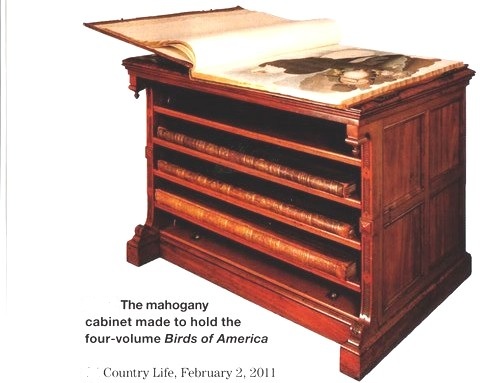
mahogany cabinet especially made for the Audubon folios

The first few prints were produced by Lizars of Edinburgh and the rest by the Robert Havells in London, and all are superb. The colouring is glorious throughout, especially the deep, rich sheen of the black plumage. This copy remained in the subscriber's family until 1951, when it was acquired for £7,000 on behalf of the 2nd Lord Hesketh.

**

Only 19 years after JJ Audubon was born, John Gould (1804–1881) was born in Dorset. Gould became a taxidermist who was commissioned to preserve the large number of exotic animals being brought to Britain by natural historians from their international travels. An important point in young John Gould’s career was when he became curator at the Zoological Society in London.

When Charles Darwin returned from the Galapagos in 1837, he sent his birds to Gould for preservation and identification. Darwin then presented his specimens to the Geological Society of London. Darwin and Gould continued to meet and Gould’s identifications were so significant that they played a role in Darwin's theory of evolution by natural selection. As I noted in an earlier post, Darwin's own book from the trip, published as his Journal and Remarks 1839, described his scientific observations.

Gould's work on the birds was published between 1838 and 1842 as Part 3 of Zoology of the Voyage of HMS Beagle, edited by Charles Darwin. The birds were retained in the natural history department of The British Museum, now the Natural History Museum.

Great Brown Kingfishers in The Birds of Australia

In 1838 John Gould and his wife Elizabeth sailed to Australia with the express purpose of studying birds from the antipodes. The couple, together with the collector John Gilbert, sailed to Tasmania to meet the vice-regal family, Governor Sir John Franklin and his wife. In February 1839 Gould sailed to Sydney, leaving his pregnant wife with the Franklins. In April Gould returned to Tasmania for the birth of his son.

In May he sailed to Adelaide to meet the famous explorer Charles Sturt, who was about to lead an expedition to the Murray River. Gould collected specimens across South Australia, returning again to Hobart in July. In just two years Gould had travelled widely across the south eastern states, collecting specimens of Australian birds and other fauna. They returned home to England in May 1840.

After the trip, Gould took a few years to complete his masterpiece called The Birds of Australia, written between 1840-48. It included a total of 600 plates in seven volumes, including 328 species that had not appeared in the literature before. Elizabeth, who had illustrated several of his earlier works, made hundreds of drawings of the 681 specimens for publication in The Birds of Australia.

Magpies in The Birds of Australia

The plates of the book were produced by lithography, Elizabeth producing 84 plates before she died in 1841. After her death, 595 plates were produced by HC Richter from Elizabeth's drawings. In total, both in text and with the plates, the book became the first comprehensive survey of the birds of Australia. Only 250 sets of the seven-volume work were printed.

Next Gould created a three volume work called The Mammals of Australia (1849–1861). Then he gathered 320 species of humming birds, which he exhibited at the Great Exhibition in Crystal Palace in 1851.

In May 1857 he travelled to North America with his son. He published A Monograph of Humming Birds with 360 plates (1849–61). Then Gould published a revised and updated version of the text of The Birds of Australia in the two-volume Handbook to the Birds of Australia (1865). He must have been very busy, despite or perhaps because of the tragic loss of his wife.

Australian postage stamp 1976, with portrait of Gould

The Gould League, founded in Australia in 1909, was named after him. I remember this organisation very fondly since back in the 1950s every grade 6 student across this wide brown nation studied bird life and environmental science. When students passed an examination at the end of the course, they received a certificate of membership in the Gould League. In 1976 the British ornithologist was honoured on an Australian postage stamp bearing his portrait.

I recommend The Business of Nature: John Gould and Australia, written by Roslyn Russell and published by the National Library of Australia in 2011. The publishers said that with all the acumen of a shrewd Victorian entrepreneur, Gould established a thriving business that took him into the world of the British aristocracy and the scientific elite. He also warned of a problem that might result from colonists introducing exotic animals into Australia i.e that the native species could be decimated. Clever man!

Duckbilled Platypus, in The mammals of Australia

26.4.11

Lola Montez: her tragedies and joys

An ordinary Irish teenager called Eliza Oliver met Ensign Edward Gilbert and became pregnant in Dec 1818. Maria Dolores Eliza Gilbert (Lola) was apparently born in Limerick, apparently in Feb 1820. I say “apparently” because none of her details were ever fully verifiable. Lola’s parents soon married and went to India but sadly Edward Gilbert died soon after they settled.

Lola was shipped off to school in Scotland. At 10, she was taken to Sunderland in a family-run boarding school. That too failed when the young teenager eloped with a soldier, Lieutenant Thomas James, in 1837. In 1839 James took her to Simla in India, but eloped with another woman himself (sic). When they separated and she had to support herself in London, she became a dancer called Lola Montez, the Spanish dancer. This name referred back to her supposedly Spanish noble ancestors, a claim she made for the rest of her life.

James Morton's book, 2007

Her move onto the Continent was rather successful. With the aid of one of her older, wealthy, male patrons, she moved to Warsaw and was accepted by the Polish Opera. Next she visited St Petersburg and then settled in Dresden (1843). Lola met and had an affair with Franz Liszt, then she met George Sand and Frederic Chopin, became the mistress of Alexandre Dumas and of newspaper owner Alexandre Dujarier. In 1846, she arrived in Munich and had a torrid affair with King Ludwig I of Bavaria. This woman had something special – she had more affairs with noblemen and wealthy businessmen than I have had hot dinners.

Despite the good citizens of Bavaria not liking Lola Montez, King Ludwig gave her a title (Countess of Landsfeld), a large home and stipend. In 1848 King Ludwig abdicated for political reasons and not because of Montez, nonetheless she left Bavaria as fast as her legs would take her. In Switzerland, Lola’s Bavarian rights were annulled.

King Ludwig I of Bavaria, painted by Joseph Stieler

Back in London in 1848, the ever-game Lola Montez met and quickly married the army officer George Trafford Heald, despite the opposition from Heald’s family. Not for the last time in her life did Lola find herself in court, charged with adultery or bigamy or both. Still Heald supported her throughout and accompanied her to Europe when she broke bail and fled the country. The Healds actually had a couple of happy years of marriage but no relationship seemed to last very long where Lola was concerned. In any case, Lola started to exhibit definite symptoms of the disease which would slowly destroy her. She was suffering from delusions that frightened Heald and made him flee (only to return each time).

She was off again, this time to America in 1851, to stun and amaze audiences on the other side of the Atlantic. By 1853, Lola Montez had arrived at San Francisco and married the newspaper owner Patrick Hull. This marriage naturally fell apart quite soon but she stayed in California for a while, earning her living by dancing and acting. 

Raymond Bradfield said that whenever something went awry with her performance, or whenever she was booed by the audience or critics, Lola ALWAYS demonstrated the Montez method of converting crises into useful publicity.

Grass Valley California, the only home Lola ever owned. 1852

San Francisco was the city where Lola first performed the dance that was to become synonymous with her name: the Spider Dance. It was a masterpiece of real dancing skill and stagecraft, using the music to display the effects of spider venom on her body. But the critics noted only one thing - apparently she raised her skirts so high that the audience could see she wore no undies at all.

In May 1855 Lola appointed a young American actor Noel Follin/Folland as her manager. With their own company, they sailed to Australia and opened in Sydney to huge publicity and notoriety. But it didn’t seem to go well.

Lola opened at Melbourne’s Theatre Royal in September, continuing the same performances that had not done well in Sydney. When they failed to charm Melbourne, Lola began to perform her beloved Spider Dance. The Sydney Morning Herald had described it as "the most libertinish and indelicate performance that could be given on the public stage". The Argus in Melbourne was even worse. It thought her performance was “utterly subversive to all ideas of public morality". Respectable families ceased to attend the theatre, which began to show heavy losses. Lola wrote back to the papers, saying that “far from pandering to morbid or sexually oriented taste”, she was actually delivering “high class art”.

Being unwanted in the big cities and having visited the goldfields of San Francisco prior to her arrival in Australia, Montez thought greatest acclaim would come from the gold fields of Victoria. Hundreds of thousands of men, without wives and girlfriends, had flocked to Bendigo, Ballarat, Castlemaine and the smaller towns to try their luck at the diggings. She certainly gave the men her all! She did musical comedy, Shakespearian dramas and her beloved Spider Dance. The nearly all-male audience adored every performance, whether it was in a tent, a tavern or a newly built music hall.

Victoria Theatre and United States Hotel, Ballarat

Lola Montez may have been older and sicker than she had been in Europe, but she wasn’t retiring yet. She publicly whipped Henry Seekamp, the editor of the Ballarat Times, because one of his editorials had denigrated her good character. At Castlemaine in April 1856, she was rapturously encored after her Spider Dance in front of 400 unkempt miners and the entire, well-dressed Municipal Council.

Eventually Lola had had enough of moralising Australian critics and adoring gold miner audiences. She sailed for San Francisco in May 1856, but tragically her manager/lover Noel Follin fell over the side of the ship and drowned! Her performing days were over, so she stayed solvent by delivering the lectures that a man called Rev Charles Chauncey Burr had written, on all kinds of topical subjects. In 1858, their tours were quite successful. But I am less convinced about her finding religion in her final days. She apparently did missionary work amongst what she referred to as “fallen women”. The great Lola Montez died, impoverished and paralysed, in New York in 1861. She was only 42.

Read Lola Montez and Castlemaine by Raymond Bradfield, published by Castlemaine Mail, for an excellent review of Australian theatrical history in the mid 19th century. For a more general coverage of her life, read Bruce Seymour’s book Lola Montez, a Life, Yale University Press, 1996. James Morton wrote Lola Montez: Her Life and Conquests, 2007.

23.4.11

Royal wedding souvenirs: rich porcelain, jewellery, condoms

I am not certain if the Romans celebrated the significant events in their reigns by making souvenirs available to their citizens. But I do know their military and dynastic successes were indeed recorded for posterity on coins, complete with emperor-portraits.

In every nation that had a royal family, the tradition of marking significant events simply grew and became more popular. In Britain, Katharine Garstka suggested that the custom truly launched itself into a new era of modernity with the restoration of King Charles II in 1660. He was so delighted to have overthrown the Puritan Commonwealth and restored the monarchy that he went a little overboard in the celebrations.

Clearly Charles II was correct to celebrate. That event was so popular that potters soon created commemorative cups and plates as permanent souvenirs that royalists could purchase and display in their homes. And when King Charles married Catherine of Braganza in 1663, only three years later, the potters and glass makers realised another dream marketing opportunity had come their way.

William Prince of Orange married Princess Mary Stuart in 1677.
They were crowned in London in 1689. Brooklyn Museum.

Amanda Vickery noted that weddings and coronations weren’t the only huge events to attract the public’s attention. William Duke of Cumberland, the butcher of Culloden, was toasted with special souvenir mugs on the anniversary of the Highlanders’ defeat in April 1746. Admiral Nelson’s military successes were remembered with special passion by collectors of textiles, pottery and even jewellery.

Thomas Frye and Edward Heylin of the Bow factory had already taken out the first English patent for porcelain in 1744. But the Kaolin clay was hard to obtain and bone ash had to be used instead. Gradually the English market became more specialised; Chelsea manufactured high quality, European-influenced wares for the top end of the market, and Bow and others created rather ordinary table wares in direct imitation of the Chinese for the lower end of the market.

History Today magazine (April 2011) published images of two royal souvenirs:
1. beautiful Worcester porcelain mugs showing Queen Charlotte and King George III, and
2. a plainer Royal Doulton coronation beaker presented by King George V and Queen Mary to children at the Festival of Empire in 1911.

Victoria was very young and gorgeous when she became queen in 1837 and no less gorgeous when she married Prince Albert in 1840. By that stage, commemorative pottery was very popular for royal events and items could be targeted to families at various income levels. Simple mugs for drinking tea, with a picture of the royal couple on the side, were hugely popular. Full dinner sets, in exquisite porcelain and decorated with finely drawn royal emblems, sold for a fortune to those who could afford them.

Queen Victoria's diamond bow-brooch

I will give just one example from the world of jewellery. Bow-brooches had been admired since long before 1840. But the bow-brooch that became hugely popular was the one made out of diamonds for Queen Victoria. Society matrons and brides wanted the same diamond bow-brooch that Queen Alexandra and Queen Mary wore at their coronations; less well heeled women were happy to wear a replica.

Later in the 19th century, paper souvenirs were becoming more available to ordinary families and more photographic in their images. When Queen Victoria’s son, Prince Edward, married Princess Alexandra of Denmark in 1863, magazine covers, coronation programmes for the church service, photographs and other paper-based souvenirs were kept to show the grandchildren that “I was there, standing right next to the cathedral door”.

coronation programme 1937, King George VI & Queen Elizabeth

So for hundreds of years, royal families have been celebrating weddings, coronations, royal tours and other major events. And for each major event, entrepreneurial craftsmen have been creating, selling and collecting souvenir items. The favourite objects have typically been small and have usually been made of porcelain, glass, gold, brass, textiles and paper. The trick for the collector is to accurately predict which objects will be valuable in 120 years time and which objects will be in the rubbish bin as soon as the children can decently throw them out.

One 2011 souvenir that looks very beautiful is the Royal Wedding Vase, made by Moorcroft Art Pottery. Designer Nicola Slaney (and The Virtual Viictorian) said that ever since the marriage of Prince Albert to Queen Victoria, a sprig of myrtle has been included in royal bouqets. Thus the myrtle along with lillies, the bride's favourite flower, and daffodils, national flower of Wales. The vase is tall (20cm) and elegant.

One 2011 souvenir that may not stand the test of time has a beautiful double portrait of the royal bride and groom, just as all previous royal wedding objects had. However I am not sure that the queen approved Crown Jewels: Condoms of Distinction's entry into a crowded souvenir market this year. "Lie back and think of England" indeed.


British Royalty Commemoratives was written by Alan H Bolton and Douglas H Flynn in 1997 and published by Schiffer. It is interesting, but only covers the 19th and 20th centuries.

19.4.11

New Zealand's Nobel Prize winning hero: Ernest Rutherford

I don’t know the first thing about electro-magnetic waves, uranium radiation or atomic transmutation. But I did want to examine the life of the most famous of New Zealand’s three Nobel Prize winners.

Ernest Rutherford 1871–1937 was son of a farming family who had emigrated from Scotland to New Zealand for a healthier life style. Ernest was born at Brightwater, near Nelson, the fourth of their twelve children. He studied at the local school and then Nelson College and finally University of New Zealand. In 1895, after graduating and doing two years of research at the cutting edge of New Zealand’s electrical technology, Rutherford sailed for England on a scholarship. He did postgraduate study at the Cavendish Laboratory, Cambridge University during the years 1895–8.

At first Rutherford continued his research on magnetism, but the discovery of X-rays by Wilhelm Conrad Roentgen in November 1895 changed everything. In 1896, Rutherford was invited to share in the research on the induction of ionisation in gases by the Roentgen rays. During the investigation of radioactivity he coined the terms alpha and beta, to describe the two distinct types of radiation emitted by thorium and uranium.

In 1898 Rutherford was offered the chair of physics at McGill University in Montreal. At first Rutherford hesitated about accepting the offer, since he had already put down roots in one of the main centres of the scientific world. Montreal was much less famous. But the Physics Building at McGill had just been opened in 1893 and was one of the best equipped science buildings in the world. And the position offered was essentially a research post, important since Rutherford did not want to spend his days teaching and marking exam papers.

First Solvay Conference, Brussels, 1911

Rutherford never forgot his New Zealand origins. His fiancĂ©e, Mary Newton, was the daughter of his landlady at Christchurch in New Zealand. They were married there in 1900, then the honey-mooners returned to Canada.

It was during his nine years at McGill (1898-1907) that Rutherford published 69 papers, either alone or with one of his very fine young colleagues. Canada was very important in his career: the original work that he did at McGill was what later gained him the Nobel Prize in Chemistry 1908.

One of the best of his Montreal colleagues was the young English chemist Frederick Soddy who collaborated with Rutherford on research into the transmutation of elements. They worked together during the years 1900-3 although they probably didn’t realise that twenty years later, Soddy was going to win the Nobel Prize for Chemistry in 1921. It would be for his research in radioactive decay and particularly for his formulation of the theory of isotopes.

Anyhow Rutherford had demonstrated that radio-activity was the spontaneous disintegration of atoms. He noticed that a sample of radio-active material invariably took the same amount of time for half the sample to decay, its half-life. He created a practical application for this phenomenon using this constant rate of decay as a clock. This could then be used to help determine the actual age of the Earth which turned out to be much older than most of the scientists at the time believed.

In 1907 Rutherford took the chair of physics at the University of Manchester. There, along with German Hans Geiger and New Zealander Ernest Marsden, he did the experiments that revealed the nuclear nature of atoms. It was his interpretation of these experiments that led him to the Rutherford Model of the atom having a very small positively charged nucleus orbited by electrons.

A photo from the First Solvay Conference, the first world physics conference held in Brussels in 1911, became something of a legend. Three people will immediately be visible in this photo above: Marie Curie (seated), Ernest Rutherford (standing, 4th from right) and Albert Einstein (standing, 2nd from right). For a complete list of attendees, see Wikipedia. Rutherford was certainly clever, but he was also surrounded by equally clever minds.

Rutherford was knighted in 1914 and spent a long holiday back in New Zealand with his parents and siblings. In 1919 and 1924 he again did long tours of New Zealand, now a world famous scientist. Wherever he went, cities and towns put on civic receptions with packed crowds to listen to illustrated lectures on his work.

Straight after WW1 ended, he returned to the Cavendish as Director. Rutherford became the first person in 1919 to transmute one element into another when he converted nitrogen into oxygen via a nuclear reaction. In 1921 Rutherford worked with Niels Bohr 1885–1962 who postulated that electrons moved in specific orbits. Rutherford theorised about the existence of neutrons, which could somehow compensate for the repelling effect of the positive charges of protons by causing an attractive nuclear force and thus keeping the nuclei from breaking apart.

Bohr was a Danish physicist who made fundamental contributions to understanding atomic structure and quantum mechanics, for which he received the Nobel Prize in Physics in 1922. Bohr mentored and collaborated with many of the top physicists then at his Copenhagen institute. So to be complete, we should really examine the lives of the other brilliant scientists at Cavendish, to see how they interacted with and influenced Rutherford. After all, he didn’t win his Nobel Prize in a vacuum – four of his students and colleagues went on to win their own Nobel Prize.

New Zealand currency, honouring Rutherford

Rutherford was admitted to the Order of Merit in 1925 and in 1931 was raised to the peerage via a new creation, Baron Rutherford of Nelson, of Cambridge. The title was chosen to honour his New Zealand origins, as did his coat of arms which included a kiwi and a Maori warrior. Baron Rutherford died in 1937 and was buried in Westminster Abbey, surrounded by other great scientific heroes.

The Rutherfords' only child, Eileen, married a mathematical physicist at the Cavendish Laboratory called Ralph Fowler. Alas she died tragically young in 1930.

My main references for scientific information were Rutherford - A Brief Biography by John Campbell and Ernest Rutherford's Life.

16.4.11

The Lewis Chessmen Unmasked

As I was examining Edmund de Waal’s ivory netsukes closely, it occurred to me to go back to have a look at the famous Lewis chess pieces in Britain. After all the two sets of objects were largely the same size, with the same amount of detailed carving and made from similar materials. I must admit, however, that the chessmen and the netsukes were made centuries apart, in two nations thousands of ks away from each other and for totally different purposes.

Lewis chess pieces in the Royal Museum, Edinburgh

The Lewis Chessmen are a group of 78 chess pieces made of ivory. When they were found in 1831 on one of the Outer Hebrides islands off the NW coast of Scotland, research suggested 12th century origins. Those origins were probably in a coastal area of Norway or in the Western Isles, a part of Scotland that was then ruled by Norway. An alternative opinion has been best represented by Chess, Goddess and Everything, a blog that noted Iceland as the country of origin for the pieces.

The pawns, represented by a tombstone-type shape, range from 3.5 to 6 cm each, while the human-looking royals, bishops etc range from 7 to 10 cm each. This suggests that the 78 pieces may have come from more than one chess set, easily possible since chess was a very popular game among the aristocracy throughout Europe in the C12th.

The debate about who should own and display these precious medieval pieces started soon after the set was discovered. They were exhibited by the Society of Antiquaries of Scotland in the same year, 1831, but for some reason the chessmen were soon split up. Sir Charles Sharpe Kirkpatrick, 6th Baronet of Closeburn bought a minority of the pieces. Later the Society of Antiquaries of Scotland bought Kirkpatrick’s pieces, eventually donating them to the Royal Museum in Edinburgh.

The treasure must have been expensive. The rather sleazy dealer called Mr Forrest wanted to cash in on the rest of the pieces that Kirkpatrick couldn’t afford and approached the British Museum in London who acquired them some months later. Thus the majority of the chess pieces are still owned and displayed by the English-based museum today. Over the last 20 years, the British Museum has lent some number of its chess pieces to major museums inside the country and internationally. Between 2003 and 2006, for example, seven pieces travelled to Cardiff, Manchester, Newcastle and Norwich, as part of the exhibition Buried Treasure: Finding Our Past.

Needless to say there are many Scottish historians and political writers who believe that the British Museum’s ownership of the chess pieces is ahistorical and perhaps illegitimate; that the entire collection should be displayed in a specially built museum in the Outer Hebrides at best, or on the Scottish mainland at least. In 2011, 30 chess pieces from the National Museums Scotland and the British Museum are touring Scotland in an exhibition called The Lewis Chessmen Unmasked. This exhibition says it is providing all the up to date research, delving into the mysteries of one of the most significant archaeological discoveries ever made in Scotland!

A very nice book was written by James Robinson, The Lewis Chessmen, and published by the British Museum Press in 2004.  Treasure: Finding our Past, by Richard Hobbs, was the book that accompanied the travelling exhibition. It too was published by The British Museum Press.

12.4.11

Widener's sublime art treasures in Philadelphia

Lynnewood Hall 1900 was a huge Georgian mansion in Elkins Park Pa. Thought of as the largest surviving mansion in the Philadelphia area, it was designed by society architect Horace Trumbauer for industrialist Peter AB Widener in 1897 and was completed within three years.

Widener had created his vast wealth via a history as a robber baron - originally from trams and trains and later from  US Steel, the American Tobacco Company and Standard Oil. By the end of the century, he needed to polish up his image. And Lynnewood Hall was the place to do that polishing.

Lynnewood Hall, near Philadelphia

I am quite interested in the original architecture, now slightly derelict. But I am very interested in how, within one and a half generations, a newly wealthy family in the late 19th century came to own one of the most important Gilded Age (c1880-1920) private art collections assembled in the USA.

Roadside Americana and Modern Ruins has great information. Built from Indiana limestone, Lynnewood Hall was huge. In addition to a large and very special art gallery, the 110-room estate also included a ballroom that replicated Louis XIV’s taste in 1700. So elaborate and grand was Lynnewood Hall, PAB Widener’s other son and heir Joseph called it The Last of the American Versailles.

Lynnewood Hall, library and art space

Many paintings were bought in PAB’s time. Jonathan Lopez wrote in Apollo that  Widener was a little naĂŻve in the beginning of his collecting career. In particular, he had no success with the Dutch art dealer Leo Nardus. During the 1890s and early 1900s Widener purchased 93 paintings, primarily Old Masters, from Nardus who operated out of New York and Paris. Of these works, Widener suspected their authenticity and chose to keep only two – the Rembrandtesque panels Head of Saint Matthew and Head of an Aged Woman, now in the National Gallery of Art in Washington. Widener immediately auctioned off the rest. Sadly the sale, held in Amsterdam in June 1909, did not attract the expected interest from the trade. So we can only assume that for a man of Widener’s wealth, the money generated was probably less important than the principle i.e. getting some form of recompense from Nardus.

Rembrandt, The Mill, c1647

PAB certainly wanted public acknowledgement. James Fenton in The Guardian 8/12/2007 noted that Widener had a catalogue published of his collection, as it stood in 1900. The two volumes were bound in red leather and the illustrations had been engraved in Paris. Yes it was a vanity publication of which 250 copies had been printed for distribution, but the catalogue was only intended to impress the top end of the art collecting world.

With the rock solid advice of Joseph Duveen and Bernard Berenson in the next eight years of life remaining to him, Widener assembled one of the finest collections in the world. M. Knoedler and Co. sold him A Genoese Noblewoman and Her Son c1626 in 1909. In 1911 he acquired a genuine and absolutely beautiful Vermeer, Woman Holding a Balance c1663, also from M Knoedler.

Lord Lansdowne sold Rembrandt’s stunning landscape The Mill c1647 to the Wideners in 1911. The Small Cowper Madonna by Raphael was trumpeted in the New York Times of Feb 1914, as “the most valuable picture ever brought to this country which has been sold by Duveen Brothers of this city to PAB Widener of Philadelphia for a price said to exceed $700,000”. The paintings were classical, refined, full of learning. Presumably they made Lynnewood Hall and its family classical and refined as well.

Vermeer, Woman With a Balance c1663

PAB Widener died at Lynnewood Hall at the age of 80 in 1915. With first son George and grandson Harry already dead in the unthinkably tragic Titanic sinking of 1912, Joseph became administrator of the family business and one of the richest men in the USA. Joseph Widener was passionate about all the arts himself and was an important a collector in his own right. The family apparently had a close relationship with John Singer Sargent and Augustus John, so some very fine C20th portraits were hanging in Lynnewood’s galleries and staterooms.

Time Magazine (24/10/1932) described a Widener party, specifically mentioning the art treasures on the walls, floors and shelves. “There were 300 guests at Lynnewood Hall one day last week, more than could be seated in the dining room with its dark red French tapestries and the majestic bust of the great Prince de Conde. The ballroom, with its Louis XV and XVI furniture, its Chinese vases, its four crystal chandeliers, was filled with tables. Joseph Early Widener, master of the Hall, was having a large party.” And “the guests at Lynnewood Hall last week included not just a dozen or so millionaires, but at least 100 of the country's richest men.” Display, it would seem, was all-important.

So what happened to the Widener treasure trove? PAB Widener died too early to see the National Gallery which was being planned for Washington DC in 1938, but he certainly knew that his collections should eventually end up in a centre of national importance. In 1939 Joseph, himself a patron of the National Gallery, did agree to donate most of his family’s collection to the Washington gallery at the request of President Roosevelt. The Widener gift consisted of 600 objects: paintings dating to the Italian Renaissance, drawings, sculpture, furniture and a great deal of specialist porcelain. The President announced the Widener gift at a dinner in 1941 in front of thousands of special guests, including Joseph Widener.

Of course Lynnewood Hall wasn’t the only source of art objects that eventually ended up in the National Gallery of Art. Andrew Mellon donated his art collection to the nation. The Mellon pieces were all beautiful, but most beautiful of all were 21 masterpieces from the Hermitage Museum in St Petersburg. Samuel H Kress donated 375 Italian paintings and 18 works of sculpture, all of world class.

Van Dyck, Genoese Noblewoman and Son, 1626

After being sold many times and finally emptied, Lynnewood Hall has been added to the Preservation Alliance for Greater Philadelphia's list of most endangered historic properties. Now the home is being put on the National Register of Historic Places.

9.4.11

From Germany to Australia: photographic art of the 1950s and 60s

The author Robert Deane refers to the years from 1938 till after WW2 as a period of foreign influences in Australian photography. As a young man, Deane didn’t know of non-British or non-Australian photographers in Australia, and was rather delighted to find an entire generation of beautifully trained artists on our shores. Sadly the efforts of Australian security and suspicion of enemy aliens had largely denied one immigrant photographer, Margaret Michaelis, the opportunity to work to her potential during the war. And three of her artist contemporaries had to serve their time in the Australian Army, labouring: Wolfgang Sievers and Henry Talbot in Employment Companies and Helmut Newton as a truck driver.

As this blog has shown before, several of Australia’s leading artists and art critics of the period were either virulently anti-Semitic or derisive of the new art forms being introduced by Ă©migrĂ© artists. Nonetheless these emigres, largely German speaking, did eventually get into their proper careers.

I have analysed the contribution of Wolfgang Sievers in this blog in the past, but readers should also consider Athol Shmith, Helmut Newton and Heinz Tichauer/Henry Talbot. After the war, for example, Henry Talbot revived his passion for photography and in 1956, he set up a joint studio specialising in fashion and advertising in Melbourne with fellow Dunera internee Helmut Newton. Their joint contribution to the history of post-war photography in Australia was displayed in an enormous book of photographs from the 1950s-60s.

The Paris End of Collins Street: Photography, Fashion and Glamour Exhibition at the National Gallery of Victoria (2006) showcased the work of some of Melbourne’s best-known photographers from the period up to the 1960s, including Athol Shmith, Jack Cato, Julian Smith, May and Mina Moore, Ruth Hollick, Helmut Newton, Henry Talbot and Wolfgang Sievers. All of them had established studios in the glamorous area at the top of Collins St, fondly called the Paris end.

Block Arcade Melbourne, 1960s, by Strizic

A few years ago, spouse and I were invited to visit the rural retreat of another very fine photographic artist, Mark Strizic. Mark gave a speech about what it was like being an artist after the war, who was doing good work and who was doing dodgy stuff, who was sleeping with whom etc. Then all the visitors moved into the studio where the tables were loaded up with photos, folders and documents, the massive papertrail of a long, creative life.

Strizic was born in Berlin in 1928, moved to Croatia during the war, and then finally moved to Melbourne in 1950. He became a labourer at Maribyrnong's Department of Works and Housing, then went to an office job at the railways. But even those dingy jobs were acceptable. I would imagine like many other Displaced Persons after the war, Strizic chose Melbourne to be as far away from the carnage of Europe as one could get, without falling off the globe. Fortunately Strizic had arrived in Australia more or less at the same time as these other art photographers, mainly German speaking as I noted. And in 1957 he felt he could take up photography as a career.

Arguably it was his new-comer status that allowed Strizic to photograph this booming city with fresh eyes. Boomerang Blog believed that as Strizic was the product of Europe, and viewed Australian life through post-war European eyes, his images did not celebrate our good fortune, but merely wondered at it. StevenClark also found the work of this immigrant photography to be incredibly interesting. He particularly loved the display “Melbourne: A City in Transition”.

Immigrants were very grateful for a secure, peaceful life and here was a grateful migrant with a good eye and a fine camera. I personally remember Melbourne in the early 1950s as a beautiful Victorian city, not yet destroyed by the developers’ bulldozers. Just as well Strizic captured those final years of Melbourne's architectural beauty and endless parkland. Young people today will have few other historical records of what Melbourne looked like, but for my generation it wasn’t history. It was our lives!

By the 1960s, the decision-makers wanted a smarter, taller, more modern Melbourne and “Whelan The Wrecker Was Here” signs started appearing on building sites (bomb sites?) everywhere. Even the very beautiful Paris End of Collins Street, Melbourne’s most prestigious address, was changing. And so were Melbourne's less than lovely back streets and inner-suburban slums.

In any case, Strizic had to move quickly. He photographed the destruction of buildings, before, during and after the wreckers were busy. Melbourne's architectural beauty, with its romantic European skyline of spires, cupolas and arches, was disappearing fast.

Modern domestic architecture, designed by Robin Boyd, by Strizic.

Strizic’s father had been an architect and Mark himself clearly had a lifelong interest in art and architecture. As well as the freelance photography of Melbourne’s architecture, Robin Boyd collaborated with Strizic on specific book called Living in Australia, in 1970. And in a special issue of the magazine Architecture in Australia commemorating Boyd in April 1973, Strizic did the photography.

Now a new book, by Emma Matthews, has emerged. Mark Strizic, Melbourne: Marvellous to Modern was published in 2009 by Thames & Hudson in association with the State Library of Victoria. Matthews said of Strizic that he was astounded by a general disregard for aesthetics in what he thought was such an opulent country, so his work became a kind of visual essay. Too late of course, but at least the book documents what was lost of the grand, the Victorian, the Marvellous Melbourne years.

Capers Restaurant, 1960s, by Strizic

Perhaps his most intimate photos were those of people going about their daily business in town. In the 1960s a shopping trip to the city was rather special, and restaurateurs created elegant, stylish environments where ladies could lunch. The restaurateur Ross Shelmerdine commissioned architect Robin Boyd to redesign Capers Restaurant in 1960. The renovation was finished in 1962 and included a courtyard cafe with umbrellas and plants.

In 2007, the State Library of Victoria acquired Strizic's entire archive of about 5000 negatives, colour transparencies and slides. Last year, the library received a collection of Strizic's photographs donated through the Australian Government's cultural gifts programme.

Emma Matthews' new book on Mark Strizic and Melbourne

Read: Foreign Influences in Australian Photography 1930-80 by Robert Deane (on line).

An exhibition called Melbourne – A City in Transition was held at Gallery 101 in Melbourne in 2009. Art Blart reviewed that exhibition and included some amazing Strizic photographs in the blog.

5.4.11

Jewish Shanghai 1850-1950: safe haven

I am familiar with C19th and C20th Jewish history in communities from Estonia to the Ukraine; to Spain and Britain and all countries in between. I have either read histories or walked with my own feet across Jewish Turkey, Israel and North Africa. Even India.

Ohel Rachel synagogue, opened 1920

But regarding China, the only Jewish communities I knew of were the great Russian outpost of Harbin and the would-be Autonomous Oblast of Birobijan, very close to the Russian-Chinese border. Two things changed that. Firstly two of my school friends had mothers who lived in Shanghai until the post-WW2 years and I wanted to ask them about every memory they had, while they could still tell their stories coherently. Secondly The Jewish Museum of Australia in Melbourne had a wonderful exhibition in the 1990s called The Story of a Haven: The Jews in Shanghai.

Irene Eber* acknowledged that foreigners lived a privileged life in Shanghai. They did not live amongst the Chinese but had their homes and businesses in foreign enclaves eg The French Concession. So even if China was involved in rebellions and wars, the treaty ports were insulated from the rest of the country. It was the international market that mattered, not the local one.

Three tiers of Ă©migrĂ©s from elsewhere helped make Shanghai the splendid city that it became. In the 19th century, since the opening of China's largest treaty port in 1842, a relatively small number of Jewish merchants from Baghdad helped build Nanjing Road into the Bund’s commercial centre. The Peace Hotel was built in the 1920s by Victor Sassoon, one of these successful Baghdadi Jewish families. Ron Gluckman in The Ghosts of Shanghai wrote that in 1932, the Shanghai Stock Exchange listed almost 100 members; nearly 40% were Sephardi Jews, mostly from Baghdad and mostly working in the Bund district.

If people visit the Bund today, they can still find historical banks, consulates and trading houses from Europe and the Middle East, lining the Huangpu River. The Bund neighbourhood is north of the old, walled city.

The Bund neighbourhood of Shanghai, facing the river, in 1930

A second and much bigger tier of Ă©migrĂ©s was added to Shanghai's Jewish community when thousands of Jews fleeing persecution in Czarist Russia arrived, starting just before WW1. Many settled in Shanghai's French Concession district and opened small businesses. They opened day schools, concerts, picture theatres, Hebrew classes, youth movements and fur businesses.

The final tier of Jews fled from Central Europe after the Nazis came to power in Germany in 1933 and Austria in 1938. These German and Austrian Jews tried to replicate life as they had known it in Vienna or Berlin. Everyone else rejected them, says the historian and tour leader Dvir Bar-Gal, referring to the limits other countries placed on admitting Jewish refugees. In the late 1930s, because visas were not required and because there was no anti-Semitism in China, Shanghai was the only option. As a result no other place in the whole world saved so many Jewish lives – almost 20,000 German and Austrian Jews.

At its peak, Shanghai had a Jewish community of 30,000-40,000 people. The well settled Baghdadi families contributed to the welfare of the new-comers. When refugee children filled the existing Shanghai Jewish School in the International Settlement to breaking point, the community was able to lease a vacant building in Hongkou. And by November 1939, they were running the Kadoorie School for German-speaking children.

The greatest irony of the war era was that Shanghai remained open to Jewish arrivals despite the fact that the city was under control of the Japanese. And even though the Japanese were allies of the Nazis, a Japanese diplomat in Lithuania, Chiune Sugihara, issued thousands of visas that allowed Jews to escape Europe for Japan or China. Every one of these fortunate people owed his life to Chiune Sugihara and the wonderful city of Shanghai.

German refugees arriving in Shanghai, 1938

But by May 1943 Japanese officials forced all stateless people living in Shanghai to move to one suburb (Hongkou), and turned it into an urban prison camp. Artdaily.org showed how 20,000 German and Austrian Jews were crammed into the neighbourhood, many families squished together in a room. Disease and starvation were inevitable, so the Jews tried to help themselves by setting up clinics, soup kitchens, schools and shelters. But it was never an anti-Semitic plan by the Japanese. They only rounded up stateless people and left the Russian Jews, who all had their Russian passports still, totally alone.

Ohel Rachel synagogue had been built in 1920 to provide religious services for a large group of Baghdadi Jews who had earlier settled in this port city. Built by the Sassoon family, this lovely building was one of the most significant symbols of Shanghai’s colourful Jewish history. The Sassoon family built many of Shanghai's land marks: the Peace Hotel, Grosvenor House, the Metropole. The Kadoorie family, which founded the China Light & Power Company and today owns the Peninsula Hotel Group, is also descended from Sephardi Jews who found a successful life for themselves with the Sassoon family.

But when the Jewish community emigrated to Australia and other countries, the synagogue became part of the Shanghai Education Commission compound. Now visitors may not enter the synagogue, except during World Expo 2010. The World Monuments Fund has added the synagogue to the 2002 Watch List of 100 Most Endangered Sites.

After WW2 ended, fighting continued in the civil war between the Chinese Nationalists and Communists. Israel evacuated several ships of Jews from Shanghai as Mao Zedong's Red Army crept closer in 1948. Several towns in Israel were settled entirely by Shanghai survivors. San Francisco has a synagogue founded by former Shanghai residents. Australia became a very popular destination for families on the move again.

Shanghai Jewish Refugees Museum

Jewish schools, shops and concert halls were closed, and most synagogues were demolished. So modern visitors who go on an organised tour will want to see the Shanghai Jewish Refugees Museum. This museum has the most wonderful photos, newspapers produced by the refugees and artefacts left behind by families who may have lived in Shanghai for decades. A stone monument in peaceful Huoshan Park tells visitors that the neighbourhood was once a designated area for stateless refugees.

What is there to see now? Not much. Eber says Jewish self-definition is intimately related to the creation of cultural institutions, not to the creation of farms, forests or even urban architecture. Jewish Shanghai had more musical classes and halls than Odessa, more coffee shops than Vienna and more vocational schools than the Bauhaus. But the facilities that once gave life to the Jewish community have disappeared since the 1950s. It was an extraordinary 100 years.

*The very best photos come from Passage Through China: the Jewish communities of Harbin, Tientsin and Shanghai, written by Irene Eber. This catalogue accompanied the 1986 exhibition held in Bet Hatefutsot, The Nachum Goldmann Museum of the Jewish Diaspora, Tel Aviv. Happily it was given to me by Ron Tait, son of a Shanghai mother.

Sam Moshinsky wrote Goodbye Shanghai: A Memoir, published by Mind Film in 2009. Moshinsky’s experience of wars, changing regimes, different currencies and a variety of schools reflected the evolving political landscape and his parents’ stateless status. The book shows how they were sustained, in their beloved Shanghai haven, by their Russian Jewish culture and community.

2.4.11

Agatha Christie's greatest mystery: her husband's sex life

Young Agatha Miller had a happy adolescence. She enjoyed swimming, horse riding, dancing, reading and roller-skating. She used to go to Devon’s Princess Pier in Torquay, where she ran or skated down the length of the pier. This pleasure pier had lovely wrought iron and timber seats, and ornate lamps, running the full length on both sides. When the Islander Amusement Centre was built, young Agatha enjoyed being in the concert room at the end of the pier in the wintertime. Next to the Princess Gardens stood the beautiful Georgian building, The Pavilion, where Agatha regularly attended concerts. Life was good.

In Jan 1913 Agatha went to the Pavilion with a young man who she had met a few months earlier, Colonel Archie Christie. After the concert they went back to Ashfield, and Archie proposed to Agatha. Despite it not quite being the love affair Agatha had hoped for, they married Christmas 1914. The Grand Hotel was the splendid location of their honeymoon; just one night with her aviator husband. He had come home on leave from his war work in the Royal Flying Corps in France, and returned the next day.

Agatha and Archie Christie on their wedding day, 1914

During WW1, Agatha worked at a hospital as a nurse and loved the work. She later worked at a pharmacy, a job that might have influenced her later stories, as many of her murders were carried out with poison.

The couple had one beloved child, a daughter called Rosalind (later Hicks). The family lived in Sunningdale Berkshire in the 1920s and then moved to Styles. The decade was very productive, starting with The Mysterious Affair at Styles, published in 1920. This was the novel that introduced the long-running character detective Hercule Poirot, who appeared in dozens of her novels and short stories. In 1924, she published some mystery and ghost stories, The Golden Ball. Her other well known character, Miss Marple, was introduced in a short story The Tuesday Night Club in 1927, and life for the writer seemed both creative and financially rewarding.

Then the wheels fell off. In late 1926 Archie told Agatha that he was in love with another woman and wanted a divorce. In Dec 1926 the couple had a huge argument and Archie left their Berkshire home to spend a hot and sweaty weekend with his mistress in Surrey. That same evening Agatha disappeared from her home, talking to noone and leaving her staff with the skimpiest of notes.

The next morning her car was found abandoned several kilometers away, with some of her clothes and documents scattered and disordered in the car. Her disappearance caused an outcry from the public, particularly from her novels’ fans. The police, who were half expecting either suicide or murder, got thousands of volunteers to search the land and dredge the lake in the area she loved most.

The Daily News of 11th Dec 1926 had three photos of Mrs Christie, showing the public how she might have disguised herself to avoid detection. The handsome but shifty Archie Christie, who forgot to tell reporters that he was having it off on the side, wrote “my wife stated that she could disappear at will if she liked. And, in view of the fact that she was a writer of detective stories, it would be very natural for her to adopt some form of disguise to carry out that idea”. Phantoms & Monsters blog reported that Archie told the newspapers "I would gladly give 500 pounds if I could only learn where my wife is."

Swan Hydropathic Hotel, Harrogate (now the Old Swan Hotel)

Despite the massive manhunt, and despite her face being very well known, it took 11 days to find the author. Agatha Christie was located in the Swan Hydropathic Hotel in Harrogate, Yorkshire where she was signed in as a South African tourist who wanted to use the hotel’s health care facilities and Turkish baths. Christie could not, or would not explain what happened. Was she truly amnesiac? Personally speaking, if my beloved mother had died and my husband had been bonking a bimbo in the same year, I too might have run away to a Yorkshire health resort hotel in secrecy, or worse. But the public didn’t know about either source of sadness. The public reaction did not seem to be very supportive of Agatha Christie, assuming it was some sort of elaborate publicity stunt to sell more detective novels.

Appropriately Agatha and Archie were divorced in 1928.

Agatha Christie: An Autobiography, published in 1977 by Collins

Agatha Christie: An Autobiography (published after her death) certainly discussed some of her painful life experiences, so it fascinates me that the author wrote almost nothing of these events. She briefly mentioned the death of her mother, her slow breakdown, her husband’s adultery and the end of her marriage, saying “The next year of my life is one I hate recalling” and “So, after illness, came sorrow, despair, and heartbreak. There is no need to dwell on it. I stood out for a year, hoping he would change. But he did not. So ended my first married life.”